CONTINUE>>>
Not my current storefront.
Not my wholesale accounts.
The workshop behind my mother’s house.
The place where I had started with two wax melters, a folding table, and extension cords running through a laundry-room window.
She showed me her credentials and introduced herself as Natalie Reeves.
“Ms. Vance, I need to ask you about income reported under an address connected to your earliest business activity.”
My employee Priya stopped arranging room sprays behind the register.
I felt something inside me go cold.
Very few people knew that address had ever been connected to Cedar & Salt Home Fragrance.
My stepfather, Curtis Hale, was one of them.
People who found my company now saw a bright storefront in Wilmington, wholesale cartons stacked in the back room, hotel purchase orders, barcode scanners, seasonal launches, and shelves of candles that looked effortless once the lids were on.
They did not see me six years earlier, pouring wax in a detached workshop behind my mother Elaine’s house because I could not afford commercial rent.
Curtis saw all of it.
And he made sure I knew he considered it ridiculous.
He called my first candles “expensive air fresheners.”
When a boutique reordered sixty jars, he said the owner must have felt sorry for me.
When I signed my first commercial lease, he laughed and told my mother, “Give it a year. She’ll be back in the shed with boxes she can’t sell.”
The year passed.
Then another.
I hired Priya, added wholesale accounts, and stopped asking anyone in my family whether my business looked legitimate yet.
Curtis stopped laughing as much after that.
Natalie asked whether we could speak privately.
I locked the office door while Priya covered the floor.
Natalie opened her case.
“Your return was selected after a third-party submission alleged that substantial receipts from your startup period were never reported.”
I almost smiled from disbelief.
“My accountant has every deposit from that period.”
“I’ve reviewed the records you produced.”
“And?”
“They reconcile unusually well.”
That should have relaxed me.
It didn’t.
Natalie turned a page.
“The person who contacted the government supplied additional banking records.”
There it was.
I asked whether the person had identified himself.
Natalie explained that she could not discuss every detail of the referral.
So I asked, “Did he mention my mother’s workshop?”
She looked at me for a moment before asking whether Curtis had ever participated in my business.
“No.”
“Invested?”
“No.”
“Signing authority?”
“Never.”
“Did you reimburse him in cash for utilities, rent, storage, supplies, or use of the property?”
“No. The property belongs to my mother. She let me use the workshop, and I paid the increased electric bill directly to her.”
Natalie made a note.
Then she asked whether I had ever operated a second bank account using a variation of Cedar & Salt’s name.
May you like
My Sister Left Her Daughter With Me and Secretly Flew Overseas
They Mocked the Waitress in Court Until Her Grandfather’s Letter Appeared
She Reported Her Family’s $85,000 Vacation Fraud Before They Landed
I said no.
She pulled out a statement.
The address beneath the account name was my mother’s house.
I recognized every digit.
It had appeared on my first county registration when my entire company could still fit into one detached workshop.
But the account title was wrong.
CEDAR SALT STUDIO SERVICES.
No ampersand.
No Home Fragrance.
Not my company.
Natalie tapped a column of deposits.
“The referral represented these as your unreported sales.”
I scanned the numbers.
$8,900.
$11,400.
$6,250.
In my first year, a $1,200 market weekend felt enormous. These deposits did not match my business rhythm at all.
“Those aren’t mine.”
Natalie nodded.
“That is the conclusion I was moving toward before I came here.”
I asked whose account it was.
She slid the statement closer.
The primary signer was Curtis Hale.
For several seconds, all I heard was the faint bell over the front door outside my office.
Curtis had tried to report me for hiding money.
And the bank records he supplied belonged to him.
“He gave you his own statements?” I asked.
“He supplied records he represented as evidence connected to your business.”
Then Natalie turned another page.
“There is a second listed member.”
The name beneath Curtis’s was Amelia Ward.
My mother’s older sister.
My Aunt Amelia had died five years earlier after a short illness.
She had never invested in my company.
She had never poured a candle with me.
She had never even liked online banking unless someone sat beside her.
I stared at Natalie.
“She’s dead.”
“I know.”
“When was the account opened?”
“Fourteen months after Ms. Ward’s recorded date of death.”
My mind went immediately to the weeks after Amelia died.
Curtis had helped my mother clear her apartment.
There had been boxes of tax papers, insurance policies, old checks, identification copies, and estate documents.
My mother trusted Curtis with paperwork because he liked being the person who knew where everything was.
I took out my phone and texted her.
Did Curtis ever take Aunt Amelia’s documents after she died?
She replied almost immediately.
Why are you asking?
Then another message appeared.
He handled some paperwork for me. Mara, what happened?
I typed four words.
IRS is at my shop.
My phone rang less than a minute later.
I declined the call.
Natalie was reading another page.
“Ms. Vance, did Curtis ever have access to your federal tax identification documents?”
“Not with permission.”
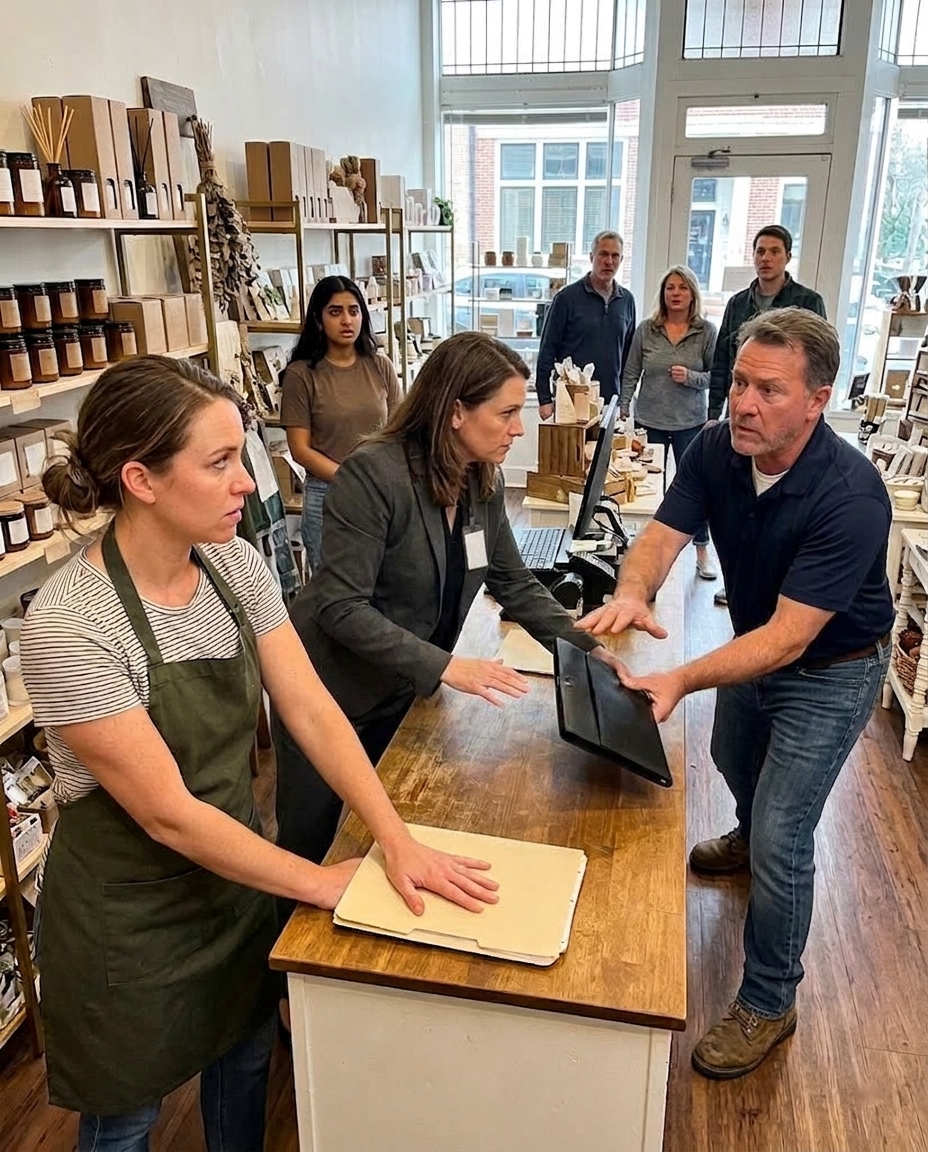
Before she could continue, voices rose near the front counter.
Priya knocked once.
“Mara?”
Then I heard Curtis.
“Open the door.”
My mother had called him.
Of course she had.
I stepped into the shop.
Curtis stood between two display tables wearing work boots and the navy polo he used for remodeling jobs.
Three customers had gone silent.
Priya stood behind the register with her phone in her hand.
Curtis pointed at me.
“You do not answer federal questions about that property without me present.”
Even then, he believed the important issue was whether I had obeyed him.
Natalie stepped into the office doorway behind me.
Curtis saw her credential wallet.
His face changed for half a second.
Then his old confidence returned.
“I’m Curtis Hale,” he said. “I’m the one who told them where to look.”
Priya’s eyebrows rose.
Curtis looked at me.
“I warned you years ago. Little businesses get sloppy.”
I did not defend myself.
I asked one question.
“Why is Aunt Amelia on your bank account?”
His face emptied.
Natalie said nothing.
Curtis looked from me to her.
“What bank account?”
Natalie opened her case again.
He saw the statement.
His hand moved before his expression did.
Curtis lunged across the edge of the counter and reached for the page.
I planted my palm over the folder while Natalie snapped the case shut and pulled it away.
“Do not touch my working papers,” she said.
Every customer in the shop was staring.
Curtis straightened slowly.
“That document is being misunderstood.”
Natalie looked at him.
“Then perhaps you can explain why an account opened fourteen months after Amelia Ward’s death lists her as a thirty-five-percent member.”
Curtis’s mouth opened.
Nothing came out.
Natalie removed one final sheet and placed it face down on the counter.
“This referral was supposed to establish that Mara Vance hid business income,” she said. “Instead, the bank’s verification package raised a different question.”
Curtis stared at the page like he already knew what was beneath it.
Natalie turned to me.
“Before I show you the authorization attached to this account, I need a clear answer. Did you ever give Curtis Hale permission to sign your name or use your business tax identification number?”
Curtis whispered, “Mara, don’t answer that.”
That was the moment everyone in my shop understood the audit had stopped being about me.
Natalie turned the page over.
My name was printed beneath a signature I had never written.
The document claimed I had authorized Cedar Salt Studio Services to use my business tax identification number and receive payments connected to “shared startup operations” at my mother’s address.
“I never signed this,” I said.
Curtis recovered quickly.
“It’s bookkeeping. Mara, you were running everything out of our property. There were overlapping expenses.”
“My mother’s property,” I said.
He ignored me.
Natalie placed the account-opening form beside the authorization.
Curtis was listed as managing member.
Amelia was listed as a thirty-five-percent owner.
The date was impossible.
Curtis tried another explanation.
“Amelia had an interest before she died.”
Natalie asked, “Can you produce an agreement dated before her death?”
Curtis did not answer.
I did.
“She had no interest. She wasn’t involved.”
Natalie pointed to the deposits Curtis had claimed were my candle sales.
They were tied to invoices for renovation work, cabinetry deposits, and a commercial credit facility associated with work Curtis had performed under variations of his own contracting business name.
Not one payment corresponded to a Cedar & Salt invoice.
Not one customer appeared in my order system.
Not one deposit had entered any account I controlled.
Curtis stepped backward.
“You’re twisting this.”
Natalie’s expression did not change.
“I’m following the records you submitted.”
Then she removed a small evidence sleeve.
Inside was a bank verification log.
The institution had recorded the phone call used to confirm the account opening.
Curtis stopped moving.
Natalie looked at me.
“There is something you need to hear before you decide whether you want to make a formal statement.”
She entered a reference number into her secured tablet and turned the volume low enough that customers near the front door could not hear every word.
The recording began with a bank employee identifying the account.
Then Curtis’s voice came through the speaker.
Older by several years, but unmistakable.
The employee asked him to confirm the relationship between Cedar Salt Studio Services and Cedar & Salt Home Fragrance.
Curtis answered, “It’s all family. My stepdaughter started it on our property. I control the back-end side.”
I felt Priya look at me.
On the recording, the bank employee asked whether Amelia Ward was available to verify her ownership percentage.
Curtis paused.
Then he said, “She’s a silent member. She doesn’t handle calls.”
Amelia had been dead fourteen months.
The employee asked about the authorization bearing my name.
Curtis said, “Mara signed off. She doesn’t understand the administrative side, so I take care of it.”
I closed my eyes.
Not because I was afraid anymore.
Because I suddenly remembered every time he had called me careless.
Every time he had called my business a hobby.
Every time he had implied I did not understand real money.
He had built part of his scheme around the belief that nobody would trust me over him.
The recording continued.
Curtis confirmed my tax identification number.
He confirmed my mother’s address.
He confirmed Amelia’s identity information.
Then he authorized the first draw on the commercial credit facility.
When the recording ended, nobody spoke for several seconds.
Curtis finally said, “You can’t prove where those numbers came from.”
Natalie closed the tablet.
“I’m not here to argue with you, Mr. Hale.”
He turned toward me instead.
“You need to tell her this was family business.”
“No,” I said.
His jaw tightened.
“Mara.”
“You reported me.”
“I reported irregularities.”
“You sent your own bank statements and told the government they were mine.”
Curtis lowered his voice.
“You have no idea what happens if you make this bigger.”
For most of my adult life, that tone had worked on everyone in my family.
It worked because Curtis never sounded frantic.
He sounded certain.
I had mistaken that certainty for knowledge when I was younger.
Now I knew it was just a habit.
I looked at Natalie.
“I want to make the statement.”
Curtis swore under his breath.
Natalie told him she was not interviewing him there and advised him not to interfere with my meeting.
He left only after Priya quietly told him she was calling building security if he remained behind the counter.
The front bell slammed against the glass when the door shut.
Then my mother arrived.
Elaine came in twenty minutes later looking as though she had aged several years during the drive.
She had Amelia’s old estate folder clutched against her chest.
“I found something,” she said.
We returned to my office.
Inside the folder was the photocopy of Amelia’s driver’s license my mother remembered giving Curtis while he helped organize estate paperwork.
The copy was missing from its original sleeve.
There was also a handwritten inventory of documents Curtis had taken home “for scanning.”
Amelia’s tax return.
Her license copy.
A canceled check.
A page bearing her signature from an old insurance form.
My mother stared at the list.
“I gave him all of this.”
Her voice broke on the last word.
I did not tell her it was fine.
It wasn’t.
But I also knew she had not signed the false account documents.
“You trusted your husband,” I said. “Now we document what happened.”
Natalie photographed the inventory and told my mother to preserve the folder exactly as it was.
Then she showed us something she had not shown Curtis.
The deposit schedule extended far beyond the figures used in the referral against me.
Across three years, the account had received more than $240,000 in contractor payments, loan proceeds, and transfers.
Curtis had apparently selected only the deposits that could plausibly be described as small-business sales when he submitted his accusation.
He thought trimming the account history would protect him.
Instead, it had given an examiner a reason to request the complete records.
That request exposed everything.
The strangest part was how ordinary the next few weeks felt.
I still opened the shop every morning.
I still approved fragrance samples.
Priya still reminded me when I forgot to eat lunch.
Customers bought candles without knowing that my accountant, an IRS examiner, and a bank fraud department were exchanging records behind the scenes.
My own books were reviewed again.
Every early deposit matched an invoice, market settlement, or documented transfer.
The electric payments to my mother matched my statements.
The old workshop expenses matched receipts.
The supposedly hidden account had no legitimate ownership connection to me.
My audit was closed without the unreported-income adjustment Curtis had tried to trigger.
His situation moved in the opposite direction.
The bank froze the disputed account while its fraud unit reviewed the authorization documents and identity information.
Natalie referred the material concerning the false signatures and account representations for additional review rather than pretending an income-tax examination alone could resolve everything.
A state investigator later contacted my mother about Amelia’s identity documents.
Curtis hired an attorney.
For the first time since I had known him, he stopped giving financial advice at family dinners.
My mother separated from him before the end of that month.
That part was not dramatic.
No screaming scene.
No suitcase thrown onto a lawn.
She changed the locks on the house, revoked his access to the detached workshop, and hired her own lawyer to examine every account and document he had ever handled for her.
She discovered things that had nothing to do with me—smaller undisclosed debts, contractor payments routed through personal accounts, and credit obligations he had always described as temporary business issues.
None was as shocking as Amelia’s name on that account.
But together they explained why Curtis had been so desperate to aim scrutiny at somebody else.
Months later, the forged authorization bearing my name became part of a formal fraud case.
The recorded verification call mattered because it showed Curtis personally describing me as an owner who had supposedly consented.
The account-opening timestamp mattered because Amelia could not possibly have approved anything after her death.
My mother’s inventory mattered because it documented how Curtis had obtained the identity papers he later used.
And his own referral mattered because he had voluntarily put the bank account in front of the government.
He had created the map himself.
I never got the cinematic moment people imagine when they hear stories like this.
Nobody marched Curtis out of my candle shop in handcuffs.
There was no judge pounding a gavel while my family applauded.
There were interviews, letters, account holds, attorneys, revised tax calculations, and months of paperwork.
Eventually, Curtis resolved substantial tax liabilities connected to income that had never appeared on the returns reviewed by the investigators. The forged identity and authorization documents were handled through separate proceedings, where he entered a plea on forgery-related charges rather than take the recorded call and bank file to trial.
My mother attended the hearing.
I did not.
I had spent enough years letting Curtis pull my attention toward whatever crisis he had created.
On the morning of his court date, I was in my warehouse approving the first shipment for a regional hotel contract.
Priya brought me coffee and placed the purchase order beside my laptop.
“You know what’s funny?” she said.
“What?”
“He spent years saying this wasn’t a real business.”
I looked at the pallets waiting by the loading door.
“That stopped bothering me a long time ago.”
And it had.
The deeper wound was not that Curtis had mocked what I built.
It was that he had believed my work, my records, and even my identity were things he could borrow when convenient and discredit when necessary.
He had assumed the old backyard address still belonged to the version of me he understood.
The woman pouring wax on folding tables.
The stepdaughter who would get nervous when an older man sounded certain.
The small-business owner he could call sloppy and expect everyone else to believe him.
What he did not understand was that I had spent six years documenting everything precisely because I knew how fragile a young business could be.
Every invoice.
Every deposit.
Every vendor bill.
Every reimbursement.
Every account.
My accountant used to joke that I kept records like I expected somebody to challenge my right to exist.
In the end, somebody did.
The records answered for me.
A few weeks after the case finally stopped dominating our lives, my mother asked whether I wanted anything from the old workshop.
I drove over on a Sunday afternoon.
The place smelled like dust and cedar boards instead of wax now.
My first dented melting pot was still on a shelf.
So was the folding table Curtis used to mock whenever he walked past the open door.
I took the melting pot.
I left the table.
Before locking up, I stood in the middle of that tiny room and remembered how enormous every problem had once felt.
A cracked shipment.
A failed scent blend.
A market with no customers.
A man in the doorway telling me none of it was real.
Then I thought about Natalie placing Curtis’s own bank statement on my counter.
He had tried to use the government to prove that my business was dishonest.
Instead, the one thing he never respected—my insistence on clean records—was exactly what separated my name from his scheme.
I locked the workshop and gave the key back to my mother.
The next morning, I opened Cedar & Salt at nine.
The front shelves were full.
The books balanced.
And for the first time, the old backyard address was just where I had started, not something anyone could use against me again.