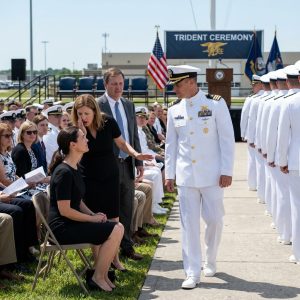
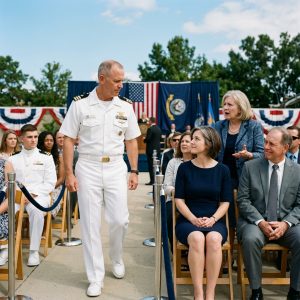
My family ridiculed me for showing up by myself at my brother’s Navy SEAL Trident ceremony. My mother labeled me “the disappointing sister” and demanded security move me out of the front row, while my father chuckled and my brother warned, “Please don’t embarrass me today.” I kept quiet. Then, midway through the ceremony, the commanding officer abruptly stopped his speech. His eyes scanned the crowd until they landed on me. His entire demeanor shifted. He stepped down from the podium and walked directly toward my seat. As a hush fell over the audience, my mother leaned in and whispered, “Eleanor… why is he looking at you?”
My name is Eleanor Vance. I was born Eleanor Hayes, but I kept my ex-husband’s last name after our divorce because my entire military career was built under it.
My family still called me Eleanor Hayes.
Professionally, almost no one did.
At 43, I had served in the Navy for 24 years. My brother, Carter, was 29 and had grown up believing I had left active duty after suffering an injury nine years ago.
I never told him that. Our parents did.
By the time I fully recovered and returned to duty, I was already largely estranged from them. Invitations to my promotion ceremonies were ignored, and phone calls home usually ended with my father making snide remarks about my “desk job.”
Eventually, I stopped sharing the details of my life.
Carter never asked. To him, I was just the distant older sister who missed birthdays, vanished during the holidays, and mailed gifts from places she wouldn’t name.
That morning, my flight from Austin, Texas, to Norfolk, Virginia, was canceled. I was rerouted through Atlanta, but my garment bag containing my dress whites was mistakenly sent to Charlotte. Rather than waiting around for another flight, I rented a car, bought a simple black dress, and drove hours through the night to reach the naval base at Little Creek.
The protocol office cleared the wardrobe change. Unfortunately, my last message was stuck in my outbox when spotty cell service near the base dropped my signal.
I reached the family entrance just minutes before the ceremony started.
A petty officer checked my ID and instantly stood taller.
“Ma’am, I need to contact protocol.”
Before he could finish, my mother, Martha, stepped between us.
“She’s just Carter’s sister,” she said dismissively. “Nothing official. Please don’t let her cause any trouble.”
The petty officer looked at me.
“Notify them,” I said quietly. “I’ll sit here until someone comes.”
My mother scowled but followed me toward the outdoor seating.
The front row had a few empty seats reserved for immediate family. I took the one closest to the aisle so the protocol team could spot me easily.
Mom immediately turned back to the petty officer.
“Could you move her further back?” she asked. “The front row should be for people who actually supported Carter.”
“This seat is fine,” he replied firmly, stepping away to use his radio.
My father, Richard, gave a nervous, mocking laugh.
“You always figure out a way to make people uncomfortable, Eleanor.”
“I haven’t said a word.”
“That’s exactly the problem,” my cousin Chloe chimed in. “You sit there silently and act like you’re vastly superior to everyone else.”
My aunt Brenda let out a small chuckle.
Carter walked up to us before taking his place with the other graduates. His white uniform was flawless, and our parents beamed with pride as he stopped in front of them.
Then, he noticed me.
“You made it.”
“I told you I would.”
His eyes dragged over my black dress. “You could have tried to look the part.”
“The airline lost my luggage.”
Mom sighed heavily. “There’s always an excuse.”
Carter’s jaw clenched.
“Please don’t make a scene today,” he muttered. “This ceremony is incredibly important to me.”
“I drove all night to be here for it.”
“Nobody asked you to.”
He turned and walked away before I could respond.
I simply folded my hands in my lap and faced the stage.
Carter had always been the sun our family orbited. He was the varsity quarterback, the prom king, and the golden child whose most minor achievements earned framed photos in the living room.
When he enlisted in the Navy, Dad started bragging that Carter was the first person in our family to serve his country in a “meaningful” capacity.
“Eleanor used to do some work for the Navy too,” he would add, making it sound like a temporary clerical gig.
My parents had skipped my commissioning ceremony because Carter had a football playoff game. They bypassed my first promotion for a neighborhood barbecue and completely ignored my change-of-command invitation because Mom assumed it was “just another administrative luncheon.”
Now, Dad leaned closer to me.
“Don’t assume you’re invited to the private reception,” he warned. “There will be high-ranking military officials there. People might ask what you actually do.”
“What should I tell them?”
His lips thinned.
“Today is not the time for your secretive, made-up stories.”
“They aren’t made up.”
“Then why can’t you ever just give us a straight answer?”
“Because certain aspects of my work are classified.”
Dad shook his head in disgust. “You’ve been using that crutch for a decade.”
I ignored him and looked back at the stage.
Commander David Rollins was standing near the podium. I had met him nine years earlier during a critical maritime extraction later known in tactical training as Operation Cobalt Dawn.
At the time, David’s unit had been completely cut off after catastrophic equipment failures, severe weather, and dead comms ruined the primary extraction plan. I commanded the joint task force that overhauled the mission on the fly and brought every single man home.
The operational specifics were still highly classified, but my leadership role had been declassified years ago. A redacted account of Cobalt Dawn had actually become a mandatory case study for every candidate going through Carter’s pipeline.
Carter had even called me after finishing that specific module.
“They never gave us the commanding officer’s name,” he had said, “but that person understood true leadership. Everything went to hell, and they didn’t leave anyone behind.”
“Just remember what that officer did right,” I had replied.
“You wouldn’t get it,” he had scoffed. “It wasn’t pushing paper. Real lives depended on those calls.”
I had almost told him the truth right then.
Instead, I let it go.
Months later, David invited me to be the keynote speaker at the Trident ceremony. He only realized Carter was my brother when he reviewed the final guest list. At my explicit request, he kept our familial connection quiet.
The ceremony kicked off with the presentation of the colors and the national anthem. As the anthem concluded, a staff member jogged over to David and whispered something in his ear.
David scanned the crowd and found me.
A wave of relief washed over his features. Then, he noticed exactly where I was seated.
He left the podium and strode straight down the center aisle.
The low chatter in the crowd died out. Programs were lowered. My mother quickly stood up and offered her hand.
“Commander, we are Carter Hayes’s parents.”
David offered a polite nod, but walked right past her extended hand.
He stopped directly in front of me.
I stood up.
He snapped to attention and delivered a crisp salute.
“Captain Vance,” he said, his voice carrying in the quiet. “We’ve been eagerly awaiting your arrival.”
The entire outdoor pavilion went dead silent.
I returned the salute.
“My apologies, Commander. My final transmission failed to send.”
“We are just honored you made it.”
Right behind me, Mom gasped, “Captain?”
David turned to his protocol officer.
“Please escort Captain Vance to the stage. She is our guest of honor and principal speaker.”
My father stared at me, dumbfounded.
“Eleanor, what on earth is he talking about?”
“My work,” I said flatly.
Then I followed David down the aisle.
Carter watched me walk up. All the arrogant confidence drained from his face as his brain desperately tried to connect the sister he had just dismissed with the high-ranking officer his own commander was deferring to.
David stepped back to the microphone.
“Captain Eleanor Vance has served our Navy with distinction for 24 years and has spearheaded joint maritime operations across multiple theaters,” he announced. “Every single graduate standing before us today studied Operation Cobalt Dawn as a mandatory leadership case study.”
Carter visibly paled.
“Captain Vance was the commander of the joint task force responsible for that very operation. When the primary extraction collapsed, she personally restructured the mission and guaranteed that every isolated operator was brought back alive.”
David paused, letting the weight of the words settle.
“There are several men standing here today who owe her far more than just their professional respect.”
He stepped aside and invited me to speak.
I walked to the microphone and looked at the graduates.
“The Trident you earn today is yours alone,” I started. “I haven’t endured your pipeline, and I will never pretend that I have. But I have served alongside the men who wear it. I have drawn up the plans with them, relied on them, and been entrusted with the heavy burden of bringing them home.”
A cool breeze ruffled the flags behind me.
“This emblem proves you survived something brutal. But from today onward, it is also a massive obligation. You will face moments where the plan shatters and the intel is wrong. Leadership in those moments requires listening hard, judging fairly, and shouldering the blame before you ever seek the credit.”
I looked out over the ranks, intentionally not locking eyes with Carter.
“You will cross paths with people whose duties you do not comprehend, and whose sacrifices will remain invisible to you. Never mistake their silence for weakness, or an unseen contribution for a worthless one. Ask better questions. Pay closer attention. Respect should never be contingent on someone’s rank or how useful they are to your ego.”
I stepped back.
“You’ve earned the right to wear the Trident. Now, spend the rest of your career earning the trust it demands.”
The senior chiefs started the applause, and it quickly roared through the entire pavilion.
During the pinning segment, I noticed Carter staring fixedly at me instead of the stage. The initial shock had melted into deep shame as David’s introduction and my words truly sank in.
Just before his name was called over the loudspeaker, he murmured something to a senior chief nearby. They exchanged a brief word, and the chief shot a look in my direction before nodding.
When Carter stepped up, he shook David’s hand.
Then the announcer spoke into the mic: “At the graduate’s special request, Captain Eleanor Vance will present his Trident.”
I saw my father go entirely rigid out of the corner of my eye.
I walked up to Carter and methodically pinned the gold emblem above his breast pocket.
Standing inches away, he didn’t look like the favored, arrogant son anymore. He looked just like the little boy who used to wait on the front porch for me to come home.
“I was so wrong,” he whispered, his voice cracking.
“We can talk about it later,” I replied.
At the reception, Mom practically sprinted over to me.
“How could you possibly hide this from your own family?” she demanded.
“I never hid anything.”
“We all thought you quit the military after you got hurt!”
“You assumed I did. Not once did you actually ask.”
“You should have corrected us!”
“I mailed you invitations to every single promotion ceremony. You threw them away.”
“We didn’t know they were a big deal.”
“They were a big deal because they were happening to me.”
Aunt Brenda hurried over, dragging Chloe.
“We really need to get a big family photo over by the flags!” she chirped.
“No.”
Mom scowled. “Eleanor, don’t be petty today.”
“You ridiculed me when you thought my life was insignificant. You don’t get to parade me around for photos just because a commander threw me a salute.”
Dad looked around, clearly panicking.
“You’re humiliating us.”
“No, Richard. You’re just humiliated because all these people now know exactly who you were insulting an hour ago.”
I turned my back and left them standing by the catering tables.
Carter tracked me down outside, standing alone by the water.
“I analyzed Operation Cobalt Dawn for three weeks,” he said quietly. “I told the guys in my cohort that the commander was the exact kind of officer I wanted to be.”
“You also told me I wouldn’t have the capacity to understand it.”
He looked down at his boots. “I did say that.”
“Yes.”
“I always knew you were still in, but Mom was so sure you took a desk job after the injury. All your official citations say Vance, and I was too lazy to dig into it. It was just easier to believe their narrative.”
“That doesn’t excuse how you spoke to me.”
“I know it doesn’t.”
He exhaled slowly.
“I treated you like a complete stranger, and then I blamed you for acting like one. I don’t expect you to forgive me today.”
“Good. Because I’m not going to.”
He nodded. “Then I’ll put in the work to earn it.”
Over the next few months, Carter called me every week. The early conversations were agonizingly stiff, but he refused to quit.
He asked why I originally dropped out of my first college, where I had actually been deployed, and why I kept Vance as my surname. Whenever I told him I couldn’t discuss a specific deployment, he no longer took my silence as a personal insult.
My parents took a very different route. Mom accused me of orchestrating the entire speech just to publicly shame her. Dad insisted my rank had turned me into a narcissist.
I gave them one final reply. I told them I would be open to repairing our relationship the day they could look at their own behavior without projecting the blame onto me.
They never reached out again.
Almost a year later, Carter flew out to visit me in Austin. Just before he headed to the airport to fly back, he handed me a small, velvet jewelry box.
Inside sat a miniature gold Trident, pinned securely to a square of navy-blue felt. It wasn’t designed to be worn on a uniform. Bolted right beneath it was a small silver plaque with eight engraved words:
FOR THE LEADER I FAILED TO SEE.
“I know the Trident belongs strictly to my brotherhood,” Carter told me. “I’m not giving this to you as a piece of uniform insignia. I just needed you to have something that says I finally see what you gave up your life to do.”
I snapped the box shut, keeping it safe.
My family genuinely believed that Commander Rollins’s salute had magically transformed me from a failure into someone who mattered.
It hadn’t.
I was the exact same woman before he ever walked down that aisle.
His salute didn’t change me; it merely forced my family to look at what they had spent a lifetime choosing to ignore.
Carter is still working to rebuild my trust, one honest phone call at a time. My parents are still sitting around, waiting for me to apologize for exposing them.
They will be waiting a very long time.
Because the most defining moment of that entire ceremony wasn’t the second a commanding officer saluted me.
It was the second I finally stopped shrinking myself down to fit the pathetic, tiny version of me my family had tried to build.
THE END