For three days, I called them from St. Agnes Hospital in Portland, Oregon. I called my mother first, then my father, then my older brother, John. I left voicemails, sent texts, and finally begged in a message I could barely type through tears.
Grandma is asking for you. Please come. She may not make it through the night.
My mother replied six hours later.
We have already said our goodbyes in our own way. Don’t make this harder.
My father never responded.
John sent only one text.
Tell her I’m sorry.
But sorry never walked through the hospital door. My grandmother, Eleanor Whitmore, had raised me more than my parents ever did. When my mother said I was too sensitive, Grandma called me gentle. When my father ignored my birthdays, Grandma baked strawberry cake and put candles in it. When John got everything because he was “the future of the family,” Grandma whispered, “One day they’ll learn what loyalty really costs.”
On her last night, she kept looking at the door.
“Is your mother coming?” she asked.
I lied. “Maybe soon.”
Her thin fingers tightened around mine. “And John?”
I could not answer.
A tear slipped down her cheek. “Then promise me something, Clara.”
“Anything.”
She turned her face toward me. Her voice was weak, but her eyes were clear. “At the funeral, don’t stop Pastor Michael from reading my letter. No matter who gets angry.”
I promised.
She died before sunrise.
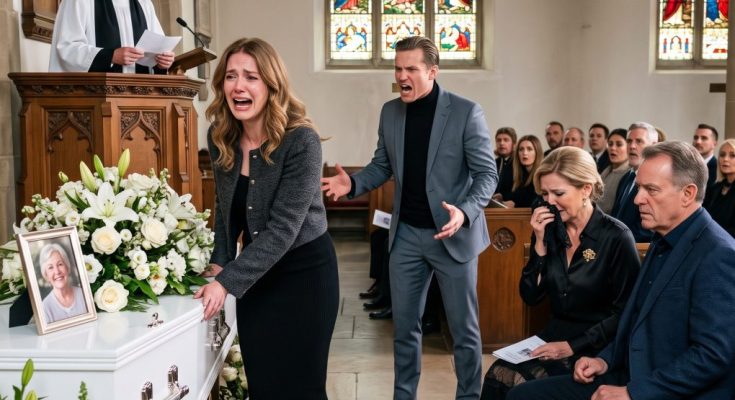
Four days later, the church was full of people who had ignored her when she was alive. My parents sat in the front row, dressed in black, wearing grief like expensive perfume. John arrived late in a gray suit, shaking hands as if he were the grieving heir of a great dynasty.
I sat alone beside Grandma’s empty chair.
Near the end of the service, Pastor Michael stepped to the pulpit with a sealed cream envelope.
“Eleanor asked me to read this after her passing,” he said quietly.
My mother stiffened.
My father looked annoyed.
John leaned back, confident.
Pastor Michael opened the letter, unfolded the page, and paused. His face changed.
Then he read the first line.
“If John is here, do not let him touch my casket, do not let him speak over me, and do not let him pretend he loved me.”
The church went completely silent.
John’s face turned white.
And my mother whispered, “Oh my God.” Pastor Michael lowered the letter slightly, as if giving the room one final chance to breathe.
Nobody did.
My brother John stared at the pulpit with his mouth half open. He was thirty-five, tall, polished, and used to being welcomed everywhere. In our family, he had always been the golden son. He got the best car, the college fund, the family praise, and every excuse my parents could manufacture.
But in that church, with Grandma’s casket resting beneath white lilies, he looked smaller than I had ever seen him.
My mother rose from the front pew. “Pastor, this is not appropriate.”
Pastor Michael looked at her gently. “Eleanor was very clear.”
“This is a funeral,” she snapped. “Not a public humiliation.”
He did not move. “It is Eleanor’s funeral.”
A murmur passed through the church.
My father grabbed my mother’s wrist and pulled her back down, but his jaw was tight. He looked at me with the same cold expression he used when I was a child and cried too loudly.
As if this were somehow my fault.
Pastor Michael continued.
“I asked all of you to come when I still had breath. Clara called. Clara begged. Clara sat beside me while machines counted down the hours of my life. My daughter, Margaret, did not come. My son-in-law, Richard, did not come. My grandson John did not come.”
My mother covered her face, but not because she was grieving. She was embarrassed.
John stood suddenly. “I’m not listening to this.”
Pastor Michael’s voice sharpened for the first time. “Eleanor also wrote that if you tried to leave before the letter was finished, I should continue louder.”
A few heads turned toward John.
He froze.
The pastor kept reading.
“John, you came to my house last winter when you thought Clara was at work. You told me I was old, confused, and cruel for not changing my will. You told me Clara had manipulated me. You told me family legacy should go to a man with children, not to a lonely girl who wasted her life caring for dying people.”
My throat tightened.
I remembered that day. Grandma had been quiet when I came home from my shift at the dental office. She said she was tired, but her hands shook when she poured tea.
John’s face flushed red. “That’s not true.”
From two rows behind him, his wife, Ashley, whispered, “John?”
He ignored her.
Pastor Michael read on.
“You slammed your hand on my kitchen table and demanded I sign papers giving you power of attorney. When I refused, you said I would die alone. You were wrong. Clara was there.”
My father stood now. “Enough.”
“No,” I said.
The word came out louder than I expected.
Everyone turned.
I stood beside Grandma’s casket with my hands trembling. “Let him finish.”
My mother stared at me with wet, furious eyes. “Clara, sit down.”
I looked at her. “You didn’t come when she was dying. You don’t get to control her voice now.”
A shocked hush filled the church.
Pastor Michael lifted the letter again.
“Clara, if you are hearing this, know that I saw everything. I saw the birthdays they missed, the calls they ignored, the way they made you feel like love had to be earned by being useful. You were not difficult. You were not weak. You were the only one who stayed.”
My knees nearly buckled.
For years, I had wondered whether anyone saw it. The empty chairs. The forgotten promises. The way my parents praised John for showing up twice a year while treating my daily care for Grandma like an obligation I owed them.
Pastor Michael’s voice softened.
“And now, before God, my family, and the people who knew me best, I want the truth recorded. I changed my will because I was not confused. I was finally clear.”
John took one step backward.
My mother gasped.
My father whispered, “What did she do?”
Pastor Michael looked down at the letter, then at me.
“She left instructions,” he said. “And Clara, she left everything to you.”
For a moment, the church felt less like a church and more like a courtroom after a verdict.
Every face turned toward me. Some with shock. Some with pity. Some with satisfaction, because small towns remember more than families think they do.
My mother’s lips parted, but nothing came out.
My father looked at Pastor Michael as if the man had personally stolen something from him.
John laughed once, a short, ugly sound. “That’s impossible.”
Pastor Michael folded the letter carefully. “Eleanor anticipated that response.”
He reached beneath the pulpit and picked up a second envelope, thicker than the first. The cream paper had Grandma’s careful handwriting across the front.
For Clara Anne Whitmore. To be opened after the service, with Attorney David Klein present.
Attorney.
The word moved through the church like wind under a locked door.
John turned to me. “You did this.”
I stared at him. “I was at the hospital.”
“You poisoned her against us.”
My mother finally found her voice. “Clara, tell them this is a misunderstanding.”
I looked at the woman who had given birth to me and realized something painful and freeing at the same time. She was not asking whether I was okay. She was not asking what Grandma had suffered. She was asking me to protect the family image one more time.
“No,” I said. “I won’t.”
Her face hardened. “After everything we’ve done for you?”
That old sentence. The family leash. The reminder that food, shelter, and school clothes were supposed to buy a lifetime of silence.
Before I could answer, a man in a dark navy suit stood from the third row. He was in his sixties, silver-haired, with rectangular glasses and a leather portfolio tucked under his arm.
“I’m David Klein,” he said. “Eleanor’s attorney.”
My father’s eyes narrowed. “Why are you here?”
“Because Eleanor asked me to attend.”
John pointed at him. “You let a dying woman change her will?”
David looked at him calmly. “Eleanor changed her will eleven months ago. She was evaluated by her physician and found fully competent. I have the documentation.”
John’s confidence flickered.
Eleven months ago.
Before the hospital. Before the final decline. Before anyone could claim she had been confused by pain medication or fear.
My mother gripped the back of the pew in front of her. “But she always said the house would stay in the family.”
David nodded. “It will. It now belongs to Clara.”
The words struck me so hard I sat down.
Grandma’s house.
The yellow house with the blue shutters on Hawthorne Street. The house where I learned how to make biscuits. The porch where she taught me to shell peas. The sewing room that smelled like lavender sachets and old cedar. The only place in my childhood where the air felt gentle.
I had not cared about inheritance. I wanted her alive. I wanted one more morning with coffee on the porch. One more phone call asking if I had eaten. One more hug from the woman who never made love feel like a debt.
But Grandma had done what she always did.
She had protected me.
John stepped into the aisle. “That house is worth almost seven hundred thousand dollars.”
Ashley, his wife, looked at him with horror. “John, your grandmother is lying in a casket.”
He snapped, “Stay out of this.”
Her face changed immediately.
It was not loud. It was not dramatic. But I saw something in Ashley’s eyes close.
Pastor Michael stepped down from the pulpit and stood beside Grandma’s casket. “John, Eleanor requested that you not approach the casket.”
“This is insane,” John said. “She was my grandmother.”
“She made her wishes clear.”
“I don’t care what that letter says.”
Then he moved toward the casket.
I stood without thinking. “John, stop.”
He glared at me. “You’ve already won. What else do you want?”
My voice shook, but I did not step back. “For you to respect her once.”
That sentence landed harder than I expected. Not because John cared, but because everyone else heard it.
Two of Grandma’s neighbors, Mr. and Mrs. Bell, stood from the side pew. Mr. Bell was seventy-eight and walked with a cane, but his voice was steady.
“John,” he said, “sit down.”
John turned, stunned. “Excuse me?”
Mr. Bell’s wife, Helen, lifted her chin. “We heard what you said to Eleanor that day. Our kitchen window was open.”
The blood drained from John’s face.
Helen continued, “You shouted so loudly we could hear every word. You told her Clara didn’t deserve a dime. You told her she owed you because your father had ‘kept the family name alive.’ You called that sweet girl a servant.”
My mother whispered, “No.”
John looked cornered now. “They’re lying.”
Mr. Bell shook his head. “No, son. You are.”
Ashley stood slowly. She did not look at me. She looked only at John.
“Did you really say that?” she asked.
John’s silence answered.
Something passed through the church then, something heavier than gossip. It was recognition. People were no longer watching a family argument. They were watching a mask come off.
Pastor Michael nodded to two ushers, both older men who had known Grandma for years. They stepped into the aisle, not aggressively, but firmly.
“John,” the pastor said, “please return to your seat or leave.”
John looked at my parents, expecting rescue.
My father stared at the floor.
My mother cried into a tissue, but she still did not move toward me.
For the first time in my life, nobody saved John from the consequences of his own mouth.
He turned and stormed out of the church. The doors slammed behind him so hard the lilies on Grandma’s casket trembled.
Ashley remained standing for a moment. Then she picked up her purse and followed him, but not quickly. Not loyally. More like a woman going to collect the truth from a man who had run out of places to hide.
The service ended quietly after that.
People lined up to hug me. Some told me how Grandma had spoken about me. Some said they were sorry. Some slipped folded tissues into my hand even though I already had too many.
My parents waited near the front pew.
I knew they wanted me to come to them first.
I did not.
I walked to Grandma’s casket and placed my palm on the smooth wood.
“I kept my promise,” I whispered.
For the first time since she died, I felt something close to peace.
After the burial, Attorney Klein asked me to meet him at Grandma’s house. Pastor Michael came with us, as Grandma had requested. My parents arrived too, uninvited but determined. John did not come. Ashley sent me one text.
I’m sorry. I didn’t know. I hope you’re surrounded by people who actually love you today.
I stared at the message for a long time before putting my phone away.
Grandma’s house looked exactly as she had left it. A blue ceramic bird by the front steps. Wind chimes under the porch roof. Mint growing wild along the side fence. Inside, her reading glasses still rested beside the armchair.
My mother broke down as soon as she entered the living room.
“This was my childhood home,” she said.
Attorney Klein opened his portfolio. “Eleanor was aware this would be painful.”
My father crossed his arms. “Then why would she do this?”
David looked at him. “Because, according to her written statement, Clara was the only family member who treated the home as a place of care rather than a future asset.”
My father flinched.
My mother wiped her eyes. “I was her daughter.”
“Yes,” David said. “And Eleanor loved you. But love was not the question she asked when she made her final decisions.”
I sat on the edge of the sofa, the same sofa where Grandma and I had watched old movies on rainy nights.
David handed me the envelope from the church.
My hands shook as I opened it.
Inside were several pages, written in Grandma’s looping handwriting.
My Clara,
If this letter is in your hands, then I am gone, and I am sorry I had to leave you with a storm. I know them. I know they will call you selfish for accepting what I chose to give. They will say you manipulated me. They will say grief made me foolish. Do not believe them.
You gave me time.
That is the one thing money cannot buy, and the one thing most people refuse to give when love becomes inconvenient.
You sat with me through appointments. You learned my medications. You fixed the loose step on the porch. You drove across town after work because I said the house felt too quiet. You slept in a hospital chair with your shoes on. You were there when my own daughter could not bear to see me weak and when John only saw what he might inherit.
I am not leaving you the house as payment. Love cannot be paid like a bill.
I am leaving it to you because it was already your home.
The page blurred.
I pressed it to my chest and cried.
Not the desperate crying from the hospital. Not the shocked crying from the funeral. This was something deeper, older. The grief of a child finally being told she had not imagined the loneliness.
My mother sat across from me, pale and silent.
I continued reading.
There is one more thing. In the hall closet, behind the old quilt box, there is a green metal tin. Inside are letters, receipts, and bank records. Keep them safe. If John or your parents try to challenge the will, give everything to David.
My father stood abruptly. “What records?”
David’s expression did not change. “I believe Eleanor wanted Clara to answer that privately.”
“No,” my father said. “This concerns us.”
I looked at him then. Really looked.
He had always seemed large to me. Even when I became an adult, even when I had my own job, my own apartment, my own life, Richard Whitmore could make me feel nine years old with one disappointed stare.
But that day, in Grandma’s living room, he looked like a man afraid of a tin box.
I stood and walked to the hall closet.
The old quilt box was exactly where Grandma said it would be. Behind it sat a green metal tin with faded flowers painted on the lid.
I carried it back to the living room and opened it.
Inside were bank statements, handwritten notes, copies of checks, and letters from my mother to Grandma dating back nearly fifteen years. The first few were requests for help. Medical bills. John’s college expenses. Emergency car repairs. Then the tone changed.
You promised family comes first.
John needs this more than Clara ever will.
Don’t tell Clara. She wouldn’t understand.
One check copy made my stomach turn.
Twenty-five thousand dollars.
Another for eighteen thousand.
Another for twelve.
My mother began to cry harder. “Mom helped us sometimes. That is not a crime.”
David took a document from the tin. “No. But this is relevant.”
It was a signed statement from Grandma.
Over the last fifteen years, I have given Margaret, Richard, and John substantial financial support. Much of it was requested under pressure. Some was never repaid, despite repeated promises. Clara never asked me for money. Clara gave me care. My estate plan reflects that truth.
My father’s face darkened. “She kept records like we were criminals?”
I answered before David could.
“No. She kept records because she knew you.”
My mother looked at me as if I had slapped her. “Clara.”
“No,” I said, my voice breaking but steady. “You let me think Grandma favored me for no reason. You let me feel guilty for being close to her. You complained that I spent too much time with her, but you were taking her money the whole time.”
“We were struggling,” she whispered.
“So was she.”
My mother looked away.
I thought about Grandma sitting at her kitchen table, writing checks to people who rarely visited, while still clipping coupons and pretending she liked store-brand coffee. I thought about the winter she delayed fixing the furnace because she said the space heater was enough. I thought about John driving a new truck that same year.
The room became unbearable.
Attorney Klein explained the will. The house, Grandma’s savings, her car, and her personal belongings were mine. A small charitable donation would go to the hospital’s hospice wing. My mother received Grandma’s wedding pearls and one handwritten letter. John received one dollar and a copy of the funeral letter.
My father received nothing.
Not because Grandma forgot him.
Because she had not.
My mother asked to see her letter. David handed it to her.
She read it silently, then folded in half.
“What did she say?” my father asked.
My mother shook her head. “It’s mine.”
It was the first boundary I had ever seen her set with him.
They left soon after. My father slammed the car door. My mother looked back once from the passenger seat, but I did not wave.
That evening, I stayed in Grandma’s house alone.
The silence was different without her. Not empty exactly. Just waiting.
I walked room to room, touching the objects that held her life. Her blue mixing bowl. Her gardening gloves. Her stack of mystery novels. The calendar still marked with her handwriting on the day she entered the hospital.
Doctor 9:30. Ask Clara about dinner Sunday.
That broke me all over again.
Over the next few weeks, John did exactly what Grandma predicted.
He hired an attorney. He claimed I had isolated Grandma. He said she had been mentally unstable. He told relatives I had manipulated a dying woman for property. But Grandma had prepared better than any of us understood.
Her doctor submitted competency records. Pastor Michael gave a statement. The Bells confirmed John’s kitchen confrontation. Attorney Klein produced notes from multiple estate meetings. The bank records showed years of money flowing from Grandma to my parents and John, while I had paid for groceries, repairs, and medical supplies out of my own pocket without asking for repayment.
John’s case collapsed before it truly began.
At mediation, he arrived with red eyes and a clenched jaw. Ashley was not with him.
I later learned she had moved out.
John refused to look at me until the mediator left us alone for five minutes.
“You ruined my marriage,” he said.
I almost smiled, but I was too tired.
“No, John. You told the truth about yourself too loudly.”
He leaned back, bitter. “You always play the victim.”
I looked at him across the table. “Grandma died asking for you.”
His expression changed.
Just slightly.
“She asked for you three times that night,” I said. “I lied and told her maybe you were coming because I didn’t want her last feeling to be rejection.”
He swallowed.
For one brief second, I saw something like shame pass through his face. Then pride covered it again.
“She shouldn’t have done that at the funeral,” he muttered.
“She gave you privacy when she was alive,” I said. “You used it to lie. She owed you nothing in death.”
He left without signing anything that day.
Two weeks later, his attorney withdrew the challenge.
My parents tried a different approach.
My mother called me first. I let it go to voicemail. Her message was soft, trembling, full of words like healing and family and misunderstanding. My father’s message came next. It was not soft.
This has gone far enough. You need to stop embarrassing your mother.
I saved both.
Then I sent one text.
I am grieving Grandma. I am not discussing the house, the will, or John. Do not come to my home without asking.
My home.
Typing those words felt impossible.
Then it felt true.
A month after the funeral, I moved into Grandma’s house.
I did not change everything. I could not. The place still smelled like lemon furniture polish and lavender. Her quilts stayed folded in the cedar chest. Her recipe cards stayed in the kitchen drawer. But I painted the guest room pale blue and turned it into an office. I replaced the broken porch swing. I planted rosemary beside the mint.
On the first warm Saturday of spring, Pastor Michael stopped by with a casserole from the church ladies and an envelope.
“She asked me to give you this after you settled in,” he said.
I laughed through sudden tears. “Of course she did.”
After he left, I sat on the porch and opened it.
Inside was a photograph of me at eight years old, asleep on Grandma’s lap under a yellow blanket. On the back, she had written:
This was the day you told me my house felt safe. I decided then that if I could, I would make sure it stayed that way.
I held the photo until the sun dropped behind the maple trees.
Eventually, my mother asked to meet.
I chose a diner, not the house.
She arrived without my father. Her hair looked less perfect than usual. She ordered coffee but did not drink it.
“I read Mom’s letter,” she said.
I waited.
“She said I loved approval more than people.” Her voice cracked. “She said I taught John to take and you to disappear.”
I looked down at my hands.
“She wasn’t wrong,” my mother whispered.
It was the closest thing to honesty she had ever given me.
“I don’t know how to fix what I did,” she said.
“You can’t fix Grandma dying alone without you.”
She closed her eyes. “I know.”
“And you can’t ask me to make you feel better about it.”
“I know that too.”
We sat in silence for a long time.
Then she said, “Can I earn a place in your life again?”
I thought about saying yes because she was my mother. I thought about saying no because I was still angry. In the end, I chose the only answer that felt real.
“Maybe. Slowly. With boundaries.”
She nodded, crying quietly. “I’ll take slowly.”
My father refused to apologize. John stopped speaking to me altogether. That hurt less than I expected. Sometimes silence is not a punishment. Sometimes it is space finally being returned to its rightful owner.
A year later, on the anniversary of Grandma’s death, I hosted a small dinner at the house. Pastor Michael came. The Bells came. My mother came alone and brought strawberry cake, Grandma’s recipe, though the frosting was uneven and the center had sunk.
“It’s not like hers,” she said nervously.
“No,” I said. “But it’s a start.”
After everyone left, I sat on the porch swing and listened to the wind chimes.
For so long, I thought the funeral was the day Grandma exposed them.
But I understand now it was more than that.
It was the day she gave me back my own story.
Not the version where I was too sensitive. Not the version where John deserved more because he demanded more. Not the version where my parents’ absence was something I had to excuse.
The real version.
I was the one who stayed.
I was the one who held her hand.
I was the one she trusted with the truth.
And when the pastor opened her final letter and said, “If John is here, do not…,” it was not revenge speaking from the page.
It was my grandmother, clear-eyed to the end, making sure the people who abandoned her could not stand over her casket and rewrite the life she had actually lived.