PART 1
The phone rang at 2:47 in the morning.
At that hour, no one calls with good news.
I woke to the sound slicing through my dark bedroom, sharp enough to make my heart race before my hand even found the receiver. Outside, rain beat against the windows of my old Pennsylvania farmhouse, steady and cold, the kind of rain that turns every country road black.
“Arthur?”
The voice was low.
Tense.
“This is Dr. Miller from the county medical center.”
I sat up at once. Dr. Stephen Miller had known my family for years. He had delivered both of my grandchildren in that same small hospital off Route 9. He was not the kind of man who frightened easily.
But that night, he sounded afraid.
“What happened?” I asked.
“It’s Christian,” he said. “He was brought in after a car accident. We’re taking him into emergency surgery.”
Christian.
My son-in-law.
The man my daughter Clare had defended for eight years. The man everyone said I had judged too harshly.
I gripped the phone tighter.
“Is Clare there?”
“No,” Dr. Miller said quickly. “And Arthur, listen carefully. Don’t call her yet.”
That sentence made the room feel colder.
“Why not?”
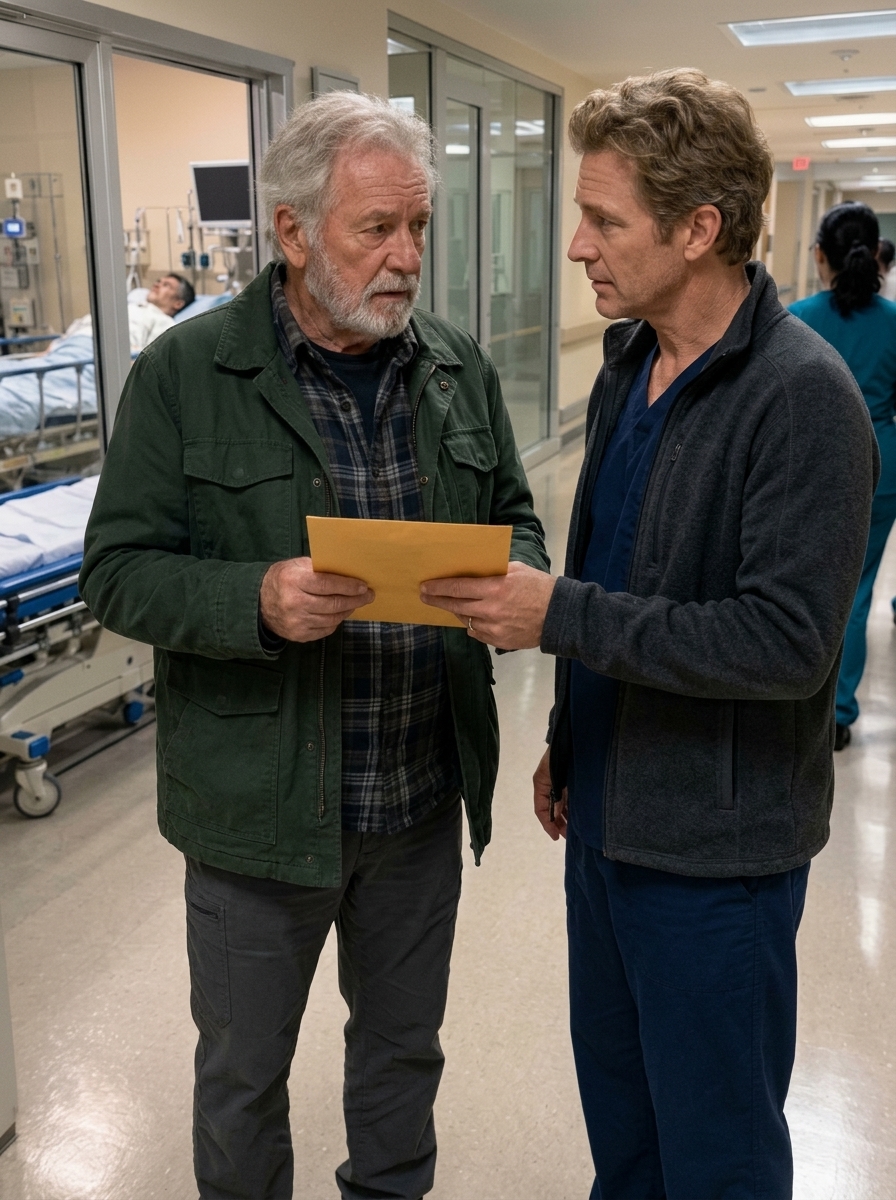
There was a pause. Behind him, I could hear the faint beeping of hospital machines.
“This accident is not what it appears to be,” he said. “Come to the hospital now. Come alone.”
Then his voice dropped even lower.
“And when you get here, do not tell anyone what I’m about to show you.”
The line went dead.
For a moment, I just sat there, staring into the darkness.
My name is Arthur Whitcomb. I am sixty-nine years old, widowed, retired, and for eight years, my daughter had treated me like a bitter old man who simply could not accept her marriage.
Maybe I had made it easy for her to believe that.
Because I never trusted Christian.
Not from the first Sunday dinner when he showed up with carnations for my late wife, Margaret.
Not when he remembered exactly how Clare liked her toast burned at the edges.
Not when he built a wooden swing for Noah and Lily and smiled while everyone called him a wonderful father.
Christian was too smooth.
Too careful.
Too good at becoming whatever people needed him to be.
He never yelled at Clare. He never insulted me in front of her. He did something smarter. Whenever I questioned him, he looked wounded. Whenever I warned Clare, he stayed calm and let me look like the jealous father.
Little by little, I became the problem.
Christian became the patient husband.
And my only daughter drifted farther away from me.
Still, even I was not prepared for that call.
I pulled on jeans, an old flannel shirt, and my canvas jacket. As I passed the front window, I saw the small American flag on my porch hanging soaked and heavy in the rain. The house felt hollow behind me when I locked the door.
The drive to the county medical center was forty-three miles.
At three in the morning, those miles felt endless.
My old Ford pickup pushed through the storm, headlights sweeping across wet pine trees, closed gas stations, and mailboxes leaning along the roadside.
All I could think about was Clare.
And the children.
Noah was four.
Lily was six.
They lived with Clare and Christian in a house near the woods, too far from neighbors for my liking. Christian always said he liked the quiet.
I had always wondered why.
When I reached the hospital, a sheriff’s cruiser sat near the emergency entrance with its engine still running.
That alone told me this was worse than a simple wreck.
Dr. Miller was waiting inside the hallway.
He did not waste time. He led me past the front desk, down a side corridor that smelled of disinfectant and old coffee, then into a small office beside the recovery wing. Once we were inside, he locked the door.
Through a narrow window, I could see Christian lying in a hospital bed. His face was scratched. An oxygen mask covered his mouth. Machines blinked around him.
For once, he did not look polished.
He looked exposed.
Dr. Miller turned to me.
“Arthur,” he said quietly, “Christian didn’t crash because of the rain.”
I stared at him.
“He lost consciousness before the car went into the ditch,” Miller said. “His bloodwork showed something that should not have been there.”
“What?”
Miller opened a drawer and pulled out a thick manila envelope sealed with black tape.
“Poison,” he said. “Slow-acting. Someone has been giving it to him for weeks.”
My throat went dry.
“Who would poison Christian?”
Miller pushed the envelope into my hands.
“That is why I called you,” he said. “Before we took him in, he said one name. Then he said your grandchildren might not be safe.”
The room seemed to tilt.
“What name?”
Miller glanced toward the door, then back at me.
“Read this in your truck,” he said. “Then go back to Clare’s house. Right now.”
Outside, thunder rolled over the hospital roof
I ran through the rain, climbed into my truck, and locked the doors. For a few seconds, I only stared at the envelope sitting on my lap.
Then I tore through the black tape.
The first thing I saw was a photograph.
Christian’s face.
But not Christian’s name.
And as my eyes moved across the page, the rain, the hospital, and the whole world seemed to fall silent around me.
I looked at the dashboard clock.
3:15 a.m.
Clare was still at the hospital.
And my two grandchildren were alone in that house by the woods.
I started the truck so fast the engine roared.
By the time I reached their road, every light in the house was off.
Except one.
A faint glow flickered in the upstairs window.
The children’s bedroom.
Then it went dark
I did not park in the driveway.
I killed the headlights at the end of the lane, rolled the truck to a stop beside the mailbox, and sat for ten seconds with the rain drumming on the roof and the envelope open on my knee.
I had read it by the dome light in the hospital lot, in the thirty seconds before I could make myself drive.
The man I had known for eight years as Christian Hale was born Daniel Thomas Prescott in Dayton, Ohio. Two fraud convictions before he turned twenty-five. A sealed juvenile file. A stack of aliases, each with a different woman attached to it. Below his photograph, in a neat typed line, was the name of his next of kin.
Mother: Helen Prescott. Registered nurse.
I knew that name.
Everyone at my daughter’s table knew that name.
Helen had arrived three years earlier, when Lily was three and Noah was just walking, after Clare went back to work at the school. A warm, round-faced woman with a gray braid and a cardigan the color of oatmeal. She baked. She sang. She lived in the little guest cottage behind the house and never asked for a raise.
Clare called her a blessing.
Below her name, the page listed four families. Four patients. Four households in three states where Helen Prescott had been employed as a private caregiver.
Four deaths.
At the bottom, in Dr. Miller’s careful hand, he had written one line.
Your wife’s name belongs on this list. I should have said so years ago.
I folded the page with fingers that did not feel like mine.
Then I got out and walked up the wet gravel, because there was no other way to do it.
The front door was unlocked.
The kitchen was dark and smelled of cinnamon. A tea towel lay folded on the oven handle. A child’s drawing hung on the refrigerator, a purple horse with too many legs.
I climbed the stairs one step at a time, keeping my weight on the outer edge where the old boards did not creak.
A thin line of light showed under the children’s door.
I pushed it open.
Helen was sitting on the edge of Noah’s bed.
She wore her oatmeal cardigan and held a small flashlight in one hand, and in the other, a glass of warm milk. She turned her head at the sound of the door, and her round face broke into a soft, tired smile.
“Arthur,” she whispered. “Good heavens. You gave me a fright.”
My heart pounded so hard I thought she could hear it.
“Helen.”
“Shh. They’re sleeping.” She nodded at the beds. Lily lay curled on her side, one arm flung over a stuffed rabbit. Noah was on his back with his mouth open. “Clare called around three. Christian’s been in an accident, poor soul. She asked me to stay with the children. I’ve been checking on them every ten minutes.”
“I saw the light go out.”
“I switched it off. Lily doesn’t like it on.” She tilted her head. “How did you know to come?”
It was the question I had been dreading.
“Clare phoned me,” I said.
It came out smoother than I felt.
“Did she?” A tiny pause. “How kind. I told her not to trouble you at this hour.”
“She’s frightened.”
“Of course she is.” Helen set the glass down on the nightstand. “Sit, Arthur. You look half-frozen. I’ll put the kettle on.”
“I’ll stand.”
“Don’t be stubborn.”
Her voice was patient. Gentle. The same voice she used when she coaxed Noah into eating peas.
I looked at the glass.
Milk, nearly full, a skin forming on the surface.
“Is that for the boy?”
“He woke an hour ago with a stomachache. Warm milk helps.”
“I’ll hold it for him.”
“Arthur, really.” Helen laughed softly. “You’ve no need to hover. I’ve done this a thousand times.”
That was the sentence that made the hair on my neck lift.
I thought of Margaret, my wife of thirty-six years, in a hospital bed we had set up in our living room five years ago. Helen’s quiet footsteps. The warm cups of tea. The long, gentle decline that every doctor told me was nobody’s fault.
I thought of how grateful I had been.
My knees felt weak.
“I’ll make the tea,” I said.
“Oh, no.”
“I insist.”
I backed out of the room and down the stairs with my hand on the rail. In the kitchen I stood in the dark for a moment with both hands braced on the sink.
Think.
The house ticked and settled around me. Somewhere upstairs a floorboard answered the weight of someone moving slowly, someone who did not want to be heard. I had spent forty years on a county road crew learning to read the sounds of a structure under load. This one was holding its breath.
Four deaths. My wife’s name. A glass of milk.
If I was wrong, I was a frightened old man who had burst into his daughter’s home on the word of a doctor and a piece of paper.
If I was right, a woman who had held my wife’s hand at the end was upstairs with my grandchildren.
I told myself it was only tea water, the oldest excuse a man has for standing in a kitchen. A sensible man would have called Collins from the porch. A sensible man would have taken the children and gone. But I had no proof, no warrant, only a feeling in my chest like a stone in a shoe, and I had been told all my life what that was worth.
I filled the kettle and set it on the burner and turned the knob. The click of the gas was loud as a gunshot.
I opened the cabinet and took down one mug. Then, as an afterthought, a second.
I did not hear her come down.
“Arthur.”
I turned.
She stood in the kitchen doorway with her flashlight pointed at the floor. The glow from the stove painted half her face orange.
“You’re very pale,” Helen said. “Sit down before you fall down.”
“I’m fine.”
“I think you should sit.”
Her phone buzzed in her cardigan pocket.
We both looked at it.
She drew it out and glanced at the screen, as a woman would who is accustomed to reading messages in the dark. And something happened to her face.
It was almost nothing. A flicker around the eyes. A slackening at the corners of the mouth.
Then the smile came back, bright and fixed.
She turned the phone slightly toward the light, the way you do without thinking, and I saw the name on the screen.
Daniel.
And beneath it, in the preview, five words.
Mom, are you at the house?
The kettle began to scream.
Neither of us moved.
The kettle screamed on the stove, shrill and thin, and Helen Prescott slid her phone back into her cardigan with the unhurried grace of a woman putting away a recipe card.
“That’s Christian’s phone,” I said.
My mouth was dry as sand.
“It is.” She lifted the kettle from the burner and the shriek died. “He keeps a second one. For his… business.”
“It says Daniel.”
“Does it?”
“And it says Mom.”
She poured water into the mugs, one, two, and set the kettle down.
“Arthur,” she said gently. “How long have you known?”
There was no point in lying.
“Since three o’clock.”
“Dr. Miller.” She sighed. “Stephen always was a worrier. I told Daniel we should have taken care of him last spring.”
The way she said it, soft and regretful, as though she were discussing a missed dentist appointment, frightened me more than a shout would have.
“Where’s my daughter?”
“At the hospital, with her husband.”
“What have you been giving her?”
“Only tea.”
“Helen—”
“She’s been so tired lately, Arthur. So worn down. You must have noticed.” She turned, and the sweetness in her face was somehow worse than anything else. “It wouldn’t have been long. She would have drifted off quite peacefully. It’s a kind way to go.”
My vision went white at the edges.
I thought of Margaret in that bed. I thought of Helen holding a teaspoon to her lips.
I took one step toward her.
“Stay there,” she said, and drew a syringe from the pocket of her cardigan.
It was small. Capped. Nearly invisible in her plump hand.
But I understood it perfectly.
“I’m sixty-nine years old,” I said slowly. “I’ve been splitting wood since I was ten. You’re not going to get that into me.”
“I don’t need to.” She smiled. “Look up.”
I looked.
Standing at the top of the stairs, in her purple pajamas, with her stuffed rabbit dangling from one fist, was my granddaughter.
“Grandpa?” Lily said. “Why are you here?”
The kitchen went completely still.
Helen’s expression changed instantly. Warm. Motherly. She set the syringe on the counter, half hidden behind the toaster, and held out her arms.
“Sweetheart, come here. Grandpa just came to check on us.”
“It’s late.” Lily came down two steps. Her eyes moved from Helen to me, and back. “Mommy said Grandpa doesn’t drive at night anymore.”
“He made an exception.”
“Why’s he mad?”
“He isn’t mad, darling.”
“Grandpa’s face is doing the thing,” said Lily, matter-of-factly. “The thing it does when Daddy talks.”
That child.
She stood on the stair with her rabbit and her bare feet, perfectly still, the way a small animal stands when it has decided the grown-ups are not to be trusted. I would have given every year I had left to be that clear-eyed.
Six years old, and she had seen what her mother had not.
I thought of every dinner I had skipped, every holiday I had sulked through with my arms folded. If I had stayed in that room, if I had looked, as Lily looked, with nothing to defend, I might have seen it three years sooner.
Helen’s smile thinned.
“Lily, go back to bed.”
“I want Daddy.”
“Daddy’s at the hospital.”
“I know.” Lily came down another step. Her chin lifted. “Daddy told me something. If Helen’s ever being weird, I’m supposed to say the storm word.”
I stopped breathing.
Helen did not.
“What storm word?” she asked softly.
“I’m not saying it,” Lily said. “It’s a secret.”
She turned and ran up the stairs.
“Lily!” Helen snapped, and in that single word I heard the thing she had been hiding for three years. Not warmth. Not patience. A flat, cold hunger, like a door swinging open on an empty room.
She lunged for the syringe.
I lunged for her.
We hit the counter together. A mug shattered. Boiling water splashed across my wrist, and I felt nothing. I caught her forearm in both hands and slammed it against the cabinet as hard as I could, and the syringe flew out of her fingers and skittered under the stove.
She was stronger than she looked.
I had forgotten that, how a person can hide a weapon in the shape of a kindness. I had forgotten that a cardigan has sleeves.
Thirty years of lifting patients had built a woman who could pin a man twice her size. She drove her elbow into my ribs. I grunted. She twisted free and ran for the stairs.
“Noah!” I shouted. “Lily! Lock the door!”
I got up. My left knee screamed. I took the stairs two at a time, and I was halfway up when the wall in front of me flashed.
A small, high-pitched squeal cut through the house.
A walkie-talkie.
The sound pulled at something old in me, a night shift, a radio on a dashboard. Somewhere in Lily’s room, a red light blinked and a voice crackled, thin with static.
“Storm, storm, this is Collins. Say again, storm?”
Deputy Sarah Collins. I had known her mother.
“Lily!” Helen shrieked. “Give me that, you wicked little—”
There was a thud. A cry.
I reached the landing.
The door of the children’s room stood open. Lily stood in the corner clutching the walkie-talkie to her chest, pressed against the wall. Her face was white.
And Helen was in the middle of the room with Noah in her arms.
He was awake now. His mouth was open in a silent, stunned wail. He was wearing his dinosaur pajamas, and his small bare feet kicked uselessly against her cardigan.
“Put him down,” I said.
“Come any closer, Arthur, and I’ll break his neck.”
It was said so quietly that I believed her.
Behind her, the window stood half-open. Rain blew in. The curtains snapped.
“Helen. Please. He’s four.”
“So was Daniel when I taught him that people leave.” Her face crumpled for an instant, and the sweetness was gone, and what remained was ancient, furious, afraid. “Do you know what I’ve sacrificed for that boy? I gave him everything. And he would have given it away for a little girl in a school sweater.”
“Let Noah go.”
“Your wife begged me exactly like that.”
The room stopped.
I heard the rain and the pounding of my own pulse.
“Margaret begged,” Helen said, quite softly, “and I held her hand the whole time, Arthur. I was very kind. I told her it wouldn’t hurt, and then I—”
She stopped herself.
She looked at Lily and the walkie-talkie. She looked at the flashing red light.
Then she turned and went through the window.
The window opened onto the porch roof.
By the time I reached it, Helen was already sliding down the wet shingles with my grandson clutched against her chest. She dropped to the lawn like a cat. Her feet hit the grass. She did not look back.
“Noah!”
The wind swallowed it.
I turned.
Lily was still pressed in the corner, the walkie-talkie to her ear. Her whole body was shaking.
“Deputy Collins is coming,” she whispered. “She said eleven minutes.”
Eleven minutes.
In the rain. On a dirt road. With a woman who had just told me she held my wife’s hand while she killed her.
“Lily, listen to me.” I dropped to my knees in front of her, and took her face in both hands. “I need you to lock yourself in the bathroom. Tub, towels, door locked. Keep the walkie-talkie. Don’t open for anyone but Deputy Collins or Mommy. Can you do that for me?”
“Where’s Noah?”
“I’m going to get him.”
“Grandpa—”
“I swear to you.” My voice cracked. “I am going to bring him back.”
She nodded once, solemn as a soldier.
I ran.
The yard was a river. Mud sucked at my boots. I heard nothing but the storm until a pale flicker of movement near the tree line caught my eye. A gray cardigan, vanishing into the woods.
The woods behind Clare’s house ran down to a creek.
In summer it was a gentle brook, ankle-deep, good for skipping stones. In April rain it was a brown torrent. There was an old wooden footbridge across it, built by Margaret’s father sixty years ago, and rotten in half its planks.
Christian, I thought, then caught myself. Daniel. He used to say he would fix it.
I plunged into the trees.
Branches whipped my face. My left knee shrieked. Somewhere ahead, I heard a small, ragged sobbing, and I followed it like a man following a thread through a dark house.
I found them at the bridge.
Helen stood at its center with Noah clamped against her shoulder. The creek roared beneath her feet, brown and swollen, churning against the posts. The old rope railing was slick and half-torn.
She heard me and turned.
“That’s far enough.”
“Helen—”
“I said stop.”
I stopped at the edge of the planks.
My chest heaved. The rain ran down my face and into my collar. Noah saw me. His wail broke into a single word.
“Pop-Pop!”
“I’m here, buddy,” I said. “I’m here.”
“Isn’t this touching,” Helen said. Her voice had changed again. Cracked, exhausted. “Do you know, in thirty years of nursing, I never had a family look at me the way that child looks at you? They always looked at me like furniture. Useful and invisible.”
“Give me the boy.”
“And then what? A cell?”
“Yes.”
“Thirty-one years of kindness, and a cell.” She laughed, high and strange. “No.”
“Helen. He’s cold. He’s four years old.”
“He’ll be fine. He’ll come with me. Daniel will join us when he’s well, and we’ll go somewhere quiet. We always did.”
“Daniel is not going anywhere with you.”
“He is my son.”
“He told Dr. Miller your name before he went into surgery,” I said. “He told him to protect his children from you. He chose, Helen.”
Her face went blank.
For a moment, the storm went on around us and she did not seem to hear it.
“He wouldn’t,” she whispered.
“He did.”
“He wouldn’t. I made him.” Her voice sharpened. “I made him everything he is.”
“Then you know he loves them.”
It was the wrong thing to say.
I saw it land. I saw the exact instant when whatever fragile thing still held her upright gave way.
“Then I’ll take them both,” she said. “So no one else can have them.”
She stepped backward.
The plank under her left foot cracked like a rifle shot.
I did not think. I ran across the bridge. I had not run like that in thirty years. The planks shuddered beneath me. The creek screamed. I caught Noah around the middle with both hands as the planks dropped away under Helen’s weight.
“Let go!” I roared.
She would not.
For one eternal second, the three of us hung in that storm, Helen clutching the boy’s pajama leg, me gripping his waist, Noah’s scream in my ear.
Then the cloth ripped.
Noah came free in my arms.
Helen fell.
I saw her mouth open. I saw her cardigan balloon. I saw the brown water take her without a sound.
The bridge gave a long groan and began to tilt.
I clutched my grandson to my chest and threw myself backward onto the muddy bank as the whole span collapsed into the creek.
We lay there in the mud.
I don’t know how long.
Noah was sobbing into my collar. I was sobbing too. A great, shuddering, old man’s sound I hadn’t made since Margaret’s funeral. I held him and rocked him and told him over and over that he was safe, he was safe, he was safe.
Blue and red light swept over the trees.
“Mr. Whitcomb!”
A flashlight beam hit my face. Deputy Sarah Collins crashed through the underbrush with two other officers behind her, her hat gone, her uniform soaked to the skin.
“Arthur! Are you hurt?”
“Noah’s all right.” My voice was a croak. “She went in the water. Helen Prescott. Cardigan. Gray braid.”
Collins stared at the brown torrent.
“God help her.”
“Don’t.”
She looked at me, and I think she understood.
“Search the banks,” she told the officers. “Get lights down the creek.”
Then she knelt and took Noah gently into her own arms. He clung to her neck, shivering.
“Lily?” I asked.
“Safe. Locked in the bathroom, like you said.” A pause. “She wouldn’t open for anybody until I said the word.”
“What word?”
“Storm.” Collins almost smiled. “Her father told her. I’ve been on his call list for two years. He called me a hundred times. He said he was worried about the house.”
I closed my eyes.
Eight years I had called that man a liar.
Something nudged my knee.
I looked down.
A canvas bag lay half-buried in the mud at the water’s edge, torn open where it had snagged on a root. Helen’s. She must have dropped it when she fell.
A few small objects had spilled out.
A hairbrush with silver bristles.
A tarnished pocket watch.
And a gold wedding band, scratched and worn, with a pale flash of lettering inside.
I picked it up with a hand that would not stop shaking and turned it to the light.
A & M, 1979.
I had buried my wife without it.
The sun came up on a gray, rinsed-clean morning, and I discovered that grief and hunger can occupy the same body.
Noah, wrapped in two blankets, was eating pancakes in the hospital cafeteria with the intensity of a lumberjack.
“I want the one with the face,” he announced.
“That one is the face,” said Deputy Collins gravely. “You’ve been eating the face for ten minutes.”
“That’s the ear.”
“Well, then it’s a very large ear.”
Noah considered this, nodded, and stole a french fry off her plate.
She let him.
I sat across from them with a cup of coffee going cold in my hands and watched my grandson live. Just that. Chew and swing his legs and argue about syrup. After the night we’d had, it was the most beautiful thing I had ever seen.
Lily sat beside me with her rabbit in her lap. She had not said much. She had held my hand all morning, her small fingers laced through mine, and every few minutes she had checked to make sure I was still there.
“Grandpa,” she said finally. “Did I say the storm word right?”
“You said it perfectly.”
“Daddy said it was important.”
“Your daddy was right.”
“I thought he was being silly.” Her lip wobbled. “Mommy says Daddy gets silly sometimes about safe things.”
I put my arm around her.
“Your daddy was the bravest man I ever met,” I said, and was startled to find it was true.
They had found Clare at six that morning, sitting in a corridor chair with her coat over her pajamas. Dr. Miller had walked up and sat down beside her, taken her hand, and told her what her blood tests showed.
Thallium.
Low-dose, accumulated over months. Enough to leave her drained and aching and dizzy. Enough to be mistaken for stress, or grief, or a bad winter.
Enough, in another six weeks, to be fatal.
She had been admitted to a room down the hall from Christian’s. She was already sitting up when I came in, a pale, thin, furious woman with an IV in her arm.
“Dad.”
I stopped in the doorway.
For eight years, I had imagined this moment. I had pictured myself saying I told you so. I had prepared my speeches.
Not one of them came.
“I’m sorry,” Clare said, and her voice broke. “I’m so sorry. I should have listened.”
“You couldn’t have known.”
“You tried to tell me.”
“I tried to tell you the wrong way.” I crossed the room and sat on the edge of her bed. “I tried to win. I should have just stayed.”
She cried, then. So did I. We held each other like two people pulled from a river, and for a long time neither of us spoke.
Christian woke at eleven.
They let me in for ten minutes. A nurse stood by the door, and Deputy Collins sat outside it with her hand on her holster.
He lay against the pillows with a tube in his nose and a bandage across his forehead. Without the polish, without the careful smile, he looked younger. And frightened. And tired in a way I recognized.
“Arthur,” he whispered.
“Daniel.”
He flinched.
Then, slowly, he nodded.
“How much do you know?”
“Enough.”
“Then I won’t lie.” His throat worked. “My mother raised me in motels. She was a nurse, and she was very good at being trusted. She’d find a family with an old man, or a sick wife, and she’d move in. I was her cover. Her son the helpful nephew. We’d stay two, three years.” He swallowed. “And then someone would die. And we’d move.”
“And you let her.”
“I was a child. And then I was an adult who had never learned to be anything else.” He closed his eyes. “I came to this town to take your daughter’s money. I swear to you, that was the plan. Helen found the family. I made the introductions.”
“Margaret.”
“Your wife was already dying when we met. The cancer was real. But Helen helped it along.” His voice shook. “I didn’t know. Not then. I thought I was being kept in the dark. And then Lily was born, and I held her, and for the first time in my life I wanted to be somebody other than Daniel Prescott.”
The monitor beeped quietly.
“I told Helen I was done. She said that was fine. She’d leave. She’d go to Florida. And six months later I started getting dizzy.”
“She poisoned you.”
“She poisoned all of us.” Tears slid down his temples. “I started collecting everything. Her notebooks. Her supply orders. Her calls. I gave the walkie-talkies to the kids so Collins could reach them if I couldn’t. I just… I couldn’t leave Clare. I couldn’t leave. If I ran, she’d have stayed.”
I looked at him for a long moment.
All those years, I had accused him of being too smooth. Of being able to become whatever people needed.
I had been right.
I had just been wrong about what he needed to become.
“You said her name to Dr. Miller,” I said. “Before they took you in.”
“Yes.”
“Why not call the police yourself?”
“Because I didn’t have proof she’d killed anyone.” His eyes opened, wet and gray. “And because she’s my mother. You may not understand that.”
“I do,” I said. “More than you think.”
I held out my hand.
He stared at it.
Then, with great effort, he took it.
That afternoon the hospital gave the children a special treat: a visit from a therapy dog named Biscuit, a floppy-eared retriever in a blue vest. Noah fed him cheese crackers. Lily lectured him on the proper way to sit.
“She’s bossy,” Deputy Collins said in my ear.
“She gets it from her mother.”
“Her grandfather, I’d say.”
I laughed, and it felt like the first real breath in years.
Lily came over a little later holding a sheet of paper and a stub of crayon.
“I drew our family,” she said.
She was proud of it. Five stick figures in a row, all with enormous smiles. Mommy and Daddy. Noah and herself. Me in my canvas coat. Above us, up in the corner of the page, was a small gray cloud with a yellow stick figure on it and a gold crown.
“That’s Grandma Margaret,” she explained. “She’s in heaven.”
“It’s lovely, sweetheart.”
“And that’s Helen.”
She pointed to a second figure, small and round, standing next to the cloud.
“She was holding Grandma’s hand when she went up,” Lily said. “Daddy told me that. He said it was very sad and very important.”
The crayon drawing blurred before my eyes.
Outside, in the hospital courtyard, the sun was shining on a ring of wet flowers.
Deputy Collins’s radio began to buzz.
“Collins here,” she said, turning her shoulder to the room. “Go ahead.”
A burst of static. Then a young officer’s voice, thin and excited.
“Deputy, we found her. Downstream at the old mill dam. She’s alive.”
I felt the floor shift.
“Say again?”
“Hypothermic. Unconscious. She caught a root under the spillway. A fisherman pulled her out. We’ve got an ambulance bringing her to County.”
Collins looked at me.
I looked at my grandson, who was feeding Biscuit cheese crackers and explaining the rules of the universe.
“Lock the ward down,” Collins said into the radio. “Two officers on her door. Nobody in or out.”
“Copy.”
She lowered the radio. Her face had gone gray.
“Arthur. She’s coming here. To this building.”
“Then I’m not leaving.”
She did not argue.
They wheeled Helen Prescott into the secure ward on the fourth floor at 12:20. I stood at the glass of the corridor and watched through the narrow window as nurses cut off her wet clothes. She looked small on the gurney. Her braid hung loose. Her lips were blue.
She looked like somebody’s grandmother.
That is what frightened me most.
At two o’clock, a man in a camel overcoat arrived at the hospital’s front desk with a briefcase.
Gregory Lowell had been the Whitcomb family attorney for twenty-six years. He had drawn up Margaret’s will. He had stood beside me at her funeral, his hand heavy on my shoulder. He was a smooth, silver-haired man who wore reading glasses on a chain, and who had always spoken to me in the gentle, careful voice people reserve for the recently bereaved.
He met me in the corridor outside Clare’s room.
“Arthur. My God. I came the moment I heard.”
“Gregory.”
“I’m so sorry. About all of it.” He took off his glasses. “I’m afraid I also have difficult news.”
He opened the briefcase.
It was a single sheet. Notarized. Dated three months earlier. At the top, in bold type: Designation of Guardian for Minor Children.
At the bottom was Clare’s signature.
“In the event that both parents are incapacitated,” Lowell said gently, “Clare named Helen Prescott as legal guardian of Lily and Noah. And as trustee of the inheritance Margaret left them.”
The words did not make sense.
“Clare would never—”
“It’s her signature.”
“She was tricked.”
“Arthur.” He lowered his voice. “I filed an emergency petition at seven this morning. Judge Voss signed it by nine. Both parents are hospitalized. By the terms of this document, custody reverts temporarily to Mrs. Prescott until a full hearing.”
“She tried to kill them.”
“Allegedly. The district attorney has not charged her. Your own account is… difficult. A man of your age, in the dark, in a state of agitation.”
I stared at him.
“You think I imagined it?”
“I think the court will see a grieving old man who has never approved of his son-in-law, who burst into a household at three in the morning and caused a child to be nearly drowned.”
The corridor tilted.
“Noah almost drowned because she took him.”
“A claim the court will weigh.” Lowell closed the briefcase with a soft click. “The order is effective at six this evening. A social worker, Ms. Pruitt, will arrive to facilitate the transfer. I’d advise you not to interfere. For the children’s sake.”
He patted my shoulder.
Twenty-six years, and I realized I had never once looked at his eyes.
I walked into Clare’s room with my hands shaking.
“Did you sign something?” I asked. “Three months ago. A paper naming Helen as guardian.”
Clare’s face drained.
“Dad—”
“Clare.”
“Helen brought it,” she whispered. “She said Gregory had drawn it up. She said it was just a precaution. She said…” She began to cry. “She said you were getting forgetful. She said I couldn’t count on you.”
I sat down in the chair.
It was so quiet that I heard the IV drip.
“I said no,” Clare said. “Twice. She said it again. She said it so gently, Dad. I thought she was looking out for us.”
“You thought I was failing.”
“I thought you were old and sad and alone, and I was afraid.” Her voice cracked. “I’m so sorry.”
I held her hand.
That was the plan, I understood. Not simply poison. The whole slow architecture of it. Isolate the father. Soften the daughter. Set the paper in place. Then wait.
Three years of cinnamon and oatmeal cardigans.
At four o’clock, I did what I had no right to do.
I asked the officer at Helen’s door if I could speak with her.
He looked at Collins. Collins looked at me for a long moment, then nodded.
The room was dim and warm. She lay propped on a pillow with a heated blanket over her legs and an IV in her arm. Her braid had been rewoven. Someone had given her a pair of reading glasses. She was holding a photograph.
A small boy in a yellow raincoat, grinning at a puddle.
She looked up.
“Arthur,” she said, hoarse and warm. “You came.”
“I wanted to hear you say it.”
“Say what?”
“What you did to my wife.”
She smiled, faintly.
“She was in terrible pain. You know that. Seven months. I only made it easier. She said to me, at the end, ‘Helen, tell Arthur I’m not afraid.’ ” Her eyes were wet. “Isn’t that a lovely thing to say?”
I felt something in my chest close like a fist.
“You killed her for money.”
“I helped her for money,” Helen corrected, with great patience. “There’s a difference. Nobody else was going to. You were far too sentimental.”
“Why keep the ring?”
“A collector keeps something.” She gazed at the photograph. “Some people save stamps.”
“And Daniel? Your son. Do you collect him too?”
Her face softened. It broke my heart a little. I wish I could say it didn’t.
“Daniel is the only good thing I ever did,” she said. “He’ll come back to me. They always do.”
I left the room.
In the corridor Collins was waiting. “Well?”
“She’ll have custody at six,” I said. “And nothing in this building can stop her.”
“Arthur—”
“Unless I find something.” I pressed my knuckles against my eyes. “Margaret left me something. The week before she died. A sewing box. She made me promise I wouldn’t open it unless I ever felt something was wrong.”
“Did you open it?”
“Never.”
“Why?”
“Because I couldn’t stand to see her handwriting,” I said.
I took my keys from my pocket.
It was 4:12. The farmhouse was forty-three miles away.
“The order’s at six,” said Collins.
“Then I’d better drive fast.”
The sewing box was exactly where Margaret said it would be.
Beneath the cedar chest at the foot of our bed, behind a folded quilt, wrapped in an old pillowcase. Square, scratched, smelling faintly of lavender. I carried it down to the kitchen and set it on the table where we had eaten thirty-six years of breakfasts.
My hands refused to open it.
Then I thought of Noah’s face in the rain, and I lifted the lid.
Thread. Pincushions. A tin of buttons. A dozen tiny scissors.
And at the bottom, under a layer of felt, a false panel.
Margaret had always been clever. Thirty-six years, and she could still out-think me from the grave.
I eased it up.
Inside lay three things. A folded letter, the paper gone soft. A small glass vial wrapped in tissue, with a crust of white powder at the bottom. And a tiny dictaphone cassette, the kind I had given her in 1998 for her book club.
I read the letter standing up.
Arthur, my darling,
If you are reading this, I am gone, and you are afraid, and you are probably right.
Helen is not who she seems. I do not know how I know. A thing in her eyes when she thinks I am sleeping. My hair is coming out, Arthur, and the doctors say it is the cancer, but the cancer does not make a woman’s nails go white.
I have been saving what she gives me. The powder is in the vial. The tape is my own voice, recording what I can.
Do not tell anyone you trust too easily. I fear it goes farther than Helen.
Protect our girl.
I loved you more than I ever said. —M.
I stood in the kitchen with the paper in my hand and wept like a man being unmade.
It was 5:41. The farmhouse clock in the hall ticked loud as a hammer behind me, and I did not say goodbye to it.
I have never driven so fast in my life.
The lobby of the county medical center at six o’clock looked like a stage.
Gregory Lowell stood near the front desk, briefcase at his feet. Beside him, a thin, tired woman in a navy blazer clutched a clipboard. Ms. Pruitt, from Child Protective Services. Two officers by the elevator. Dr. Miller by the pharmacy window, pale as paper.
In the center, in a wheelchair, with a blanket over her knees and a clean white cardigan, sat Helen.
Noah and Lily stood beside Deputy Collins, who had planted herself in front of them with both arms spread. Lily’s fingers were knotted in the hem of Collins’s jacket.
Clare was there too, in a hospital robe, being held upright by an orderly. Her face was gray with rage.
“Mr. Whitcomb,” Ms. Pruitt said, when I walked in. “I’m sorry. The order is valid. I have to ask you to step aside.”
“Ma’am, I’m asking for five minutes.”
“It’s not within my authority.”
“Then it’s within mine.”
I had never spoken that way to a stranger in my life.
She flinched.
“Arthur,” Lowell said gently. “Don’t make this harder.”
“I have evidence.”
“You have a grieving imagination.”
“I have my wife.”
I set the dictaphone on the reception desk. I pressed play.
A hiss. A rustle. And then, weak, thin, unmistakable, Margaret’s voice filled the lobby.
“It is the ninth of March. Helen has just brought my tea. It tastes bitter. She sits beside me and says it’s the new medication. I do not believe her. I think—”
A cough. A long, rattling pause.
“I think I am being murdered by a very kind woman.”
No one moved.
Helen did not blink. Her hands lay folded on the blanket.
The tape ran on. Margaret described her nausea. Her hair falling out. A night when she woke to find Helen standing over her bed, watching her sleep. “Not touching me,” she whispered. “Only watching. Like a woman looking at a clock.”
Then a clicking sound, and a voice I knew.
“Margaret, dear,” said Helen, soft as cotton. “Time for your tea.”
The recording ended.
Dr. Miller took a step forward. His hand was trembling.
“Arthur, I— The vial. May I?”
I gave it to him.
“I’ll have it tested within the hour,” he said, hoarse. “And I have to say something, in front of all of you.” He turned. “Five years ago I signed Margaret Whitcomb’s death certificate without an autopsy. I thought it was cancer. But I saw her nails. I saw her hair. And I said nothing, because Helen Prescott had been so kind, and I was a coward.” His voice cracked. “Tonight, when Christian came in, I knew I couldn’t do it twice.”
Ms. Pruitt’s clipboard sagged.
“I… Mr. Lowell, is this correct?”
Lowell had not moved.
“A recording,” he said at last. “From a dying woman on heavy narcotics. Of no legal weight.”
“And this?” Clare’s voice was razor-thin. She had taken a step forward, shaking. “Gregory, who told you I’d signed that document?”
“You did.”
“I signed it because Helen said you drew it up. You told me, in your office, that it was routine.”
“I don’t recall that conversation.”
“You billed me for it.”
There was a silence you could have cut with a knife.
“Ms. Pruitt,” said Deputy Collins, “I think you should hold that order until the district attorney has a chance to examine the circumstances.”
“Yes,” Pruitt said faintly. “Yes. Of course.”
She tore the paper in half.
Lowell reached down for his briefcase, but Collins’s hand was already on his arm. “Mr. Lowell, I’d like you to come with me. Just a few questions.”
Helen watched it all in silence.
Then, slowly, she began to laugh.
It was a soft, wheezing laugh. A grandmotherly sound.
“Oh, Arthur,” she said. “You really are your wife’s husband. She’d have loved this.”
“Helen—”
“But did you flip the tape?”
I stared at her. Nobody else in that lobby moved. Even the rain on the glass seemed to hold off.
“Side B,” she whispered. “It’s the part that matters. Margaret finished it the night before I came with the pillow.”
The room tilted.
“I never knew about the tape until I found it in her bag,” Helen murmured. “Rather clever. I couldn’t destroy it without destroying her mind. So I decided to let you keep it.” She smiled. “I wondered what you’d do with it.”
The dictaphone sat on the desk, the cassette still turning.
I picked it up. My hands were shaking.
“Arthur, don’t,” Dr. Miller said.
I flipped it.
The tape hissed.
Then Margaret’s voice came again, even thinner than before, as if each word had to be carried up a flight of stairs.
“It is the twelfth of March. Arthur, if you are listening, you have found the box, and you have probably played the first side for a room full of people. You always did like an audience when you were right.”
A small, cracked laugh. In the lobby, nobody breathed.
“I am going to say three names. Helen Prescott. Gregory Lowell. And Daniel, who I think is only a boy who never got to choose.”
Lowell’s briefcase hit the floor.
“Gregory has been moving my money since January. He told me it was a trust adjustment. He brought the papers to the bed himself, and Helen held the pen. I signed because I was tired. Arthur, I was so tired.”
I felt the room turn toward the man in the camel coat.
“The ledger is in the cedar chest, under the false bottom. Every family. Every transfer. Helen keeps the bodies. Gregory keeps the paper.”
“And Arthur. My darling. Whatever she does, whatever it costs, it is not your fault. You were not too old. You were not too slow. You were loved, and she used that. Don’t you dare carry it.”
The tape clicked off.
For a moment, the only sound in that lobby was the rain on the glass.
Then Lowell ran.
He made it exactly four steps before Deputy Collins put him against the pharmacy window.
“Gregory Lowell,” she said, “you have the right to remain silent.”
“This is absurd. This is a forgery. This is—”
“You have the right,” Collins said patiently, “to stop talking.”
I turned to look at Helen.
The wheelchair was empty.
The blanket lay on the floor, folded neatly, as though someone had set it down to be collected.
“Lily!”
It was Clare. A raw, animal scream.
I saw it in pieces, the way you see a car accident. The orderly on his knees, a hand pressed to his neck. The elevator doors sliding shut. A flash of white cardigan. And in the crook of Helen Prescott’s arm, with her rabbit trailing by one ear, my granddaughter.
Collins swore. The officers at the elevator lunged, and the doors closed on their fingers.
“Stairs!” someone shouted. “She’s taking the stairwell!”
I do not remember deciding to run. My knee had stopped hurting, which is what happens when a body decides that pain is for later.
Six flights. Seven. I counted every one in the rhythm of my breath. Behind me came Collins, and behind her, the thunder of boots.
Ahead, a door banged open on the roof.
The rain hit me like a wall.
The roof was a flat gray field of gravel and humming vents, lit orange by the city. At the far edge, where the parapet came to my waist, stood Helen.
She held Lily against her hip. She had taken off her shoes.
“That’s close enough, Arthur.”
“Helen. She’s six.”
“I know exactly how old she is.” Her voice was almost tender.
Lily was not crying. That was the worst of it. She hung in that grip with her eyes shut tight and her lips moving, and I realized she was whispering the storm word, over and over, to nobody.
“What do you want?” I asked.
“What I’ve always wanted.” Helen smiled at the sky. “To not be left. Do you know, nobody has ever stayed with me? My husband went. My patients went. Even Margaret, in the end, went to sleep with her back to me. I was the only one who stayed. Every time. I was the one who stayed.”
“That isn’t love.”
“Isn’t it?”
“It’s holding on.”
“What’s the difference?”
I had no answer for her. God forgive me, in that moment I did not have one.
The stairwell door opened again.
He came out slowly, one hand on the frame, the other dragging a pole with an IV bag still swinging from its hook. A hospital gown clung to his chest. Blood had soaked through the bandage on his head and run down into his collar.
“Mom,” said Daniel.
Helen turned. Her whole face changed.
“Danny. Oh, darling. You shouldn’t be up.”
“Put her down.”
“You’ll catch your death.”
“Put Lily down, Mom.”
He took a step across the gravel. Then another. His legs shook so badly that I thought they would fold.
“I did everything for you,” Helen whispered.
“I know.”
“Everything.”
“I know. And I let you.” He was crying now, quietly, as if he had forgotten how to do it any other way. “That’s mine to carry, not hers. Give her to me. Take me instead. Come with me, and we’ll go somewhere quiet. Just us. We always did.”
It was her own line, handed back to her.
I saw it work. I saw her arm loosen.
“Just us,” Helen said.
“Just us.”
She let him come. He reached out. His hands closed around Lily’s small body and he drew her free, and for one second the three of them were pressed together at the edge, mother and son and child.
Then Helen’s face cleared like a window wiped clean.
“No,” she said, quite gently. “You’ll leave. They always do.”
She pushed.
Not Lily. She pushed him.
I will not describe what happened next as it happened, because I have tried and it will not hold still. I remember that Daniel turned in the air. I remember that he threw Lily toward me with every ounce of strength his ruined body had left. I caught her. We went down together on the gravel. And I remember that when I looked up, the parapet was empty, and the rain was still falling, and Helen Prescott was on her knees in front of it with her hands over her mouth.
She made a sound I had never heard from a human being.
Collins reached her first. Helen did not fight. She let the handcuffs close as if they were a mercy, and she kept looking at the edge, and she kept saying one word.
“Danny. Danny. Danny.”
I carried Lily down seven flights with her face buried in my neck.
Clare was waiting at the bottom.
She took her daughter from me without a word. She held her so hard that Lily squeaked. Then Clare lifted her head, and I saw her eyes.
“You played that tape in a lobby,” she said. “With my children standing ten feet away.”
“Clare—”
“You gave her an audience. You gave her a stairwell. You gave her my husband.”
“I didn’t know she would—”
“You never know, Dad.” Her voice broke into a hundred pieces. “You just arrive. You arrive with your coat and your stubbornness and your certainty, and somebody always pays for it.”
“That’s not fair.”
“Christian is dead,” she said. “Daniel. Whoever he was. He’s dead, and you wanted to be right so badly that you couldn’t wait for one more hour.”
I opened my mouth. Nothing came.
“Don’t come to the funeral,” said my daughter, and carried my granddaughter away.
They buried Daniel Thomas Prescott on a Thursday, under a sky the color of dishwater.
I stood at the back of the cemetery, beyond the last row of stones, beside a maple that had not yet decided to turn. I had not been invited. I had not been forbidden, either, not in so many words. Clare had only said what she said, and I had taken it for a law.
Lily saw me first.
She did not wave. She held her mother’s hand and looked across forty yards of wet grass, and then she lifted her rabbit, very slowly, and moved its ear in a small salute.
Afterward, Deputy Collins found me at the maple.
“You didn’t come to the reception.”
“I wasn’t asked.”
“Arthur. You are the most stubborn man in three counties.”
“She told me not to.”
“She told you in a hospital lobby, six hours after her husband died.” Collins pushed her hat back. “People say things. Then they say other things. Come and help me, would you? We have work.”
That was how the plan began, though I did not know it was a plan. I only knew that for the first time in ten days someone had asked me for something besides my absence.
The cedar chest at the foot of my bed gave up its false bottom on the first pry.
A ledger, black cloth, the corners worn through. Thirty-one pages of Gregory Lowell’s elegant hand. Family names. Dates. Sums. Beside each, a small cross in blue ink, and in the margin, initials. H.P.
Eleven crosses.
Margaret’s was the last.
I sat on the edge of the bed with the book in my lap and understood why my wife had hidden it where only I would look. She had known I would open the box. She had known, God help me, that I would eventually stop being afraid of her handwriting.
Dr. Miller came that afternoon with the lab report in a manila folder. He stood in my kitchen and did not take off his coat.
“The vial is thallium sulfate,” he said. “Same compound as Clare’s blood work. Same compound, Arthur, as what the state lab found in the soil sample from Margaret’s grave.”
“They exhumed her.”
“Last Tuesday. Once Pruitt reported what happened in that lobby, the district attorney didn’t need persuading.”
He set the folder down.
“Thallium stays in hair and nails for years. She was in the ground five years and it was still there.”
“She told us,” I said. “She told us on a tape, in her own voice.”
“She did.” His face worked. “I should have heard her sooner.”
I looked at him for a long time. This man had signed a paper once, in a hurry, and carried it ever since.
“You heard her in time to save Clare,” I said. “That counts.”
He bowed his head. He did not speak. After a minute I put the kettle on, and we drank our coffee without either of us mentioning forgiveness.
The district attorney, a tired, exact woman named Ruth Okafor, laid out the case on a conference table at nine the following morning.
“We have the tape,” she said. “We have the ledger. We have Dr. Miller. We have Daniel Prescott’s notebooks, which Mrs. Hale found in the wall behind the children’s bed.”
“Clare found them?”
“She brought them in herself on Monday. She asked me to tell you.” Okafor did not look up from her papers. “She did not say anything else.”
I swallowed that. It tasted of iron and of hope.
“What we don’t have,” Okafor continued, “is Helen’s history. The ledger gives eleven families. It gives no origin. Lowell has asked for counsel and said nothing. Helen has asked for tea and said nothing. And a defense attorney will tell a jury that a woman cannot be charged with the sins of her whole life, only with what we can prove.”
“Then we prove it.”
“How?”
I put my hand flat on the ledger.
“Gregory kept paper. Paper has names. Names have people.” I turned to Collins. “Margaret wasn’t the first family to have a daughter who didn’t believe. Find the daughters.”
So we did.
For six days we worked, Collins on one phone and I on another, Dr. Miller reading medical records with a magnifying glass, a young clerk from the district attorney’s office driving to county courthouses with a list. We called Ohio. We called Tennessee. We called a nursing home in Duluth where the staff remembered a gentle woman with a gray braid and a little boy who colored in the newspaper.
Every call ended the same way. A silence. Then a voice, thin with years, saying: I always thought something was wrong.
Nobody had listened to them either.
On the seventh day, Gregory Lowell’s lawyer called Okafor and said that his client wished to make a statement.
The hearing took place in the old county courthouse, in the long oak room that smelled of furniture polish and rain. Lowell sat at the defense table in a gray suit three sizes too large. He had lost weight. His reading glasses hung from their chain like a rosary.
Helen sat beside him.
They had put her in county orange. Her braid was gone, cut short for the jail, and without it she looked like what she had been all along: a small tired woman with careful hands. When she saw me in the gallery she smiled, the old cinnamon smile, and lifted her fingers in a tiny wave.
I did not wave back.
Clare was sitting in the second row.
She had come alone. She did not turn her head. But the seat beside her, on the aisle, was empty, with a folded coat lying across it, and I understood that the coat was not an accident.
I sat down.
Her hand moved along the bench, found mine, and closed.
“Mr. Lowell,” said Judge Hartley, “you understand the rights you are waiving?”
“I do.”
“Then proceed.”
Lowell cleared his throat. His voice was dry as paper.
“I met Helen Prescott in nineteen eighty-eight,” he said. “She did not call herself Prescott then.”
Helen’s smile slipped.
“She was Helen Marsh. She had a husband who died in a fall, and a boy of four, and a very persuasive manner. I was a young estate lawyer in Dayton. She was looking, Your Honor, for a family that would leave her everything.”
“Gregory,” Helen said softly.
“Be quiet,” said Lowell, without turning. “Please. For once.”
The double doors at the back of the courtroom opened.
A woman came in slowly, leaning on a cane. She was eighty, perhaps more, in a good wool coat and a hat pinned to her white hair. She carried a worn leather purse clutched to her chest with both hands.
She did not look at the judge, or the lawyers, or me.
She looked at Helen.
“Hello, Helen,” she said in a clear, quavering voice. “I am Dorothy Ames. You will not remember me. You were very kind to my mother.”
The whole room turned.
For the first time since I had known her, Helen Prescott did not smile.
Dorothy Ames spoke for forty minutes, and nobody in that courtroom coughed once.
She told them about a farmhouse outside Dayton, thirty-one years ago, and a mother named Ellen who had been sick for a long winter. She told them about a nurse who arrived with a casserole and stayed. About a little boy in a yellow raincoat who learned to read at her mother’s kitchen table.
“I came home at Christmas,” Dorothy said, “and told my mother something was wrong with that woman. She said, Dottie, she is the only one who has ever sat with me.”
She stopped. Her hands were trembling on her purse.
“I did not push. I have never forgiven myself for that. I was twenty-three, and I thought that it would be rude.”
At the defense table, Helen looked at the grain of the wood.
“My mother died in March. The doctor said her heart. A lawyer came with papers, and the house was gone by April. I wrote a letter to the sheriff. I wrote four. No one answered.” She lifted her chin. “I kept them all. I kept copies of everything. I am a bookkeeper, you see. I could not help it.”
She opened the purse and laid a thick brown envelope on the rail.
Thirty-one years of letters, carbon-copied, dated, stamped. Eleven families. Eleven daughters or sons, or nieces, or neighbors, who had all, in the end, done what Margaret did. Who had said I am afraid, and been told, gently, that it was grief.
Judge Hartley put on her reading glasses and picked up the first page.
When she looked up again, her eyes were wet.
“Mrs. Ames,” she said, “thank you for being patient with us.”
“It took you long enough,” said Dorothy, and the courtroom laughed through its tears.
They found Helen Prescott guilty on every count, in a trial that lasted nine days. Lowell testified. Dr. Miller testified. Clare testified. When she stepped down she walked past my seat, and without turning her head said, very low, “You can stop holding your breath, Dad.”
I had not known I was.
The sentence was life, without parole.
Helen asked to see me afterward.
I told Collins no. Then I sat an hour in the parking lot with my hands on the wheel, and went in.
The visiting room was gray and clean. A table, two chairs, a guard at the door. Helen sat with her hands folded. Without the cardigan, without the braid, without the careful warmth, there was almost nothing left. She was a small pale woman who had been dying of loneliness for fifty years and had decided to share it.
“You came,” she said.
“I did.”
“They tell me Danny is buried beside his father’s people. In Ohio.”
“Clare arranged it. She thought you’d want to know.”
Helen’s eyes closed.
“Why?”
“Because he was your son. And because he asked me, in that hospital bed, to understand that you were his mother.” I waited until she looked at me. “I understand it. That’s all I can give you. I won’t forgive you. I’m not that good.”
“Margaret would have tried,” Helen said.
“She never once looked at me with contempt,” Helen said. “Even at the end, even when she knew. Isn’t that strange? I used to sit by her bed and wait for it. The disgust. And it never came.”
“She was not afraid of you.”
“No. She was afraid for you.” Helen opened her hands in her lap, and for the first time I saw how small they were. “I think that was the part I could not forgive. That she had someone to be afraid for.”
I stood up.
“I hope someone sits with you,” I said, and found to my surprise that I meant it. “At the end. I hope you aren’t alone.”
She did not answer. I did not wait for one.
In the spring, Clare called me on a Saturday.
“Dad. The county’s rebuilding the footbridge.”
“I heard.”
“They asked if we wanted a plaque.” A pause. “I said maybe one thing. For Daniel.”
“What would it say?”
“I don’t know yet. I thought you might help.”
I closed my eyes. The kitchen was quiet. Rain on the window, only rain, and a kettle on the stove that I had not turned on in a very long time.
“I’ll bring my toolbox,” I said.
We went on a bright April morning, the four of us and a new yellow dog named Biscuit, who had been adopted from the therapy program and who ate a sandwich off the bank in front of God and everyone.
The bridge was cedar this time, with a railing that came to Noah’s chin. A small brass plate sat in the center post.
DANIEL THOMAS PRESCOTT
He chose.
Lily knelt and touched the letters with one finger. Noah ran across the planks twice, shrieking, and was recalled twice.
Clare stood beside me at the water’s edge. The creek was brown but slow, hushed and full of light.
“I don’t know how to forgive you,” she said, without turning. “And I don’t know how to stop.”
“You don’t have to do either one today.”
“I was so angry.”
“You were right to be.” I reached into my coat.
She looked at the ring in my palm.
A & M, 1979. They had returned it from evidence the week before. I had polished it. I had not known what to do with it.
“It belongs to the one who can wear it,” I said. “Margaret would want you to have it. She put the box in my hands because she trusted that I would one day hand it on.”
Clare took it. She turned it to the light and read the letters, and then she did what she had been doing since she was seven years old, when she could not decide how to feel: she put her head against my shoulder and said nothing.
Across the creek, my grandchildren were making a sandcastle out of mud and sticks. Lily had appointed herself architect. Noah was demolishing it.
“Grandpa!” she called. “He’s doing it wrong!”
“He’s four!” I shouted back.
“That’s not an excuse!”
“It’s mostly an excuse!”
Clare laughed. It was a rusty, cracked, beautiful sound, and it went out over the water, and the water, for once, kept it.
I thought of Margaret then, and of a field of buttercups in 1979.
I think about the people who sensed something and said nothing: Dr. Miller and his pen, Dorothy Ames and her unanswered letters, and the small hesitations that let a kind face walk into a house.
Here is what I have come to think.
The people who love you will sometimes be clumsy about their fear. They will say the wrong thing at the wrong hour. They will arrive in the rain. But if you hear the same worry from the same trembling voice more than once, do not file it under pride, or age, or grief. Sit with it. Ask one more question. It costs so little.
And if you are the one who is afraid, say it again. Say it until somebody lays down their coffee and listens.
Margaret did.
THE END