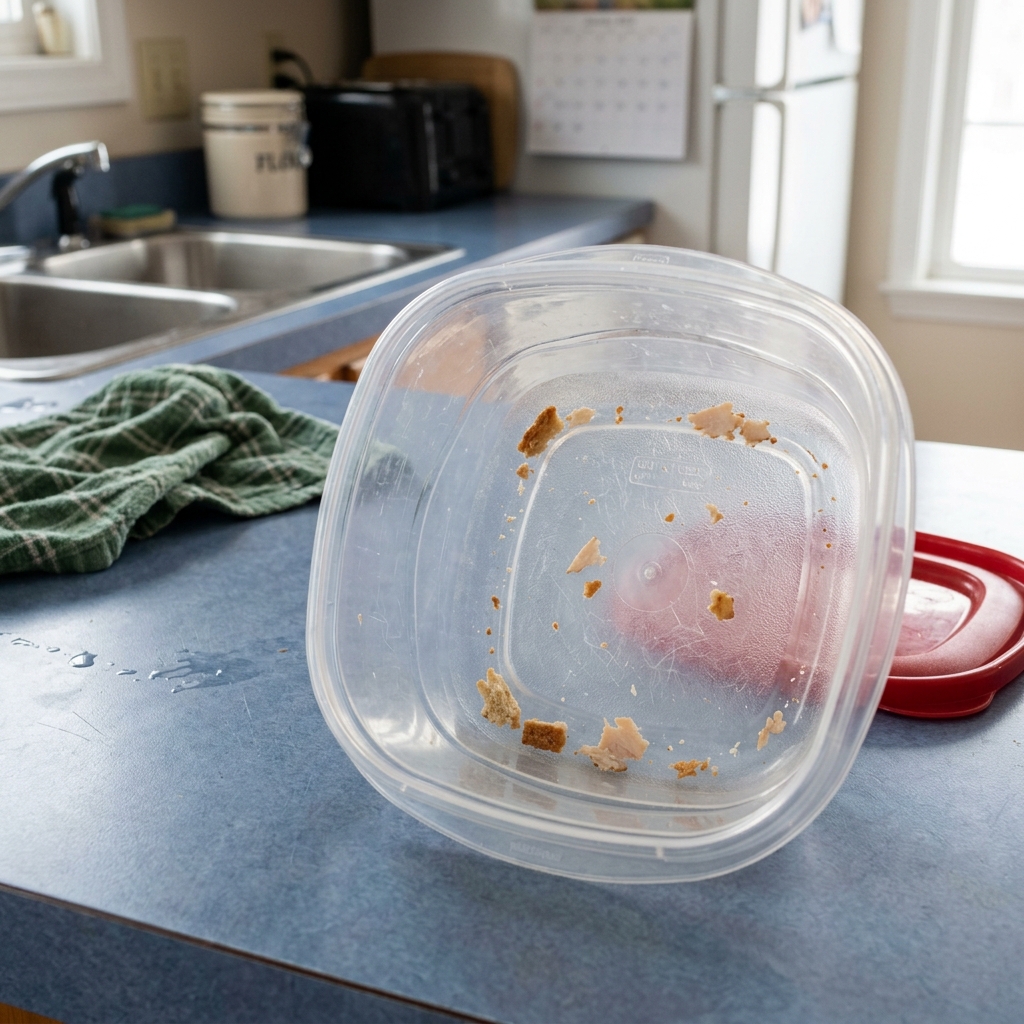
The plastic storage container sat on the blue laminate counter of my kitchen, empty and unwashed, with a few dried crumbs of turkey sandwich stuck to the bottom like little flakes of skin. I had washed that same red-lidded box every single evening for five months, packing it with two slices of whole-wheat bread, roasted deli turkey, a handful of apple slices soaked in lemon juice so they wouldn’t brown, and a small paper carton of milk. It came out to about forty-five dollars a week if you counted the fruit and the snacks, money that came straight out of the grocery envelope I kept tucked behind the flour canister in the pantry.
My son Leo was seven years old then, with a mop of sandy hair that always stuck up in the back no matter how much water I smoothed over it before he ran out the front door to catch the bus. I never thought twice about the empty box when he dropped it into the sink every afternoon at three fifteen. Kids eat fast on the playground, I figured, or maybe he traded a cookie for a bag of chips with one of the boys in his second-grade classroom. You don’t interrogate a seven-year-old about where his lunch goes as long as he comes home with rosy cheeks and mud on his sneakers.
The phone call came on a rainy Thursday morning when the sky over our county road looked like a wet slate shingle. Mrs. Gable, who had worked the cafeteria line at Lincoln Elementary for twenty-two years and knew every child by the way they dragged their boots, didn’t bother with a polite hello when I picked up the receiver off the wall mount. “Mrs. Anderson, you need to get down here to the cafeteria right now,” she said, her voice dropping into that raspy, no-nonsense register she used when a kid had a broken arm or a stomach bug.
I asked her what was wrong, thinking Leo had fallen off the climbing frame or knocked his two front teeth out on the asphalt. “It’s not Leo,” she told me, and the line hissed with the sound of cafeteria trays clattering in the background. “Your boy gives his entire lunch to the same little girl every single day. She never brings food, she hasn’t brought food since the school year started back in August, and today I finally asked her why she was just sitting there watching him eat. She told me she doesn’t have anything to bring.”
I stood there in my kitchen with the dishrag still damp in my hand, staring at the calendar hanging by the refrigerator where I kept track of dentist appointments and PTA meetings. “Who is it, Mrs. Gable?” I asked, my chest tightening up in a way that felt heavy and cold. “It’s Lily,” she said, naming a little girl from Leo’s class whose father I had seen once or twice at open house, a tall man with slicked-back hair who always wore a heavy gray coat even when the weather was mild. “Same clothes every week, Mrs. Anderson.
Same oversized sweater, and today when she reached for the milk carton Leo handed her, her sleeve slipped up. You need to come look at her wrist.” I didn’t wait to change my shoes or grab a proper coat. I just pulled my old green barn jacket over my sweater, slipped my feet into my muddy garden clogs, and drove my station wagon down the two miles of county road to the school as fast as the gravel would let me.
The school smelled of floor wax and stale vinegar when I pushed through the double front doors and hurried down the green-tiled hallway toward the cafeteria. Mrs. Gable was waiting by the double swing doors, her white apron tied tight around her waist, and she didn’t say a word as she motioned me toward a corner table near the tall windows. Leo was sitting there with his plastic lunch box open in front of him, but instead of eating, he was carefully breaking his apple slices in half and sliding them across the table toward a little girl with dark, tangled hair who sat huddled inside an oversized gray wool sweater that swallowed her hands.
When I got close enough to see her face, my stomach turned over. She was paper-thin, her cheekbones sharp under skin that looked the color of skim milk, and there was a dark, purple-yellow bruise shaped like three fingers right above the cuff of her left sleeve.
I knelt down on the sticky linoleum right beside Leo’s chair, ignoring the way my knees popped, and placed my hand gently over his small fingers. “Leo, honey,” I said, keeping my voice as steady as I could manage. “Why didn’t you tell me you were sharing your lunch every day?” He looked up at me with those wide brown eyes, scared he was in trouble for giving away food I’d bought with our tight grocery money, and his lower lip started to tremble just a little bit. “Mom, I had enough,” he whispered, casting a quick, protective glance toward the little girl beside him. “She was always so hungry, Mom. She told me her dad locks the fridge.” Those ten words hit me like a splash of freezing well water on a January morning, and the cold truth of what was happening behind closed doors in our quiet town settled into my bones with a sickening weight.
I stood right back up, my legs shaking under me, and looked at Mrs. Gable, who gave me a sharp, grim nod that told me she had already drawn the exact same conclusion. “Watch them for two minutes,” I told her, turning on my heel and walking briskly out the front doors and straight to my station wagon parked by the flagpole. My fingers were shaking so hard it took me three tries to unlock my phone screen and punch in the digits for the state child welfare agency. When the operator finally picked up, I didn’t bother trying to sound calm or professional. “My name is Martha Anderson, I’m at Lincoln Elementary School in Cass County, and I need a caseworker here right now,” I said, my voice rising over the sound of a passing logging truck out on the highway. “A seven-year-old girl in my son’s class is being starved and abused at home, and her father keeps the kitchen locked up.” The intake worker tried to ask me standard protocol questions about my relationship to the child, but I cut her off. “Just send someone, please. The little girl’s name is Lily Vance, and her father lives just off Route 9 in that old white farmhouse with the green shutters.”
Caseworker Sarah Miller arrived forty minutes later in a gray sedan with state plates, pulling up right behind my wagon with her hazard lights blinking in the pale morning sun. She was a woman in her forties with sharp, intelligent eyes behind wire-rimmed glasses and a clipboard tucked firmly under her arm. Officer Vance from the county sheriff’s department pulled in right behind her, his cruiser kicking up a cloud of loose limestone dust that settled over our hoods. We didn’t waste time talking in the parking lot. I gave Sarah the quick details about what Leo had said and what Mrs. Gable had seen in the cafeteria, and Officer Vance listened with his hand resting casually on the strap of his duty belt, his face set in a hard, flat line. “Let’s go pay Mr. Vance a visit,” the officer said, and the three of us piled into our separate vehicles to make the short drive down to the property on Route 9.
The house sat back from the road behind a row of overgrown cedar trees that dropped dry, brown needles all over the neglected gravel driveway. It was a two-story white farmhouse that looked normal enough from the outside, except for the heavy iron padlocks hanging off the handles of the exterior bulkhead doors that led down to the root cellar. Arthur Vance answered our knock before Officer Vance even had a chance to rap his knuckles against the scarred wooden door a second time. He was wearing a flannel shirt with the sleeves rolled up to his elbows, his dark hair combed back with grease, and a wide, pleasant smile stretched across his face like he was greeting old friends who had dropped by with a pie. “Well, this is a surprise,” Arthur said, his voice smooth and entirely unbothered as he leaned one shoulder against the doorframe. “Officer Vance, is it? We don’t usually get county folks out this far unless the deer fence is down.”
Officer Vance didn’t smile back, stepping right up onto the narrow porch with his badge catching the weak noon light. “Mr. Vance, we have an emergency welfare report regarding your daughter Lily from the elementary school,” the officer said, his tone flat and official. “We need to step inside and check on the child.” Arthur’s smile flickered for just a split second, a tiny twitch at the corner of his mouth, before he smoothed it right back into place with practiced ease. “That’s ridiculous,” Arthur chuckled, shaking his head and crossing his arms over his chest in a defensive posture. “The girl’s fine. She had a bowl of oatmeal before the bus picked her up, she’s just high-strung and a bit sickly since her mother passed away two years back. You don’t need to come tracking mud through my house over a schoolteacher’s gossip.” He made no move to step aside, blocking the threshold with his broad frame, but Sarah Miller slipped past him with a quiet authority that caught him completely off guard. “State child welfare laws give us the right to inspect the living quarters of any minor reported in distress, Mr. Vance, and I suggest you don’t make this harder than it needs to be,” Sarah said, already stepping into the dark, narrow hallway that smelled faintly of old floor wax and sour milk.
Arthur’s friendly facade dropped instantly, the smile sliding right off his face to reveal a hard, ugly glare that made my own breath catch in my throat. “You have no warrant for this,” Arthur snapped, his voice rising an octave as he turned back inside to block Sarah’s path toward the kitchen. “Get out of my house right now or I’m calling my lawyer.” Officer Vance stepped over the threshold and placed a heavy hand right on Arthur’s forearm, steering him firmly away from the hallway. “Nobody’s calling anybody until we see the child’s living quarters, Mr. Vance,” the officer said, his voice dropping into that low, dangerous register that told any man with half a brain not to test him further. “Walk us upstairs. Right now.” Arthur stood there for a second, his jaw working furiously as he weighed his options, before he finally turned and started stomping up the wooden staircase with his boots thudding hard against the steps. “She’s just a lazy girl,” he muttered under his breath, his back rigid with anger. “Always crying about something she doesn’t need.”
We followed him up to the second floor, where the hallway was lined with closed doors covered in peeling beige paint. Arthur stopped directly in front of the master bedroom at the very end of the hall, the door that should have belonged to a married couple but now stood as the centerpiece of his twisted control over that little girl. Unlike the other bedroom doors, this one wasn’t just shut; it was reinforced with a thick steel hasp screwed deep into the wooden doorframe, held securely in place by a heavy brass padlock the size of a fist. Arthur stood in front of it with his hands shoved deep into his pockets, glaring back at us with a look of pure defiance. “There’s nothing in there worth your time,” he said, his voice tight and shaking slightly with suppressed rage. “It’s just storage. Old things of my wife’s.” Officer Vance stepped right up to the door, looked at the heavy brass lock, and then turned his gaze back to Arthur. “Open it, Mr. Vance,” the officer commanded, holding his hand out flat. “Hand over the key.”
Arthur let out a harsh, bitter laugh that sounded more like a bark. “I lost the key,” he lied, refusing to move an inch. “Must’ve dropped it somewhere out in the barn last week.” Officer Vance didn’t waste another second arguing with him. He drew back his right boot and delivered a single, devastating kick right beside the steel hasp, snapping the old pine doorframe with a loud crack that echoed through the quiet upstairs hallway. A second kick sent the door swinging wide open into the dark, stuffy bedroom, and the smell that rolled out into the hall made me slap my hand over my mouth. It was the heavy, stagnant smell of old dust, stale air, and something sour, mixed with the chilling realization of what a man could do behind closed doors when nobody was watching.
Sarah Miller clicked on her flashlight and stepped into the room first, sweeping the beam across the space while Officer Vance kept a firm grip on Arthur’s arm. The master bedroom wasn’t a bedroom at all anymore; it had been converted into a padlocked fortress of systematic deprivation. Right in the center of the room sat a full-sized commercial refrigerator unit, the kind you see in convenience stores, secured with thick heavy chains wrapped around its middle and locked with a combination padlock. Next to it stood multiple heavy-duty metal storage trunks, all padlocked tight, alongside a desk holding a small television monitor wired to a camera lens mounted in the corner of the hallway ceiling. Sarah walked over to the commercial unit and clicked her flashlight beam lower, illuminating shelves packed solid with dozens of boxes of cereal, canned hams, bags of flour, fresh fruit, and blocks of cheese, all locked away from a starving seven-year-old child who lived just down the hall. In the corner of the room, tucked behind an old armchair, sat a small pile of discarded plastic wrappers and a stack of crumpled coloring book pages where Lily had drawn crude pictures of loaves of bread and plates of eggs with a purple crayon.
Arthur’s face went completely slack, the color draining right out of his cheeks as he stared at the open doorway and the evidence of his cruelty laid bare under the harsh light of the police flashlights. “She was stealing from me,” Arthur whispered, his voice cracking into a pathetic, whiny plea as Officer Vance slapped a pair of steel handcuffs onto his wrists with a sharp, metallic click. “She’d eat everything in sight if I left it out. She had to learn some discipline.” I didn’t say a word to him as they led him past me down the stairs, his head hanging low as the weight of what he had done finally caught up with him. I just walked over to the small bedroom down the hall where Lily had been kept, stepping inside to find a bare mattress with no sheets, a single worn blanket, and a small wooden latch installed on the outside of her door so she could be locked in at night. Sarah Miller called for emergency medical transport right from the landing, and within twenty minutes an ambulance from the county hospital arrived to take Lily in for immediate nutritional evaluation and treatment for her injuries.
That was six months ago, and a lot has changed down here in the bottomlands since the day Officer Vance kicked that bedroom door off its hinges. Arthur Vance is currently sitting in the county detention center awaiting trial on multiple felony counts of child abuse, criminal endangerment, and willful neglect, with a judge denying bond given the severity of the evidence recovered from that padlocked room. Lily spent two weeks in the pediatric unit at the regional hospital getting her weight back up and her iron levels stabilized under the care of doctors who finally listened, and she is now living safely with a vetted maternal aunt who treats her with the kindness and warmth every child deserves. She still comes over to our house on Tuesday and Saturday afternoons to play with Leo, and she doesn’t have to sneak food or worry about someone watching her through a lens anymore.
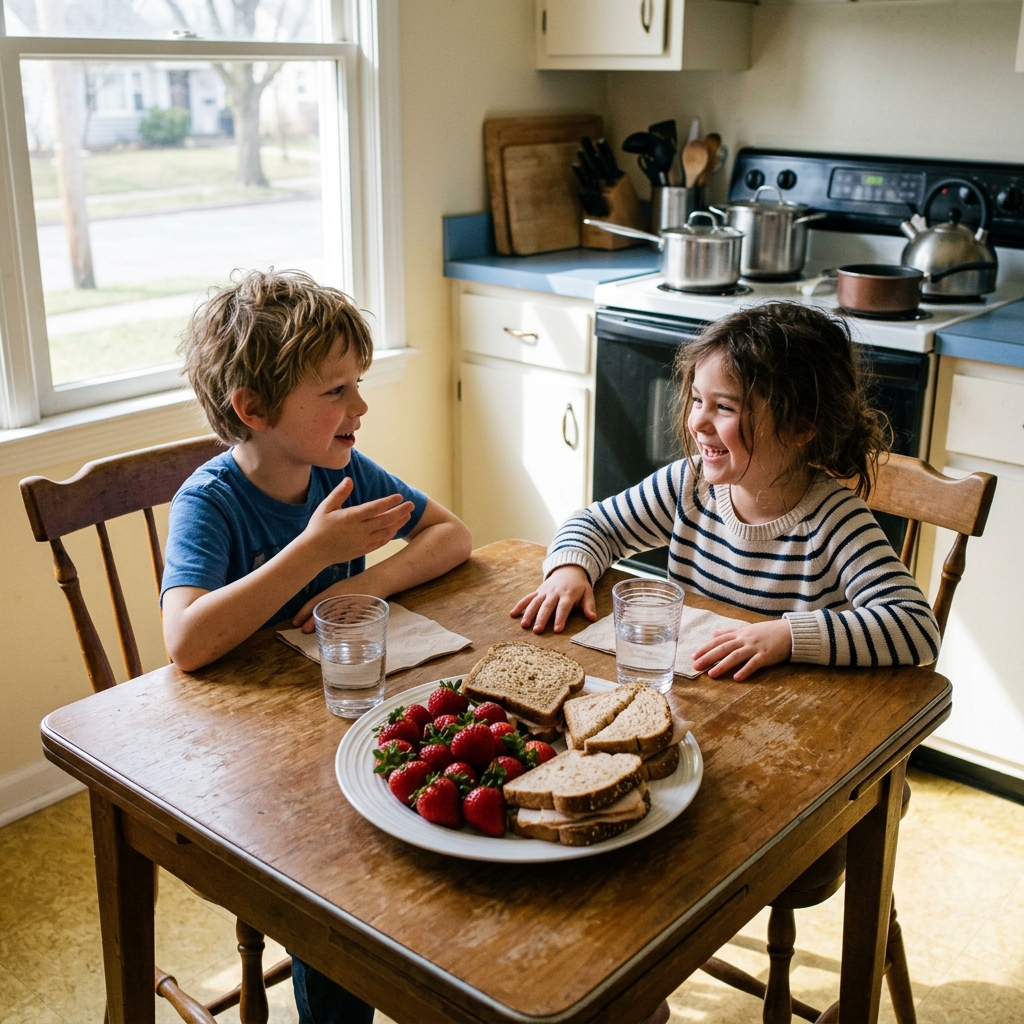
Today the sun is shining bright and warm right through our kitchen windows, turning the linoleum a pale, welcoming gold as the kettle starts to whistle softly on the back burner. The table is cleared off except for a white ceramic plate piled high with fresh, bright red strawberries and thick-sliced turkey sandwiches that Leo cut himself with a dull butter knife. Lily sits right across from him in the wooden chair by the window, laughing at something silly Leo said about his dog, her small hands resting flat on the table with no bruises in sight and no locks anywhere in the house. There are no heavy doors, no chains, and no secrets left to hide in the dark, just the sound of two kids eating lunch together in the middle of a quiet afternoon where nobody is hungry anymore.