The hospital room smelled like instant decaf and floor wax, that particular institutional mix that seems to leach the warmth out of everything it touches. Uncle Carl was seventy-eight, and his lungs had finally decided they were done with the work of breathing, though he had spent the last three days arguing with the nurses about his slippers. I was sitting in the hard vinyl chair by the window, shelling a stale peppermint because my hands needed something to do, when he suddenly stopped staring at the acoustic ceiling tiles and rolled his head toward me.
His eyes weren’t cloudy the way they’d been all week; they had that sharp, terrifying clarity people sometimes get right before the machinery shuts down for good.
He didn’t use my name, and he didn’t waste breath on preamble. He just reached out a hand that felt like dry corn husks and caught my wrist with a grip that had no business belonging to a dying man. I never met my biological father. My mother said he died before I was born. I believed her until I was forty-four, right up until the second Carl opened his mouth and ruined forty-four years of clean, quiet grief with six short sentences.
He didn’t die. He lives in Bakersfield. Your mother made us all promise.
The heart monitor by the bed kept up its steady, rhythmic beep, but everything else inside my chest seemed to drop right through the floorboards. I tried to pull my hand back, thinking the oxygen was failing him, thinking his brain was playing tricks the way dying brains do.
But he just held tighter, his fingernails pressing into my pulse point until it hurt. He whispered that the address was written in the back of his old black address book in the top drawer of his desk at home, right beside his spare dentures and a tin of mints. He told me he was tired of carrying it, tired of the silence, tired of the way my mother had ruled the whole family like a general with a grudge that outlived her.
Carl passed away four hours later, right as the shift change brought a new nurse with a clipboard and a clipboard smile. But I didn’t stay for the funeral arrangements that night. I drove straight to his small, cluttered house on the edge of town, let myself in with the spare key he’d given me back when I bought my first pickup, and went straight to the desk.
The address book was right where he said it would be, wedged under a stack of old irrigation bills from 1994. The ink was faded, but the street name was clear enough to read without squinting. Bakersfield.
I didn’t sleep that night. I sat at my own kitchen table with the address written on a scrap of junk mail, watching the digital clock on the microwave crawl from two in the morning to five, listening to the old refrigerator cycle on and off like a dying generator. Every memory I had of my mother came up through the floorboards to fight me. She had been a woman of iron rules and starched blouses, someone who never raised her voice because she didn’t have to; a look from her could stop a conversation dead in its tracks. Whenever I asked about the father whose face was missing from every family album, she would tighten her mouth into a hard, white line and tell me that some men weren’t worth the breath it took to curse them, that he was gone before I took my first lungful of air, and that was the end of the matter.
By Saturday morning, my bags were already in the trunk of the car, packed for three days even though I had no idea if I’d be back by nightfall. The drive down Interstate 5 is a long, hypnotic stretch of asphalt where the heat waves dance off the blacktop and make the horizon look like water, and I spent the whole four hours arguing with myself out loud in an empty cabin. Part of me was convinced I was chasing a dying man’s delusion, some final hallucination brought on by morphine and failing organs. But another part of me, the stubborn, angry part I probably got from the very man I was driving to see, wouldn’t let me turn the steering wheel toward home.
When I pulled up to the address in Bakersfield just past noon, the heat was already pressing down on the car like a heavy wool blanket. It was a modest stucco bungalow with a patch of dry Bermuda grass in the front yard and a faded yellow porch swing that looked like it hadn’t moved in a decade. The screen door was hooked open, letting in whatever breeze could find its way through the neighborhood, and I could see a ceiling fan turning lazy circles in the living room. I sat in my car for five full minutes with my hands glued to the steering wheel, watching dust motes drift across the windshield, wondering what the hell I was going to say to a ghost.
I finally got out, walked up the three concrete steps, and knocked once on the wooden door frame before I could change my mind. The sound was hollow and dry in the quiet afternoon. Inside, floorboards creaked, slow, heavy footsteps coming down a narrow hallway. When the door swung open, an old man stood there in a gray cotton cardigan that was a couple of sizes too big for his shrunken frame, holding a white ceramic mug that was steaming slightly at the rim. He had my nose, or rather, I had his; it was the same slightly crooked bridge that had looked back at me from the mirror every morning for decades without me ever knowing where it came from.
He didn’t jump, and he didn’t look confused the way people do when a stranger appears on their porch uninvited on a Saturday. He just stood there for a second, his eyes moving over my face with a quiet, devastating familiarity that made my throat tighten up.
I’ve got coffee on.
That was all he said. Like he’d been waiting. Like he always knew I’d show up eventually, as if the last forty-four years were just a long lunch hour we were finally coming back from. He stepped back and held the door open, his movements slow and deliberate, and I walked past him into a front room that smelled faintly of old paper, peppermint tea, and pine cleaner.
We didn’t talk in the hallway, and we didn’t hug. We walked straight back to a small kitchen with yellow linoleum floors and a round oak table where a single ceramic pot was hissing softly on the stove. He poured a second mug without asking how I took it, black, the way I’d been drinking it since I was twenty, and slid it across the table toward me before pulling out the chair opposite mine. I sat down because my legs didn’t feel like holding me up anymore, and I wrapped both hands around the warm ceramic just to feel something solid.
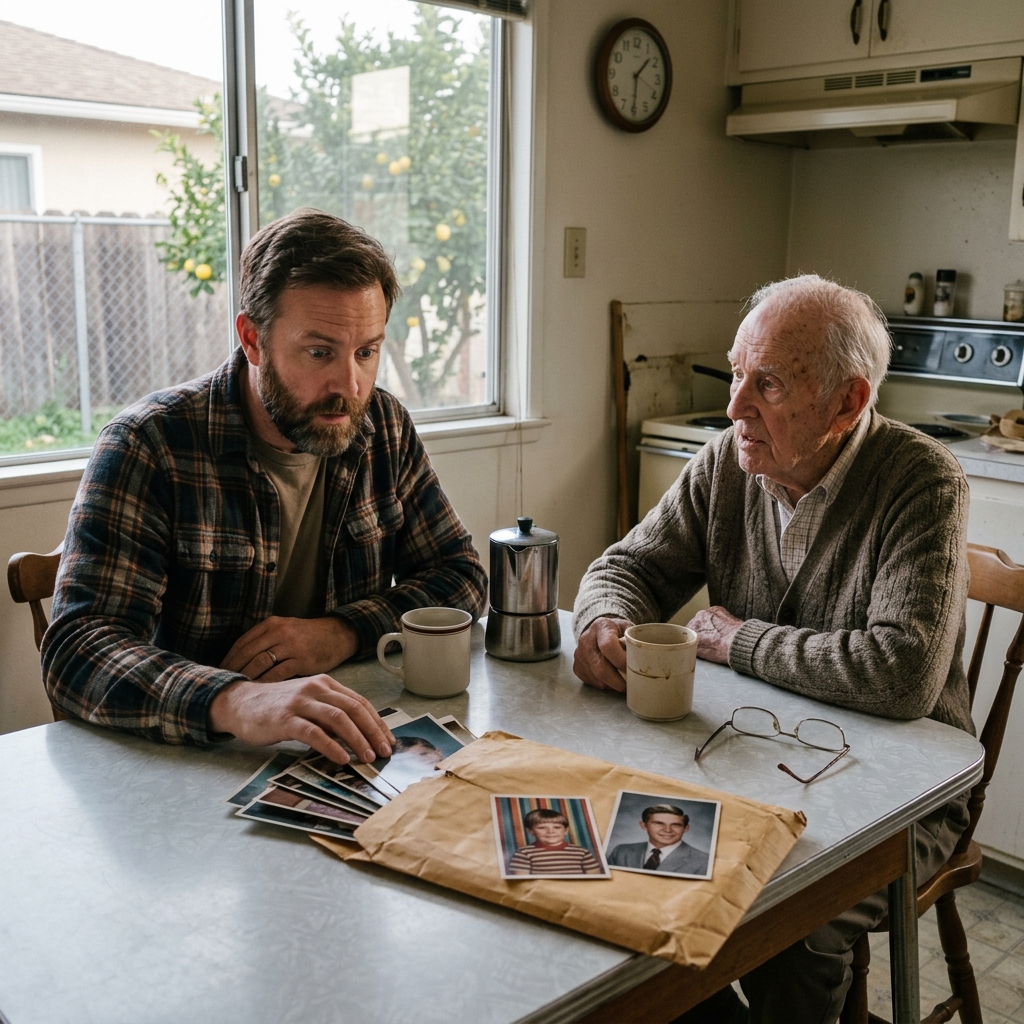
He didn’t ask who I was, and he didn’t ask how I found him. He already knew, the same way a farmer knows when the first frost is coming. He reached down to a low shelf under the table, pulled out a shallow wooden box, and lifted the lid with a dry scrape of hinges. From inside, he took out a thick, worn manila envelope held together at the flap by a piece of yellowed scotch tape that had lost its stick decades ago. He didn’t open it right away; he just rested his palm on top of it, his fingers scarred across the knuckle from some old workshop accident I’d never get to ask about.
Inside was every school picture of mine from kindergarten through twelfth grade.
Not copies, and not prints from digital files. The actual heavy cardstock portraits with the fake studio backdrops that my mother used to order in packs of twenty every autumn. There was little me in the blue-striped polo shirt from third grade with the missing front tooth, and teenage me with the terrible haircut and the acne I used to hide behind my bangs, right up to the stiff cap-and-gown photo from the high school auditorium where my mother had sat in the front row alone. Someone had been sending them to him every single year, right on schedule, like clockwork, without a single note or return address to explain who was on the other end of the line.
He looked across the table at me, his eyes steady and tired, carrying the weight of four decades of empty autumns.
I know who sent them, he said, his voice raspy like dry leaves scraping across concrete. And when I tell you, you’re going to be angry.
I just sat there staring at the edge of the envelope, watching the steam rise off my coffee until it vanished into the air between us. The house was so quiet I could hear the refrigerator humming in the corner and a dog barking somewhere down the block, ordinary sounds that had nothing to do with the fact that my entire life had just been unpicked at the seams. My mother had been dead for six years, buried under a polished granite stone that listed her as a devoted mother and a woman of unblemished grace, and yet here she was, reaching out from twenty feet under the dirt to pull one last string.
It wasn’t malice that separated us in the beginning, Arthur explained after a long, heavy silence where neither of us touched our mugs. It was pride and a very small-town kind of cruelty. When I was six months old, my mother’s family had decided that Arthur didn’t fit the picture they were painting for their daughter’s future. He came from a family of tenant farmers who didn’t own the dirt they worked, and my grandfather had made it clear with a checkbook and a closed fist that my father could either sign away his rights or watch the whole clan use every legal lever they had to erase him from the county records entirely.
They gave him a choice between a quiet exile in the Central Valley or a protracted custody battle he couldn’t afford to fight on wages that barely covered seed and fertilizer. My mother had stood behind her father on the porch that afternoon, her face as blank as a church wall, holding me in her arms while I gummed at a silver teething ring. She hadn’t said a word when he handed over the signed papers, and she hadn’t looked back when he got into his old Ford truck and headed south toward the desert.
They made us all swear a blood oath, Carl had told me in that hospital room, and for most of the family, the fear of my grandfather’s temper was enough to keep the secret buried. But my mother had a sister, Aunt Clara, who lived out her days in a small house three streets over from ours, growing prize-winning hydrangeas and keeping books for the local feed store. Clara was the quiet one, the aunt who always smelled like vanilla extract and slipped extra peppermint sticks into my Easter basket when my mother wasn’t looking. She had watched the silence stretch out year after year, had watched me grow up across town without ever knowing the man who shared my jawline, and somewhere around my fifth birthday, something inside her had simply snapped under the weight of the lie.
She had started buying an extra portrait package every fall when the school photographer set up folding tables in the gymnasium. She would slide the duplicate envelope into the bottom of her knitting bag, take it home, and drop it into the mail slot down at the post office with a plain white label addressed to a post office box in Bakersfield that Arthur had kept open for ten years after he left, just in case a miracle walked through the door.
I drove back home on Sunday evening, taking the long way through the foothills so I wouldn’t have to look at the flat, gray expanse of the interstate. By the time I pulled into my driveway, the sun was sinking behind the ridge and the sky was the color of a bruised plum. I didn’t go inside right away; I sat in the dark cab of my truck with the engine off, listening to the metal pinging as it cooled down in the evening air, letting the silence settle into my bones.
Aunt Clara was eighty-one now, living in that same little house with the hydrangeas, her memory starting to fray around the edges like old burlap. I drove over there on Monday morning before the mail carrier even made his rounds, parking my car right by her white picket fence. She was out on her knees in the dirt, wearing a faded straw hat and blue gardening gloves that were stained dark around the fingertips with potting soil, carefully pruning dead blooms off her prize bushes with a pair of rusted shears.
She didn’t look up when the gate latch clicked, probably thinking it was the paperboy or the girl from next door bringing back her garden hose. I walked up the flagstone path, stopped three feet from where she knelt, and held out the manila envelope I’d brought back from Bakersfield, letting the flap hang open so the school pictures spilled slightly over the edge into the morning light.
Clara froze with her shears halfway through a dead stem. She didn’t drop them, but her hands started to tremble inside the thick blue rubber, a fine, trembling shake that went all the way up to her elbows. She stayed down there on her knees for a long time, staring at the little cardboard faces of me at seven, me at ten, me at fourteen, all those lost years captured on cheap studio paper and mailed across the desert in the dark.
I didn’t yell at her. I didn’t have any voice left for yelling after forty-four years of quiet. I just stood there looking down at the back of her straw hat, watching the wind rustle the dry leaves at the edge of the flowerbed, waiting for her to say something that could bridge the gap between what I thought my life was and what it had actually been.
She finally set the shears down on the grass, very slowly, as if she were afraid they might bite her, and she took off her gardening gloves one finger at a time, folding them together in her lap like a pair of church gloves.
She told me she had to do it, her voice cracking right down the middle like dry pine. She told me nobody should be able to erase a man just because he was poor and her father had a mean streak. She looked up at me then, her eyes swimming behind thick bifocals, looking smaller and older than she ever had when I was a kid sneaking cookies out of her pantry.
She said she kept the receipts in a shoe box in the back of her closet, every single postal slip from every single autumn, just in case someone ever came looking for the truth.
I stayed with her on the porch for twenty minutes, drinking a glass of lukewarm tap water she brought out in a jelly jar, neither of us saying much else while the traffic rolled by on the main road. When I left, I didn’t say goodbye, but I didn’t slam her screen door either; I just hooked it back on its latch the way she liked it, walked out to my truck, and pointed the hood back toward the south.
Arthur and I didn’t try to make up for forty-four years in one weekend, because people like us don’t know how to talk about things that big without tripping over our own boots. But I started driving down to Bakersfield once a month on my days off, taking the Friday afternoon shift off so I could get there before dark. We sit at that same yellow kitchen table, drink the same bitter black coffee, and talk about nothing at all, the price of diesel, the way the apricot trees are holding up against the drought, the way the wind comes howling down through the valley in November.
On my last trip down there, right before we sat down to eat a plate of dry ham and canned peaches, I brought a small digital camera and set it on the corner of the table between our coffee mugs. I didn’t ask him to smile, and he didn’t ask me what it was for. We just stood out on the front porch in the harsh afternoon glare, shoulder to shoulder against the faded yellow siding, while the timer clicked down three seconds in the empty air.
The resulting print now sits on the kitchen table in Bakersfield, resting right beside a clean, unsealed manila envelope that holds no pictures at all, just a blank piece of heavy white cardstock and two pens, waiting for the next time the mail gets delivered.