Part 2: The Foyer Where the Lie Collapsed
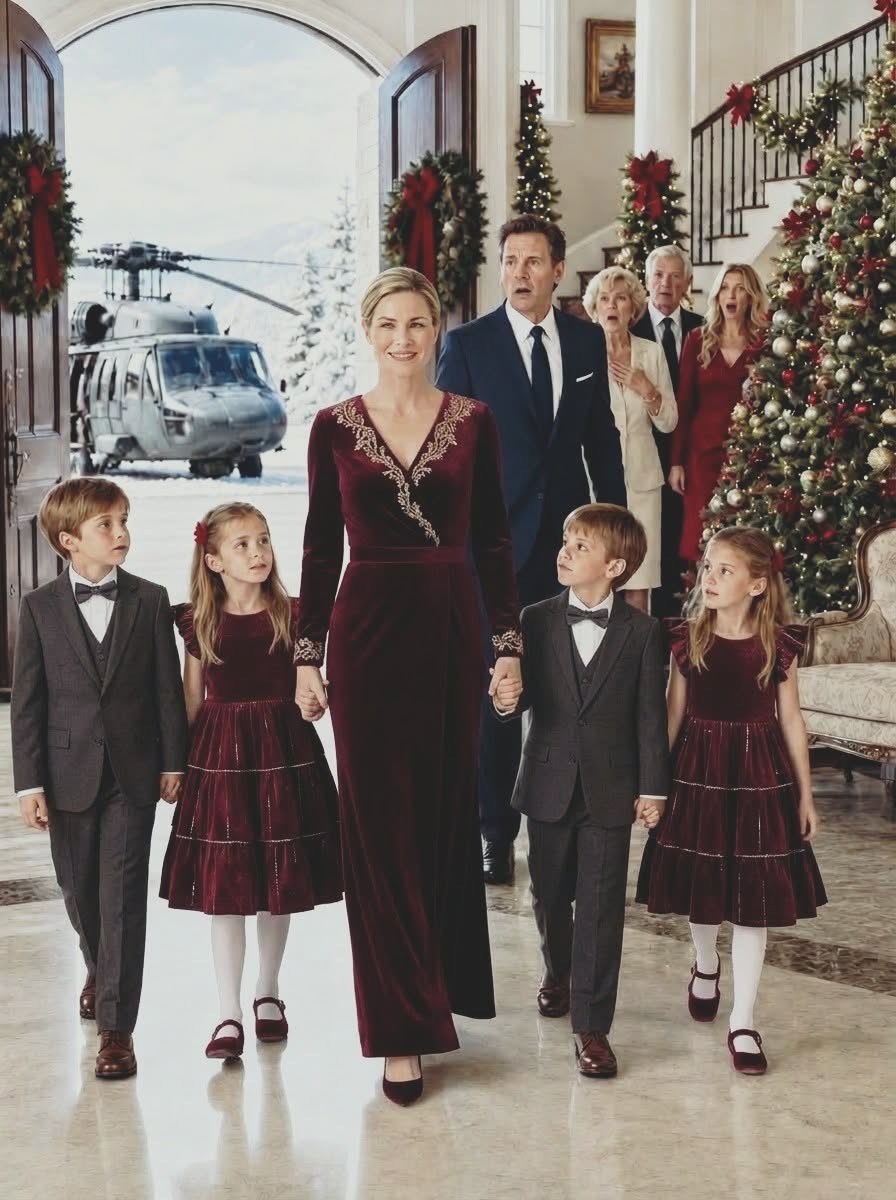
The Ashford foyer was built to impress.
Marble floors. A chandelier that probably cost more than the car I drove. A grandfather clock ticking steadily against the wall like a metronome for a family that measured everything in generations.
But for approximately nine seconds, nothing in that foyer moved except Grant’s expression.
He stared at my sons. His eyes traveled from Carter to Mason to Reid to Owen, and I watched him perform the calculation he had spent eight years refusing to make.
Four boys. Same age. Same features. Same jawline he saw in his own mirror every morning. Same brow his father carried in the portrait hanging six feet behind him.
Helen recovered first. She had the particular composure of a military wife who had spent decades managing ceremonies, funerals, and family scandals with equal precision.
Grant, she said quietly. Who are these children.
Grant did not answer.
His fiancee, a woman named Vanessa whom I had never met, looked from the boys to Grant with the slowly dawning expression of someone realizing that the story she had been told was incomplete in ways that mattered.
I stepped forward.
Helen, these are your grandsons. Carter, Mason, Reid, and Owen. They are eight years old. They are Grant’s children. And despite what you have been told for the past eight years, they have always been real.
The foyer went silent except for the grandfather clock.
Carter stood beside me with his hands in his coat pockets, watching his father with the steady, evaluative gaze of a boy who had grown up studying the absence of a man he had never met and was now, for the first time, studying the man himself.
Mason shifted his weight from foot to foot, the way he did when he was nervous. Reid was looking at the Christmas tree with undisguised awe. Owen was still studying the photographs on the wall, the men in uniform, the medals, the legacy.
Grant finally spoke.
This is not possible.
I looked at him.
Quadruplets, Grant. Born seven months after you filed. Delivered at thirty-two weeks at Memorial Hospital in Virginia. I sent you the birth announcement. You returned it unopened.
His jaw tightened.
You told me you made up the pregnancy.
No. You told everyone I made up the pregnancy. I told you the truth. You decided the truth was inconvenient.
Helen set her champagne glass on the hall table with a small, precise click.
Grant. Is what she is saying accurate.
Grant looked at his mother. Then at Vanessa. Then at the four boys standing in his childhood foyer, wearing secondhand winter coats and borrowed dress shoes, looking up at a twelve-foot Christmas tree in a house they had never been invited to enter.
I need a minute, he said.
You have had eight years of minutes, I said. Your sons have had zero Christmases in this house. I think the minutes belong to them now.
Helen looked at me. Then at Carter.
She knelt.
It was the last thing I expected. Helen Ashford, matriarch of a family that measured its worth in service records and reputation, knelt on her marble floor and looked my son in the eye.
What is your name, she asked.
Carter. Carter Reeves.
She studied his face. I watched her see what I saw every morning. Grant’s chin. Grant’s brow. The Ashford features rendered in miniature, undeniable, as clear as a signature on a document that had been waiting eight years to be read.
Her hand went to her mouth.
Oh my God, she whispered. Grant, these are yours. Look at them. These are yours.
Grant did not move.
Vanessa did.
She stepped away from Grant, crossed the foyer, and stood beside Helen. She looked at the boys with an expression that contained no jealousy, no anger, only the focused assessment of a woman recalculating the man she had agreed to marry.
You told me there were no children, she said to Grant.
Her voice was calm. Too calm. The calm of a woman who was not going to explode in a foyer full of guests but was going to remember this moment with surgical precision for the rest of her life.
Grant opened his mouth. Closed it. Opened it again.
It was complicated, he said.
Vanessa looked at the four boys.
It does not look complicated to me. It looks like four children.
She turned and walked into the house without another word.
Grant stood in his foyer in his dress uniform, surrounded by the symbols of a family that prized honor above everything, and watched the lie he had maintained for eight years dissolve in the time it took four boys to remove their coats and hang them on the rack beside the door.
Carter was the last to take off his coat. He folded it neatly, the way I had taught him, placed it on the hook, and turned to Grant.
My mom said you were in the military, he said.
Grant nodded stiffly.
Carter looked at the medals on the wall.
She said military people are supposed to be honest.
The foyer was very quiet.
Carter looked at his father.
Were you honest about us.
Grant said nothing.
And in that silence, eight years of fabrication met eight years of truth, and the truth was standing in borrowed shoes on a marble floor, looking up with his father’s face and his mother’s backbone, waiting for an answer that was already, irreversibly, too late.
Part 3: The Table Where Four Chairs Were Added
The dinner was supposed to seat forty-two.
Helen’s seating chart, which I later learned had been finalized three weeks in advance with the precision of a military logistics plan, accounted for every Ashford cousin, uncle, in-law, and family friend in the Colorado Springs area.
It did not account for four eight-year-old boys.
Within fifteen minutes of our arrival, Helen had instructed the caterer to set four additional places at the main table. Not at a children’s table in the adjacent room. Not at a folding card table beside the kitchen. At the main table, between the adults, in chairs pulled from the study.
Grant objected.
Mother, this is not the time, he said. We can discuss this after the holiday.
Helen looked at her son with an expression I had never seen her use before. Not anger. Disappointment. The specific, devastating disappointment of a woman who had raised a man on principles of duty and honor and was now watching him apply neither to his own children.
These boys will sit at this table, she said. They are Ashfords. And they should have been sitting here for eight Christmases.
The dining room was enormous. A long mahogany table stretched beneath a chandelier that scattered light across crystal glasses and white china. Candles burned in silver holders. Pine garlands ran the length of the table, dotted with red berries and small gold ornaments.
The boys had never seen anything like it.
Mason sat in his chair and ran his hand across the linen napkin as though it were made of something he had never touched before. Reid counted the forks beside his plate, arriving at three, and looked at me with an expression that clearly asked which one to use first.
Start from the outside, I whispered.
He nodded.
Owen placed his napkin on his lap without being told, because Owen was the boy who watched everything and followed the room.
Carter sat beside Helen. She had placed him there deliberately. She had placed him at her right hand, in the chair usually reserved for the family’s senior guest, because Helen Ashford had spent sixty seconds looking at Carter’s face and decided, with the authority of a woman who did not require committee approval, that her grandson belonged beside her.
Grant sat across the table. His expression had hardened into the controlled blankness of a man who was accustomed to managing tactical situations and was now discovering that his mother had outflanked him with a seating chart.
Vanessa was not at the table. She had excused herself thirty minutes earlier and had not returned. Her absence was conspicuous, and the guests who had been told tonight was an engagement celebration were beginning to notice that the bride-to-be was missing.
Grant’s uncle, Colonel Richard Ashford, retired, was seated three chairs from Carter. He had been watching the boys since they entered the dining room. He was seventy-four, silver-haired, built like the career infantry officer he had been, and possessed of the particular directness that military families either admire or fear, depending on which end of it they are standing on.
He leaned forward.
Son, he said to Carter. What is your last name.
Reeves, sir.
Richard looked at me. Then at Grant.
And your mother’s maiden name.
Reeves is my name, I said. I did not take Grant’s.
Richard nodded slowly.
And these boys are Grant’s.
Yes.
All four.
Yes.
Richard sat back. He folded his hands on the table. He looked at Grant the way a commanding officer looks at a subordinate who has been caught in a lie that affects the unit.
Grant, he said. I want you to explain to me how four children who carry your face have been absent from this family for eight years.
The table went quiet.
Not gradually. Instantly. The way sound stops when everyone in a room simultaneously decides to listen.
Grant set his fork down.
This is not the appropriate venue for this conversation, Uncle Richard.
This is exactly the appropriate venue. You invited their mother to this table. You expected her to arrive alone so you could display your new life beside the woman you left behind. And she arrived with four boys who look more like Ashfords than half the people in this room.
Grant’s face darkened.
I was told the pregnancy was not real.
By whom, Richard asked.
By her. She was emotional. She was desperate.
Richard turned to me.
Ma’am. Were you desperate.
I looked at the colonel.
I was pregnant with quadruplets, seven months from delivery, and my husband had just filed for divorce. I was many things, Colonel. Desperate was probably one of them. But dishonest was not.
Richard turned back to Grant.
Did you request a paternity test.
Grant did not answer.
Did you visit the hospital.
No.
Did you open the birth announcement.
No.
Richard placed both hands flat on the table.
Then you did not reject the truth because it was unbelievable, Grant. You rejected it because it was inconvenient. And that is the least honorable thing I have heard at this table in forty years of Ashford Christmases.
The dining room remained silent.
Mason looked at me from across the table with wide eyes. I gave him a small nod, the one that meant everything is okay, the one that meant your mother is here, the one I had been giving him since the day he was born and had never once failed to mean exactly what it said.
Helen reached over and placed her hand on Carter’s arm.
Carter, she said. Would you like more potatoes.
He looked at her.
Yes please, he said.
She passed the dish.
And dinner continued, because Helen Ashford understood something her son had never learned. That family is not a performance. That legacy is not a seating chart. And that four boys who arrived in secondhand coats deserved a plate of potatoes and a place at the table every bit as much as the man in the dress uniform who had tried to erase them.
Part 4: The Study Where Grant Finally Stood Alone
After dinner, Grant found me in the hallway.
The boys were in the family room. Helen had taken them there herself, introducing them to cousins and aunts and uncles who looked at their faces and needed no DNA test to see what was obvious. Reid was already deep in conversation with a twelve-year-old cousin about whether submarines or fighter jets were more important. Mason had found the dessert table. Owen was studying a framed photograph of his grandfather in uniform with the quiet intensity of a boy building a filing system for a history he had only just been given access to.
Carter sat on the couch beside Helen, eating pie.
Grant stopped me at the door of the study.
We need to talk, he said.
We are talking.
Privately.
I followed him inside. He closed the door.
The study was dark wood, leather, brass. A desk the size of a dining table. More photographs. More flags. A framed letter from a four-star general thanking Grant’s father for thirty years of service.
Grant stood behind the desk like a man defending a position.
You should not have brought them here.
You should not have told everyone they did not exist.
That is not what happened.
It is exactly what happened. You told your mother, your family, your friends, and apparently your fiancee that the pregnancy was a fabrication. You told them I was a desperate woman who invented children to keep a marriage together. And you maintained that story for eight years while four boys grew up without a father.
I had my reasons.
What reasons.
He pressed his hands against the desk.
Because if I had acknowledged them, it would have changed everything. The custody battle. The financial obligations. My career timeline. My engagement.
So you erased your sons to protect your schedule.
That is not what I said.
It is exactly what you said. You just used different words.
He looked at the door.
What do you want, he said.
What I want has not changed in eight years. I want my sons to know their family. I want them to have what every Ashford child has had: a place at the table, a photograph on the wall, and the knowledge that they belong here.
And if I cannot offer that.
You cannot offer it, I said. Because it was never yours to withhold. Your mother just seated Carter at her right hand. Colonel Richard just told a table full of people that your sons look more like Ashfords than half the room. Your family has already decided, Grant. The only person still pretending these boys do not exist is you.
He sat in the leather chair behind the desk.
For the first time that evening, he did not look like a major. He did not look like the man who ran tactical operations and delivered briefings and wore his uniform the way other men wore armor.
He looked like a man sitting alone in a room full of his father’s legacy, realizing that the most important mission of his life had been the one he refused to accept.
I am going to need a paternity test, he said.
I already have one. I had it done when the boys were two. The results are in my attorney’s office. I will have them sent to you.
Why did you not send them before.
Because I should not have had to. A father should not need a lab report to acknowledge his own children.
I walked to the door.
Grant.
He looked up.
Your sons are in the next room eating pie with your mother. You can sit in here with your excuses, or you can walk through that door and meet them. That choice is yours. But it is a choice you are making right now, and they will remember which one you picked.
I opened the door and walked out.
Behind me, the study was quiet.
I went to the family room. Carter was still on the couch beside Helen. He had finished his pie and was listening to her describe the photograph above the fireplace, a portrait of Grant’s father in full dress uniform.
That is your grandfather, Helen was saying. He served for thirty years. He believed that the measure of a man was not what he achieved but what he protected.
Carter looked at the portrait.
He looks serious, Carter said.
He was, Helen replied. But he also made the best French toast in Colorado. Every Sunday morning, without fail.
Carter smiled.
I sat beside them.
Twenty minutes later, the study door opened.
Grant walked into the family room.
He stood in the doorway for a long moment. The noise of the party continued around him. Glasses clinking. Laughter. Holiday music. His relatives moving through the house the way they always had, secure in the structure of a family that valued order above everything.
Then he crossed the room and stopped in front of the couch where Carter sat.
He looked at his son.
Carter looked at his father.
Eight years of distance. Eight years of silence. Eight years of a boy growing up with a question he could never answer and a man who chose, every single day, not to answer it.
Grant knelt.
Not gracefully. Not the practiced kneel of a man accustomed to ceremony. The awkward, uncertain kneel of a man who was doing something for the first time and had no training for it.
I am Grant, he said.
Carter studied him.
I know who you are, Carter said.
Grant swallowed.
I should have been here.
Carter looked at the portrait above the fireplace. Then back at his father.
Yes, he said. You should have.
Grant pressed his hand against his knee. His jaw tightened. Something behind his eyes shifted, the way tectonic plates shift beneath the surface of things that appear solid but are not.
Can I start now, he asked.
Carter did not answer immediately. He looked at me. I gave him no signal, no nod, no direction. This was his. This moment, this decision, this answer belonged to an eight-year-old boy who had earned the right to give it on his own terms.
Carter turned back to his father.
You can start, he said. But starting is not the same as staying. My mom taught me that.
Grant nodded.
Then he looked at Mason, who was holding a plate of cookies. At Reid, who had paused his submarine argument to watch. At Owen, who was standing beside the photograph of his grandfather with one hand resting against the frame.
Four boys. His boys. Standing in the house where they should have grown up, eating pie they should have been served every Christmas, surrounded by a family that should have known their names from the day they were born.
Grant looked at Helen.
His mother’s expression was clear.
It said: you lost eight years. Do not lose another minute.
Grant stood up.
He walked to Mason first.
Part 5: The Wall Where Four Photographs Were Hung
Grant did not become a father overnight.
He became one the way all real things are built. Slowly, imperfectly, with the full understanding that the foundation had been damaged and the repairs would take longer than the original construction.
The paternity results arrived at his attorney’s office within two weeks. They confirmed what every person at that Christmas table had already seen with their own eyes. Four boys. His features. His blood. His responsibility.
The legal process began in January. Grant’s attorney and mine negotiated a custody arrangement that reflected the reality of the situation. I retained full physical custody. Grant received structured visitation, supervised initially, expanding over time as the boys and I felt comfortable.
He did not contest the structure. That was the first sign.
The second sign came in February, when Grant drove five hours from Colorado Springs to my home in Virginia to attend Mason’s school science fair. He arrived in civilian clothes, not his uniform. He stood at the back of the gymnasium and watched Mason present a poster about volcanoes that included a baking soda eruption, which went slightly sideways and covered the adjacent project in foam.
Mason was mortified. Grant helped him clean it up.
They knelt side by side on the gymnasium floor, wiping baking soda off a poster about photosynthesis that belonged to a girl named Eliza, who told Mason she did not mind because the foam made her project look more exciting.
Grant laughed. I had not heard him laugh in nine years.
The monthly visits continued through the spring. Grant flew to Virginia or drove, depending on his schedule. He did not cancel. He did not reschedule. He showed up, every time, which was the baseline, not the achievement, but baselines matter when the previous standard was absence.
He took the boys to lunch. He learned their preferences. Carter liked grilled cheese with tomato, never ketchup. Mason ate everything and wanted seconds. Reid ordered whatever the most unusual item on the menu was, because Reid approached food the way he approached life: with a preference for the unexpected. Owen ordered the same thing every time. A plain cheeseburger and a glass of milk.
Grant learned these things the way a man learns a language late in life. With effort. With mistakes. With the particular humility of someone who understands that fluency is years away and conversation is all he can offer right now.
Vanessa ended the engagement in March.
I learned this not from Grant but from Helen, who called me on a Wednesday evening.
She told me Grant was devastated, Helen said. But I do not think he is devastated about Vanessa. I think he is devastated because Vanessa was the last wall between him and the truth about what he did.
What did he do, I asked.
He chose his pride over his children. And he built an entire life on that choice. When the life collapsed, the choice was still underneath it, and now he has to look at it every day.
Helen paused.
I am sorry, she said. For believing him. For every Christmas those boys should have been here. For every photograph that should have been on my wall.
You did not know, I said.
I should have known. A mother should know when her son is lying.
A mother should also know when her grandchildren exist. And you know now.
She was quiet for a moment.
May I send birthday gifts.
You may send birthday gifts.
All four.
All four.
The gifts arrived in April. Four packages, wrapped identically, labeled in Helen’s precise handwriting. Each box contained a book about a different branch of the military, a handwritten letter from Helen to each boy individually, and a small framed photograph of their grandfather.
Owen opened his first. He held the photograph and studied it for a long time.
He looks like Carter, Owen said.
Carter looked at his own photograph.
He looks like all of us, Carter said.
They were right. The resemblance was as clear in the photographs as it was in the mirror. Four boys carrying a legacy they had been denied access to, holding it now in their own hands.
In June, Grant asked if he could bring the boys to the estate for a week.
I agreed, with conditions. I would accompany them. We would stay in the guest house, not the main residence. And the visit was for the boys, not for Grant’s reputation.
He accepted every condition.
We arrived on a Saturday. The estate looked different in summer. The pine trees were full and green. The flags along the drive rippled in a warm breeze. The stone entrance, which had looked imposing in December, looked almost welcoming with the sunlight on it.
Helen was on the porch. She had set up a table with lemonade and sandwiches and a plate of cookies that she told me she had made herself for the first time in twelve years because she wanted them to be homemade when her grandsons arrived.
The boys ran from the car to the porch. Mason reached the cookies first. Reid challenged Owen to a race around the side of the house. Carter walked, because Carter always walked, and he sat beside Helen on the porch swing and accepted a glass of lemonade with the quiet composure of a boy who understood that this moment had been eight years in the making and deserved to be entered slowly.
During that week, Grant took the boys fishing. He taught Carter to cast, badly, because Grant had always been better at briefings than bait. He helped Reid build a model airplane from a kit they found in the study. He sat with Mason on the dock and talked about nothing in particular, which is the most important kind of conversation a father can have with an eight-year-old who is still deciding whether to trust him.
Owen spent most of the week in the study.
He studied the photographs. He read the inscriptions beneath the medals. He asked Helen questions about every portrait on the wall, and she answered each one with the thoroughness of a woman who had been waiting decades for someone to ask.
On the last evening, Grant came to the guest house.
The boys were asleep. I was sitting on the porch with a cup of tea, watching the stars over the Colorado mountains.
He sat in the chair beside me.
Neither of us spoke for a while.
I want to put their photographs on the wall, he said.
I looked at him.
I brought frames, he continued. Helen helped me choose four photographs from the ones you sent her. I want to hang them in the hallway beside the others. If you will allow it.
They are your sons, Grant. You do not need my permission to put their faces on your wall.
I am asking anyway. Because I should have asked about a great many things eight years ago and I did not.
I was quiet for a moment.
Hang them, I said.
The next morning, before we left, Grant took the boys to the hallway.
Four new frames hung on the wall beside the generations of Ashfords in uniform. Carter, Mason, Reid, and Owen. School photographs, taken six months earlier. Carter with his serious expression. Mason with his wide grin. Reid with the slightly sideways look of a boy who had been told to sit still and was already planning his next move. Owen looking directly into the camera with the quiet focus that made everyone who met him believe he was memorizing the world.
The boys stood in front of their own photographs.
Mason pointed at his.
I look like Grandpa, he said.
Reid looked at his.
I look like me, he said.
Owen touched the frame gently.
Carter just stood there, looking at his photograph hanging on a wall he had never been allowed to enter, in a house that carried a legacy he had always been part of but had never been told about.
He looked at Grant.
Thank you, Carter said.
Grant nodded. His jaw was tight. His eyes were wet.
You belong here, Grant said. You always did.
Carter considered this.
We know, he said. Mom told us.
Grant looked at me.
I looked back at him.
I had told them. Every day, in every way I knew how. Not with flags and medals and marble floors. With grilled cheese and science fairs and couch cushion fortresses and secondhand winter coats that I washed every Sunday night so they would be clean for Monday morning.
I had told them they belonged. Not to the Ashford legacy. To themselves.
And now their photographs hung on a wall in a house in Colorado, beside men in uniform and folded flags and glass-encased medals, and the four boys looking out from those frames were wearing school shirts and crooked smiles and the faces of a family that had finally stopped pretending they did not exist.
We drove home that afternoon. The boys fell asleep by hour two. Carter lasted the longest, as he always did, watching the mountains shrink in the rearview mirror.
Mom, he said.
Yeah.
Was that okay. Going there.
I thought about it.
Yeah, sweetheart. That was okay.
He was quiet for a moment.
I think Grandma Helen really likes cookies.
I think you are right.
He smiled. Then he leaned against the window and closed his eyes.
I drove through the Colorado landscape with four sleeping boys in the back and the mountains behind us and the long, straight highway ahead, and I thought about what Helen had said on the phone. That Grant had chosen his pride over his children and built an entire life on that choice.
He had.
And the life had collapsed.
But the boys were still standing. The photographs were on the wall. And a grandmother who had missed eight Christmases was already planning the ninth.
The highway unrolled ahead of us, flat and honest, the way all roads are when you have finally stopped hiding and started driving toward the thing that was always true.
Four boys. Mine. His. Theirs.
Real.
They had always been real.
And now, at last, everyone knew it.