
Part 2: The Report They Never Expected
Ashley did not recover quickly.
She stood in the service kitchen with her arms slowly unfolding, her designer blouse spotless while my wife’s clothes were soaked through with grease water, and she attempted the only maneuver she had ever been good at.
She tried to rewrite the room.
Daniel, oh my God, you are home early. We were just finishing up. Emily offered to help with the cleanup. She insisted.
Emily did not look at Ashley. She looked at me. Her eyes were red. Her hands were trembling at her sides. And the expression on her face was not relief.
It was shame.
She was ashamed. Not of what had been done to her but of being seen in this condition by the man she loved. She did not want me to see her like this, standing in dirty water in the back of her own house, because somewhere in the months I had been gone, they had convinced her that this was where she belonged.
That realization broke something inside me that I did not bother to repair.
I held up the report.
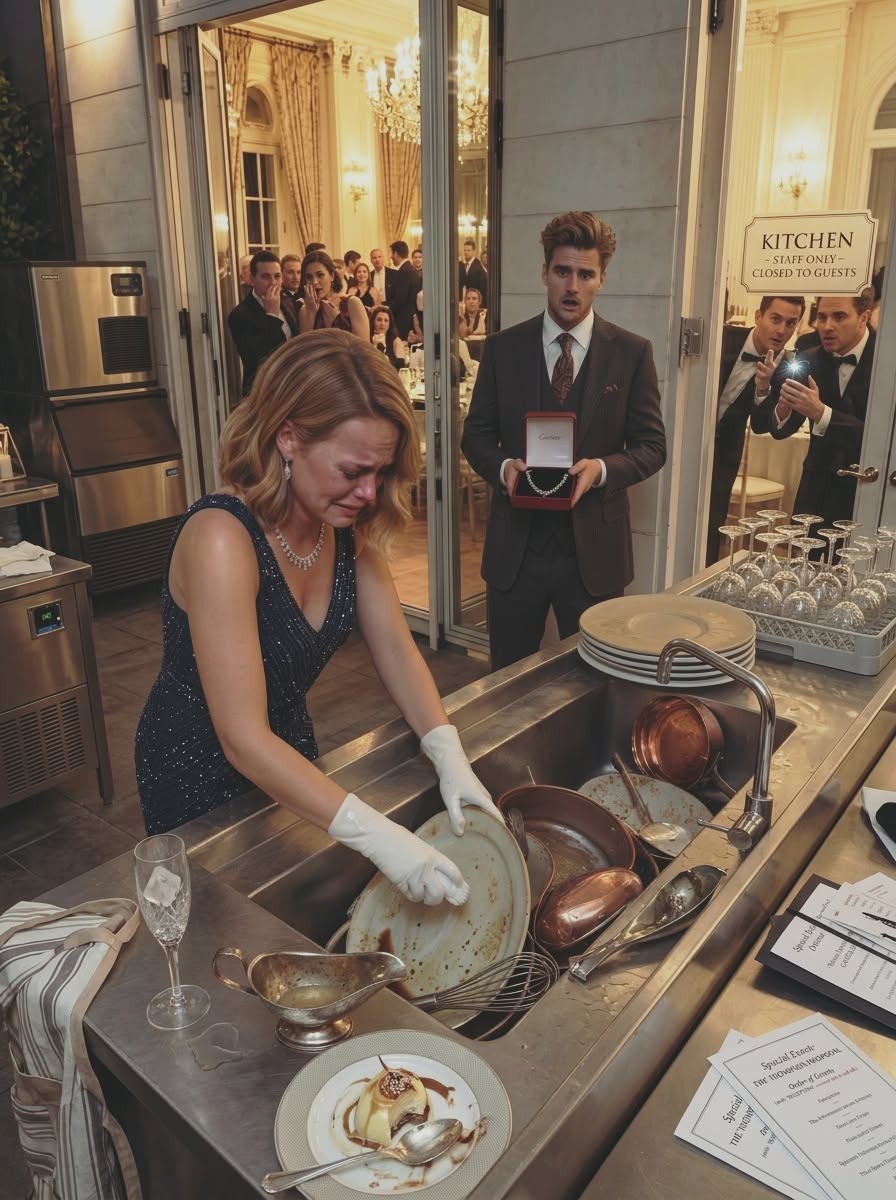
Ashley, sit down.
She did not move.
I am not asking. Sit down. And call Margaret and Michael into this room.
Her face changed. Not to fear. To calculation. The rapid, practiced assessment of a woman deciding which version of the story to deploy.
Daniel, you are overreacting. Mom just wanted to help while you were traveling. We organized a few small gatherings to keep the house lively. Emily was overwhelmed with the household, and we stepped in.
I opened the report to the first tabbed section.
In the past eleven months, seven hundred and twelve thousand dollars has been withdrawn from the household operating account. I set up that account for Emily. She was the sole authorized user. Would you like to explain how your name ended up on the signature card.
Ashley went still.
Or would you prefer to explain the forty-three thousand dollars in personal purchases charged to a supplementary credit card issued under a name I did not authorize. Your name, Ashley.
She opened her mouth.
Or the ninety-seven thousand dollars transferred to an account held by Michael’s LLC, an LLC that has no registered business activity, no employees, no revenue, and no purpose other than receiving my money.
She closed her mouth.
Emily was watching from beside the sink. She had not moved. She had not spoken. She stood in the steam of the service kitchen with her cracked hands pressed against her apron and watched me read numbers she had tried to warn me about for months.
Because Emily had tried.
I understood that now. The phone calls she made to me at midnight, the ones I was too exhausted to fully hear. The careful sentences that always started with something is not right with the accounts and ended with but your mother says it is being handled. The time she told me Ashley had asked her to sign a document she did not understand, and I had said just sign it, Em, they are family.
Just sign it. They are family.
Three words and a trust that cost me seven hundred thousand dollars and cost my wife her dignity.
Margaret appeared in the doorway. She had heard the commotion. She was wearing the gold jewelry and the expression of a woman who had been the center of the party and was now being summoned to the kitchen like staff.
Daniel, she said. What a wonderful surprise. We had no idea you were coming home.
I know. That was the point.
She looked at the report in my hand.
What is that.
It is a forensic audit of every account connected to this estate. Commissioned eight weeks ago by my attorney, Marcus Webb, after Emily’s third attempt to tell me that something was wrong with our finances was finally heard by someone who listened.
Margaret’s composure cracked. Not visibly. Structurally. The way a wall cracks behind the paint.
Michael arrived behind her, still holding a glass of wine from the dining room.
What is going on, he said, with the casual tone of a man who had not yet realized the party was over.
I looked at my brother.
To Daniel, I said. May those generous monthly transfers never stop.
The glass lowered.
That is what you said, Michael. At the table. While my wife was in this kitchen scrubbing pots. You raised a toast to the money I earn, in my house, with my wine in your glass, and you laughed about it.
I did not raise my voice.
I did not need to.
The report was forty-seven pages. The voice could stay quiet. The numbers were loud enough.
Part 3: Seven Hundred Thousand Dollars and a Pair of Cracked Hands
That night, after the catering staff had been dismissed and the guests had scattered with the particular haste of people who realize the host has returned and the atmosphere has shifted from celebration to reckoning, I sat with Emily in our bedroom.
She was on the edge of the bed. I was kneeling on the floor in front of her, holding her hands, examining the damage.
The skin was raw. The knuckles were cracked and bleeding at the creases. Her fingertips were pruned and tender from hours in water that was too hot, using chemicals that were too strong, doing work that was not hers to do in a house that was entirely hers.
How long, I asked.
She did not answer immediately.
Em. How long has this been happening.
She looked at the ceiling.
It started small. About eight months ago. Your mother said the household staff was costing too much and we should reduce expenses. She let the housekeeper go. Then the cook. Then the gardener. She told me it was temporary.
It was not temporary.
No. After the staff was gone, Ashley told me I should handle the cleaning myself since I was home all day and not contributing financially. She said it was the least I could do while you were working so hard.
And you believed her.
I believed her because your mother agreed. And because every time I called you and tried to explain, you told me to trust them. You said they were family.
I closed my eyes.
She was right. I had said that. Over and over, from hotel rooms and airport lounges and the back seats of cars in cities I could not name, I had told my wife to trust the people who were dismantling her life because I was too busy building mine to look closely at what was happening inside my own house.
Emily continued.
The parties started about six months ago. Small ones at first. Then bigger. Ashley would organize them. Michael would arrange the catering. Your mother would invite people. They used the house like it was theirs. They spent money like it was theirs. And when I asked questions, Margaret told me I was ungrateful and that I should remember where I came from.
Where you came from.
She thinks I married you for money, Daniel. She has always thought that. She told me once, to my face, that a woman who cannot afford her own rent has no right to question how the rent is spent.
My jaw tightened.
When I pushed back, Emily said, Ashley told me she would call you and say I was being difficult. She said you would believe her over me because you always do.
Did I.
Emily looked at me.
Yes. You did.
The room was quiet.
I held her hands, the hands that had been cracked by industrial soap and grease water, the hands that had once held mine in a one-bedroom apartment while we ate takeout on the floor and talked about the future like it was something we could shape together.
These hands had carried everything. My confidence when I had none. My hope when the business nearly failed in year two. My belief in myself when the world was indifferent and the only person who saw value in what I was building was the woman sitting in front of me now with split knuckles and a wet apron.
And I had told her to trust the people who were destroying her.
I pressed my forehead against her hands.
I am sorry, Emily. I am sorry I did not listen. I am sorry I chose convenience over attention. I am sorry I let them.
She touched my hair.
You did not let them, Daniel. You did not know.
I should have known. That is the same thing.
She was quiet for a moment.
No it is not. But it is close.
I stayed on that floor for a long time.
Then I opened the velvet box.
The diamond necklace caught the light from the bedside lamp and scattered it across the walls in small, fractured points.
Emily looked at it.
I did not buy this because you need diamonds, I said. I bought it because I have been living in hotels and airports for five years, and every night before I fall asleep, I think about the woman who sat on a cold floor with me and told me I was going to build something. And I wanted her to have something as beautiful as what she gave me.
Emily took the necklace from the box. She held it in her cracked hands, the delicate platinum chain draped across fingers that had been scrubbing industrial cookware an hour earlier.
She did not put it on.
She set it on the nightstand.
I do not need the necklace tonight, she said. I just need you to stay.
I am staying, I said. I am not leaving this house again until every person who did this to you is gone from it.
She leaned against me.
I held her the way I should have been holding her for five years instead of sending money and trusting other people to deliver the love I owed her in person.
The necklace sat on the nightstand. Untouched. Beautiful. Waiting.
Like Emily had been waiting.
Part 4: The Morning They Lost Everything They Never Earned
I did not sleep.
I sat at the desk in my study with the forensic report open and Marcus Webb on speaker at 6 AM.
Marcus had been my attorney since the second restaurant. He was methodical, unhurried, and spoke with the flat precision of a man who had spent twenty years watching families dismantle themselves over money and had stopped being surprised by any of it.
Walk me through the accounts, I said.
The household operating account was funded by automatic monthly transfers from your primary business account. Fifty thousand per month. Over eleven months, five hundred and fifty thousand dollars was deposited. Seven hundred and twelve thousand was withdrawn.
How is the withdrawal higher than the deposit.
Because your mother added herself as a signatory seven months ago and authorized an overdraft facility using the property as collateral. She borrowed against your house, Daniel. Without your knowledge and without Emily’s consent.
I pressed my hands flat on the desk.
The supplementary credit card issued to Ashley has accumulated forty-three thousand dollars in charges. Clothing, spa services, electronics, furniture, and four separate jewelry purchases.
Ashley bought jewelry on my account.
She purchased a bracelet, two pairs of earrings, and a necklace. Total approximately nineteen thousand dollars.
While my wife’s hands were cracking from dish soap.
Marcus paused the way attorneys pause when they want the silence to carry weight.
Michael’s LLC received ninety-seven thousand dollars across six transfers. The LLC has no business activity, no revenue, and no registered purpose. The transfers originated from the household account and were authorized by Margaret’s signature.
My mother funded my brother’s empty company with money I sent home for my wife.
That is the documented pattern, yes.
I closed the report.
What are my options.
You can terminate all account access immediately. Revoke Margaret’s signatory authority. Cancel Ashley’s card. Freeze the overdraft facility. And I would recommend filing a formal demand for restitution of the misappropriated funds.
And the house.
The property is in your name and Emily’s name jointly. Neither Margaret nor Ashley has any ownership claim. If they refuse to vacate, you can initiate a formal removal process.
How long.
If they cooperate, they can be out today. If they do not, we file for a court order. Given the documented financial misconduct, a judge will act quickly.
Do all of it, I said. Today.
At 9 AM, I walked into the dining room.
The tables from last night’s party were still set. Half-eaten lobster. Wine glasses with residue at the bottom. Napkins crumpled beside plates that my wife would have been expected to clear.
Margaret was in the living room. Ashley was beside her. Michael was on the couch scrolling his phone with the posture of a man who had not yet realized that the morning was different from every other morning.
I set the forensic report on the coffee table.
I need the three of you to listen carefully.
Margaret looked at the report the way she looked at everything she did not want to acknowledge, with the practiced disinterest of a woman who had spent a lifetime deciding which realities applied to her.
Daniel, can we discuss this later. I have a lunch appointment.
You do not have a lunch appointment. You have a conversation with your son about seven hundred and twelve thousand dollars in unauthorized withdrawals from my household account.
She uncrossed her legs.
Ashley shifted beside her.
Michael set his phone down.
Effective immediately, I continued, your access to all accounts connected to this estate is terminated. The credit card has been canceled. The overdraft facility has been frozen. And Marcus Webb’s office will be sending each of you a formal demand for restitution of the funds you took without my authorization.
Margaret stood up.
You cannot do this. I am your mother. I was managing the household while you were away building your empire. Everything I did was for this family.
You threw a lobster party for sixty people, I said. Emily was in the service kitchen scrubbing pots with hands so raw they were bleeding. That is not family. That is staffing.
I was trying to teach her responsibility.
You were trying to erase her. You reduced the household staff so she would do the work. You removed her access to money so she could not push back. You told her I would believe you over her. And you were right. I did. Until eight weeks ago, when Emily called Marcus directly because she had given up on reaching me.
Margaret’s expression shifted.
Emily called your lawyer.
Emily called my lawyer because she could not reach me. Because every time she tried, I told her to trust you. And every time I said that, you used it as permission to go further.
Margaret looked at Ashley. Ashley looked at Michael.
None of them looked at Emily, who was standing in the doorway behind me. She had showered. She had changed. She was wearing a simple white blouse and the quiet, steady composure of a woman who had spent months being diminished and was now watching the people who diminished her discover that the walls they had been leaning against were not theirs.
You have until five o’clock today to collect your personal belongings and leave this property, I said. If you are not gone by five, Marcus will initiate the legal process to remove you.
This is my son’s house, Margaret said. I have a right to be here.
This is Emily’s house, I said. Her name is on the deed beside mine. Your name is on nothing except a credit card you should never have had and an overdraft facility you took out against a property you do not own.
The room was very quiet.
Michael stood.
Daniel, I think you are making a mistake.
I looked at my brother.
The toast you gave last night. To Daniel. May those generous monthly transfers never stop. You said that while drinking my wine and eating my food and cashing cheques from an LLC that exists for no purpose other than receiving money you did not earn.
He did not respond.
The transfers have stopped, Michael. As of this morning. Your LLC will receive a demand letter by end of business today.
He walked out of the room without another word.
Ashley tried one more approach. The tears. The sudden, strategic tears that arrived whenever the situation required a performance that words alone could not sustain.
Daniel, I love Emily. I was trying to help her. She was overwhelmed and I was just stepping in because she is not used to managing a household this size.
I looked at my sister.
You told my wife to wash pots while you hosted a party in her dining room. You wore designer clothes purchased with her household budget. And you told her that if she complained, you would call me and tell me she was being difficult.
The tears stopped. They stopped the way all strategic tears stop, not gradually but completely, like a switch being flipped, the wet on the cheeks already drying before the sentence was finished.
Five o’clock, I repeated. Marcus will be in contact.
I turned to Emily.
She was standing in the doorway with her hands at her sides. The hands that were still red. The hands that would take weeks to heal.
I held one of them.
We walked out of the living room together.
Behind us, Margaret sat back down in the chair she had occupied at the head of the table the night before.
The chair was not hers.
The table was not hers.
The house was not hers.
And by five o’clock, none of it would contain her.
Part 5: The Necklace She Finally Wore
They were gone by 4:47 PM.
Not gracefully. Margaret left with three suitcases and the particular silence of a woman who had been asked to leave a house she believed she controlled and was processing the experience as a personal injustice rather than a consequence.
Ashley left with two rolling bags and a cardboard box that contained, among other things, a bracelet and two pairs of earrings purchased with money she had stolen from her brother’s household account. Marcus Webb’s office would be requesting those items back by certified mail within the week.
Michael left first. He carried one duffel bag, got into one of the expensive cars in the driveway, and drove away without speaking to anyone. The car, which I later confirmed was leased using funds from the household account, would be returned to the dealership by the end of the month.
By five o’clock, the house was quiet.
Not the artificial quiet of a family that has been pretending. The real quiet. The kind that arrives when the people who filled the rooms with noise were not filling them with presence, and their absence reveals how hollow the sound had been all along.
Emily stood in the foyer and looked around.
For months, this space had not been hers. The furniture had been rearranged by Ashley. The art on the walls had been chosen by Margaret. Even the flowers on the entry table had been selected by someone else, ordered weekly from a florist whose bills went to an account Emily was no longer allowed to access.
She touched the entry table.
I want to change the flowers, she said.
We will change everything you want to change, I said.
She looked at me.
I want the staff back. The housekeeper. The cook. The gardener. Not because I cannot do the work. Because I should not have to prove that I deserve to live in my own house by performing labor that was forced on me.
Done.
And I want the accounts restructured. My name on everything. Not your mother’s. Not your sister’s. Mine.
Done.
And I want you to stay home for more than a week, Daniel. I want you here. Not your money. Not your transfers. Not your gifts. You.
I looked at my wife. This woman who had survived eight months of systematic erasure by the people I had trusted most, who had scrubbed industrial pots with bleeding hands while her sister-in-law stood behind her giving orders, who had called my lawyer at midnight because she could no longer reach me, and who was now standing in the foyer of her own home asking not for diamonds but for the one thing I had failed to provide for five years.
My presence.
I took the velvet box from my pocket.
I want you to have this, I said. Not as an apology. Apologies do not come in boxes. But as a promise. That the man who bought this necklace in Milan while thinking about the woman who sat on a cold floor with him and believed in him when no one else did is the man who is standing here right now. And he is not leaving.
Emily took the box. She opened it. The diamond caught the evening light coming through the foyer windows and scattered it across the marble floor in the same fractured, beautiful pattern it had cast the night before.
She held the necklace for a moment. Then she turned around and lifted her hair.
Put it on me, she said.
I fastened the clasp. The diamond settled against her collarbone. She turned back toward me.
She was wearing a white blouse, no makeup, no designer clothing, no jewelry except the necklace and the thin wedding band she had never removed even during the worst months.
She looked like the woman I had married.
She looked like the woman I had almost lost.
She looked like the owner of every room in this house.
The restitution process took three months. Marcus Webb’s office pursued the full recovery of misappropriated funds through a structured repayment plan backed by legal demand.
Margaret returned approximately one hundred and sixty thousand dollars, derived from the sale of jewelry, the closure of accounts she had opened using my household funds, and a partial liquidation of assets she had accumulated during her eleven months of unauthorized spending.
Ashley returned the jewelry she had purchased. The credit card charges were absorbed as a loss, documented in Marcus’s files for potential future action if needed.
Michael’s LLC was dissolved. The ninety-seven thousand dollars was partially recovered through the sale of assets the LLC had purchased, which turned out to be a boat, a motorcycle, and a home entertainment system installed in Michael’s apartment.
A boat. A motorcycle. A home theater.
Funded by cheques written from an account meant to support my wife.
The total recovery was approximately three hundred and forty thousand dollars out of seven hundred and twelve thousand. The remainder was gone, spent on parties, dinners, vacations, and the accumulated cost of a family that had mistaken proximity to wealth for ownership of it.
I did not pursue criminal charges. Not because what they did was legal, but because the purpose of the reckoning was separation, not destruction.
They were removed from the property. They were removed from the accounts. They were removed from the daily architecture of Emily’s life, which was the thing that mattered most.
Margaret called once, in March. I answered.
Daniel, I am your mother.
I know who you are.
What I did was wrong. But I was trying to protect the family legacy.
The family legacy is the woman you made scrub pots in her own kitchen. She is the legacy. Not the lobster. Not the parties. Not the gold jewelry you wore to your own son’s dinner table while his wife stood in the back with bleeding hands.
She was quiet.
If you want to be part of this family going forward, you start by calling Emily. Not me. Emily. And you ask her what she needs. Not what you think is best. What she needs.
Margaret did not call Emily that month. Or the next.
In June, she sent a letter. Not to me. To Emily.
I did not read it. Emily did. She set it on the kitchen counter afterward and said nothing about it for three days.
On the fourth day, she said: Your mother asked if she could visit. She said she wants to learn how the kitchen works.
Emily looked at me.
The real kitchen. Not the service one.
What do you want to do, I asked.
I want to think about it.
She thought about it for two weeks.
Then she said yes.
Margaret visited on a Sunday. She arrived without jewelry. She wore a plain blouse and flat shoes. She did not sit at the head of the table.
She sat beside Emily.
Emily showed her the kitchen. The real kitchen. The one with the marble counters and the professional range and the copper pans hanging from the rack that Emily had chosen herself when we first moved in, before the staff was dismissed and the real kitchen became a showpiece nobody was allowed to touch.
Emily made pasta. Margaret watched. At one point, Emily handed her a wooden spoon and told her to stir.
Margaret stirred.
It was not a reconciliation. It was not forgiveness. It was the beginning of a negotiation that would take years to complete, conducted not in a lawyer’s office but in a kitchen, over pasta, between two women who had hurt each other and were now standing at the same counter trying to figure out whether the damage could be cooked down into something edible.
That evening, after Margaret left, Emily put on the diamond necklace.
She had not worn it since the night I fastened it in the foyer. She had kept it in the velvet box on the nightstand, not because she did not value it but because she was waiting for a moment that felt earned rather than compensatory.
She looked at herself in the bedroom mirror. The necklace. The white blouse. The hands that had healed, finally, the knuckles smooth again, the cracks closed.
She caught my eye in the mirror.
I am wearing it now, she said.
I see that.
Not because you gave it to me. Because I am ready.
She turned from the mirror and walked downstairs, the diamond catching the hallway light, the blouse bright against her skin, the woman inside both of them standing taller than she had stood in a year.
I followed her to the kitchen. She was already pulling out ingredients. Flour, eggs, olive oil. She was making pasta again. For us. In her kitchen. In her house.
No staff. No catering. No party. Just Emily, standing at the counter she had chosen, using the pans she had selected, cooking a meal in a kitchen that had been taken from her and returned.
I sat at the island and watched.
She did not need me to do anything.
She just needed me to be there.
So I was there.
And the kitchen smelled like flour and olive oil and the particular warmth that fills a room when the person cooking in it knows, without question, without negotiation, without anyone’s permission, that every surface, every utensil, every square foot of the space she stands in belongs to her.
It always had.
Now everyone knew it.