The fluorescent lights of the county probate office hummed with a dry, buzzing vibration that made my temples throb, but that sound wasn’t even the worst part of Tuesday afternoon. The worst part was the way Lester cleared his throat, gathering up his leather portfolio with that smooth, self-satisfied snap of the brass latches, while Ray stood right behind him like a big, quiet shadow nodding at everything his older brother did.
We were sitting in the walnut-paneled conference room of Mr. Henderson, our family attorney for thirty years, and the air smelled heavily of old wool, stale carpet, and the peppermint candies that sat in a glass dish by the door.
Mr. Henderson had just finished folding the stiff white pages of Daddy’s final testament, creasing the paper with his thumb so precisely it made a sharp, dry sound, before he looked across the mahogany desk directly at me.
The farm on Miller Road, the two tractors with the rusted fenders, the eighty rolling acres of corn and timber, and the ninety-six thousand dollars spread across four separate certificates of deposit at the Farmers Bank were all deeded squarely to Lester and Ray. That left me with exactly one item from the entire estate.
Lester pushed his chair back with a loud scrape against the parquet floor and let out a short, dry bark of laughter that bounced off the wood-paneled walls. He walked over, dropped a heavy, square black vinyl case right onto my lap with a dull thud, and patted the latches twice like he was patting a good dog.
He looked down at me with those small, pale eyes that always missed everything important and said that exact sentence which felt like a slap across my jaw. “Figures. You were always the sentimental one.” Ray didn’t say a word, just gave me that pitying, downward tilt of his chin that men use when they think they have successfully managed a sister who doesn’t know how the real world works.
They didn’t wait for me to answer, didn’t ask if I needed a ride back to my little rental house down on 4th Street, and certainly didn’t offer a single dime of the cash to help me clear out my mother’s old medical bills that were still sitting in a blue wicker basket on my kitchen counter. They just walked out that heavy oak door, their boots clicking down the marble hallway with the heavy, unhurried cadence of men who believed they had won the entire game before the first inning was even finished.
I sat there in that big leather chair for ten minutes after they left, staring at the black vinyl case on my knees until Mr. Henderson quietly excused himself to go check on another file, leaving me alone with the smell of peppermint and my own quiet, burning humiliation.
When I finally got home, the kitchen was cold because I had turned the thermostat down before leaving to save on propane, and the gray late-November light was flattening out across the linoleum floor.
I set the black case down on the worn wooden table that Daddy had built out of white oak back in sixty-four, the one with the notch in the corner where Ray had dropped his hunting knife when we were kids. I didn’t want the thing, honestly; I hadn’t touched the old piano or the accordion since I was twelve years old and Daddy used to make us stand by the woodstove singing Christmas hymns while he pumped the air through the reeds until his face turned bright red.
But it was all I had left of forty years on that farm, the only tangible slice of a childhood where things still made a kind of rough, hard-working sense before Mama got sick and everything went sideways. I popped the metal latches on the case, and they gave a sharp, rusted snap that sounded too loud in the empty house, lifting the lid to reveal the dark mother-of-pearl keys and the gray fabric bellows that had sucked in every Christmas breath Daddy ever took. I reached in to lift it out by the leather strap, but as soon as the weight shifted, something inside the body of the instrument slid sideways with a dry, hollow rattle that didn’t sound like wood or metal reeds.
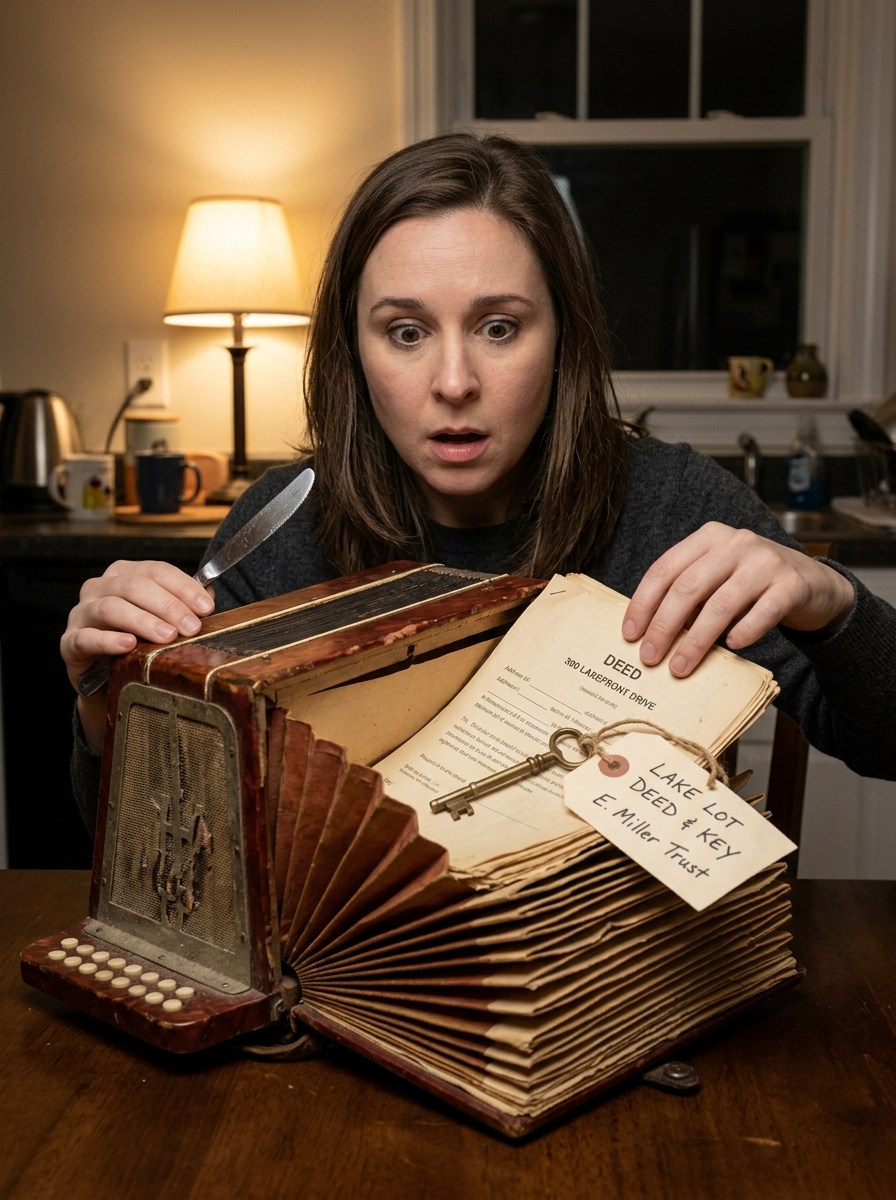
I frowned, running my fingers along the seam of the bellows where the cardboard and cloth had worn thin from thirty winters in an unheated parlor, and noticed the corner of the back plate was held down by an old brass screw that had been forced in crooked. I didn’t even think twice; I walked over to the cutlery drawer by the sink, pulled out my favorite butter knife with the slightly bent tip that I used for spreading butter on toast, and jammed the flat edge right into the seam. With a sharp little twist that nearly chipped the blade, the corner plate gave way, popping loose with a dry, papery snap that let out thirty years of accumulated dust and old cedar-chest smell. I reached two fingers inside the dark, hollow cavity beneath the bass buttons, feeling around the dusty wooden braces until my fingertips brushed against something cold, stiff, and folded thick. My breath caught right in my windpipe, a sudden hard hitch that made my chest seize up as I dragged the hidden bundle out into the dim kitchen light. Folded deep into the belly of the accordion was a thick stack of yellowed legal papers held together by a rusty paperclip, along with a heavy brass key dangling from a small square of cardboard marked with faded blue ink.
The top page was an official county deed bearing the embossed red seal of the recorder’s office, and the address typed across the top wasn’t the eighty acres on Miller Road that Lester and Ray were already planning to divide into residential lots. It was the three-acre lakefront parcel down at Clear Creek, the one beautiful stretch of pristine timber and deep water that Daddy had bought back when we were still teenagers, the piece of land my brothers had been fighting over, arguing about, and trying to wheedle out of him for the last ten years. My eyes dropped straight to the bottom line where the legal transfer was stamped and signed, and my own full legal name was typed clear as day right there as the sole, unencumbered owner. I just stood there at that kitchen table, staring down at those blue typewriter letters until the gray light outside the window turned the color of wet cement, my brain refusing to process how my name got onto a property worth more than the entire rest of the estate combined.
I sat down hard in the wooden chair, the butter knife still clutched in my right hand, and tried to remember every conversation from the five years since Mama passed away, trying to figure out how Daddy had pulled this off right under Lester’s nose without anyone in the family catching a single whiff of it.
The memory of those two years with Mama came rushing back then, unbidden and sharp as a broken Mason jar, filling the cold kitchen with the ghosts of bedpans, damp sheets, and the quiet, terrible sound of shallow breathing in the back bedroom. While Lester was busy expanding his grain-hauling business and Ray was running off to Peoria every weekend to chase some pipe-dream trucking franchise, I had packed a single duffel bag, quit my job down at the hardware store, and moved back into the tiny spare room off the kitchen. For twenty-four solid months, I was the one who lifted Mama when her hips gave out, who spooned broth into her mouth when she forgot how to swallow, and who sat by her narrow iron bed at three in the morning holding a damp washcloth against her forehead while she cried out for a childhood she had lost thirty years prior.
My brothers visited maybe once a month, always on Sunday afternoons when church let out, staying just long enough to eat whatever chicken salad I had managed to fix and to complain loudly in the hallway about how messy the farmhouse was getting under my watch. Lester had even cornered me by the root cellar one afternoon, his breath smelling of stale beer and cheap cigars, telling me I was wasting my best years wiping up after old people and that I should just put Mama in the county home down by the highway so the rest of them could move on with their lives. I didn’t cry then, and I didn’t yell at him either; I just turned my back, walked back inside the screen door, and spent the next hour helping Mama swallow her evening pills without a single complaint passing my lips.
Daddy had seen all of it, even when he pretended to be busy out in the machine shed repairing tractor hydraulics or sharpening discs until his hands were stained black with grease. He never said a word to me about the sacrifice, never sat me down to offer praise or hand me a twenty-dollar bill for groceries, because Daddy wasn’t a man given to grand emotional speeches or warm hugs. But five years ago, right around the time Mama finally let go and the house got so quiet you could hear the mice chewing inside the lath and plaster, Daddy must have taken his separate savings from the timber sales and quietly gone down to the county seat. He hadn’t told a soul, not even his poker buddies down at the grain elevator, choosing instead to put that prime waterfront acreage in my name and then bury the proof inside the one object he knew Lester and Ray would never touch, value, or suspect of containing anything more than moldy bellows and wheezing reeds.
I picked up the brass key from the table, turning it over in my palm until the sharp edges bit into the callus on my thumb, and realized that the key wasn’t just a souvenir; it was the second half of a puzzle that Daddy had left behind for me to solve on my own terms.
I didn’t call Lester, and I didn’t drive out to the farm that night, even though part of me wanted to march right up to their front doors and throw the yellowed deed right into Lester’s smug, arrogant face. Instead, I waited until Wednesday morning at nine o’clock, when the bell above the door of the County First Bank jingled as I walked into the quiet lobby that smelled of floor wax, polished mahogany, and old money. The loan officer, a polite man named Mr. Abernathy who had known my father since they served together on the rural fire board back in the seventies, looked up from his desk with a mild, professional curiosity when I laid the brass key and the small square cardboard tag right on the edge of his blotter. He picked up the tag, squinted at the faded blue ink where the words “Box 114 – Farmers Bank” were written in Daddy’s unsteady, block-letter handwriting, and his expression shifted from polite boredom to something much more guarded and serious.
He didn’t ask any questions about my brothers or the will reading from the day before, just stood up silently from his leather swivel chair, motioned for me to follow him down the carpeted corridor toward the heavy steel vault door at the back of the building, and unlocked the heavy inner sanctum with a key of his own.
The safe-deposit box slid out of the wall with a smooth, oiled hiss, revealing a long, rectangular tin box that felt surprisingly heavy when Mr. Abernathy lifted it out and set it down on the private consultation table under the harsh brass reading lamp. He left me alone in the small, windowless room, pulling the heavy oak door half shut behind him to give me privacy, and I let out a long, shaky breath that tasted of stale coffee and nerves. I slid the small key into the brass lock, turned it until it clicked with a solid, satisfying sound, and lifted the hinged lid of the tin box to see what else Daddy had left behind in the dark. Right on top lay a second, thicker envelope addressed to me in that same familiar, block-letter handwriting, along with a certified copy of the land registry showing that the Clear Creek lot had been transferred free and clear five years ago with all property taxes paid in advance through the year twenty-thirty. My fingers trembled slightly as I pulled the folded sheet of lined tablet paper out of the envelope, unfolding the creases carefully so I wouldn’t tear the fragile, yellowed paper where Daddy had written his final message to his only daughter.
The letter was short, written in those stiff, awkward sentences of a man who spent his whole life talking to livestock and machinery instead of people, but every single word hit me right in the center of my chest with the force of a hammer blow. He wrote that he knew what Lester and Ray were like, that they would strip the farm down to bare dirt and sell off every acre before the year was out, but that I was the only one who had ever stayed true to the house and to Mama when things got hard. He told me that the lake lot was mine, bought with his own timber money so I’d never have to depend on my brothers for a roof over my head or a warm meal when I got old, and he ended it with a line that made the tears finally spill over my eyelashes and drop onto the paper. “Don’t let them take it from you, Clara,” he wrote, his pen pressing so hard into the paper the ink had nearly torn through the back. “They didn’t earn an inch of it, and neither did I, but you earned every foot of that shoreline while I was too weak to watch.” I sat there in that little vault room for twenty minutes, wiping my eyes with the back of my sleeve and reading those four sentences over and over again until I knew every smudge and stroke by heart.
When I walked out of the bank with the tin box tucked securely under my arm, the November wind was blowing hard off the river, carrying the sharp, bitter scent of dead leaves and woodsmoke across Main Street. I drove my old gray pickup truck straight out toward the farm on Miller Road, my tires crunching over the gravel driveway with a loud, familiar grinding sound that I had heard every single day of my youth. Lester’s shiny red Dodge pickup and Ray’s blue sedan were both parked right by the machine shed, and through the kitchen window, I could see the two of them leaning over the enamel table with a topographical map spread out between them, arguing loudly about surveyors and timber bids. I killed the engine, climbed out of the cab without making a sound, and walked up the three wooden steps of the back porch just as Lester was slamming his hand down on the map with a loud slap that rattled the coffee mugs. I didn’t bother knocking; I just reached out, grabbed the wooden handle of the screen door, and shoved it open so hard it banged against the exterior wall with a sharp crack that made both of my brothers jump in their chairs.
Lester looked up, his face immediately twisting into that familiar, condescending sneer he reserved for when I interrupted important family business, and he didn’t waste a single second before opening his mouth to put me in my place. “What are you doing here, Clara?” he snapped, his voice sharp and impatient as he reached down to fold the map up before I could get a good look at it. “Ray and I are trying to finalize the subdivision plan for the Clear Creek acreage, and we don’t have time for you to come out here crying about the old piano or whatever else is in that box.” I didn’t say a word, didn’t flinch at his tone, and didn’t back down an inch as I walked right up to the table, pulled the certified land registry and Daddy’s original deed out of the tin box, and dropped them square in the middle of the map. I leaned my hands down on the table, looking straight into Lester’s pale, narrow eyes, and told him the truth in a voice that didn’t shake at all. “You can stop planning your subdivision, Lester, because you don’t own that lake lot, and neither does Ray, no matter how many times you argued about it over Daddy’s fence.”
Ray stood up so fast his chair tipped backward, hitting the linoleum floor with a heavy crash that sent his coffee mug rolling across the room until it smashed against the baseboard. Lester grabbed the top paper, his eyes scanning the embossed county seal and my full legal name typed neatly across the owner line, and I watched the color drain right out of his face until his skin looked the exact shade of sour milk. “This… this is a mistake,” Lester stammered, his fingers clawing at the yellowed paper like he could somehow scratch my name off the record with his fingernails. “Daddy wouldn’t do this. He knew we were supposed to get the whole spread, the whole estate, everything undivided so we could sell it as a block to the developers from Springfield!” I reached into the envelope, pulled out Daddy’s handwritten letter, and laid it right beside the deed, letting him see the familiar block letters that proved without a shadow of a doubt who the old man trusted. “He knew you inside and out, Lester,” I said, my voice dropping down into a quiet, hard register that filled the whole kitchen. “He knew you’d sell the farm out from under us the second he was cold in the ground, and he knew you wouldn’t give me a nickel of it, so he made sure I had something that belonged to me before you ever got your hands on the keys.”
Lester slammed his fists down on the table, his face turning a dark, blotchy red as the realization that he had been outsmarted by a dead man finally sank into his thick skull. “You tricked him!” he yelled, his voice cracking with fury as he leaned over the table toward me like he was going to reach across and shake me by the shoulders. “You manipulated him while Mama was sick, you poisoned his mind against us so you could steal the best piece of ground in the county!” Ray just stood there by the refrigerator, his mouth hanging open like a hooked fish, looking back and forth between Lester’s red face and the legal papers on the table without offering a single word of support to his big brother. I didn’t blink, didn’t step back, and didn’t let him intimidate me for even a second because I knew every word on those papers was as solid as the concrete foundation beneath our feet. “I stayed here for two years while you two were out living your lives, Lester,” I said, my voice cold and steady as I looked him dead in the eye. “You can scream all you want, you can hire every lawyer in the state of Illinois, but that deed is recorded, the taxes are paid, and that land is mine.”
Lester snatched up the letter, his eyes darting frantically across Daddy’s awkward handwriting as if he hoped to find some loophole, some technicality that would give him back the prize he had spent ten years counting on. But there wasn’t any loophole, and when he realized that Daddy had outmaneuvered him completely from beyond the grave, he threw the paper down on the floor, turned on his heel, and stormed out the back door without saying another word. Ray looked at me once, a strange, complicated expression crossing his face like he was trying to figure out how he had gotten himself mixed up in Lester’s schemes, before he grabbed his jacket off the peg by the door and hurried out after his brother. I watched their trucks kick up two long tails of gray gravel as they tore down the driveway, their tail-lights disappearing around the bend by the old corn crib until the farm was finally, truly quiet for the first time in ten years. I bent down, picked Daddy’s letter up off the floor, smoothed the creases out against my palm with infinite care, and slid it back into the tin box right alongside the brass key and the deed.
That was three weeks ago, and now the snow has started to settle over the hills around Clear Creek, turning the timber into a clean, silent landscape of white and gray. I didn’t keep the old farmhouse, I let Lester and Ray have their precious eighty acres and their ninety-six thousand dollars in CDs, because keeping that drafty old place would have just meant living among ghosts and bitter memories. Instead, I moved out here to the lakefront lot into the small, sturdy cedar-sided cabin that Daddy had built years ago as a hunting shack, fixing the roof and painting the porch rail a bright, clean white. I sit out here on the wooden bench at the edge of the water every afternoon just as the sun starts dropping behind the ridge, watching the gray ripples lap softly against the wooden pilings of the dock. The old accordion rests right on my lap, the mother-of-pearl keys catching the last pale sliver of daylight while the gray bellows rise and fall under my hands as I pull a clean, warm chord out into the freezing evening air.