The betrayal that hurt the most didn’t come from my husband of twenty-six years; it came from the one person I had paid to protect me. We were exactly three weeks away from our final divorce trial when my phone buzzed on the kitchen counter. It was an email from my high-priced attorney, Evelyn. Without a single phone call or warning, she was formally withdrawing from my case. Her explanation was written in cold, sterile legalese, but the core message was clear: she claimed my case was “too complicated” and “emotionally draining.” I sat alone at my dining room table in a quiet suburb of Columbus, Ohio, clutching the printed email as tears of absolute devastation blurred my vision.
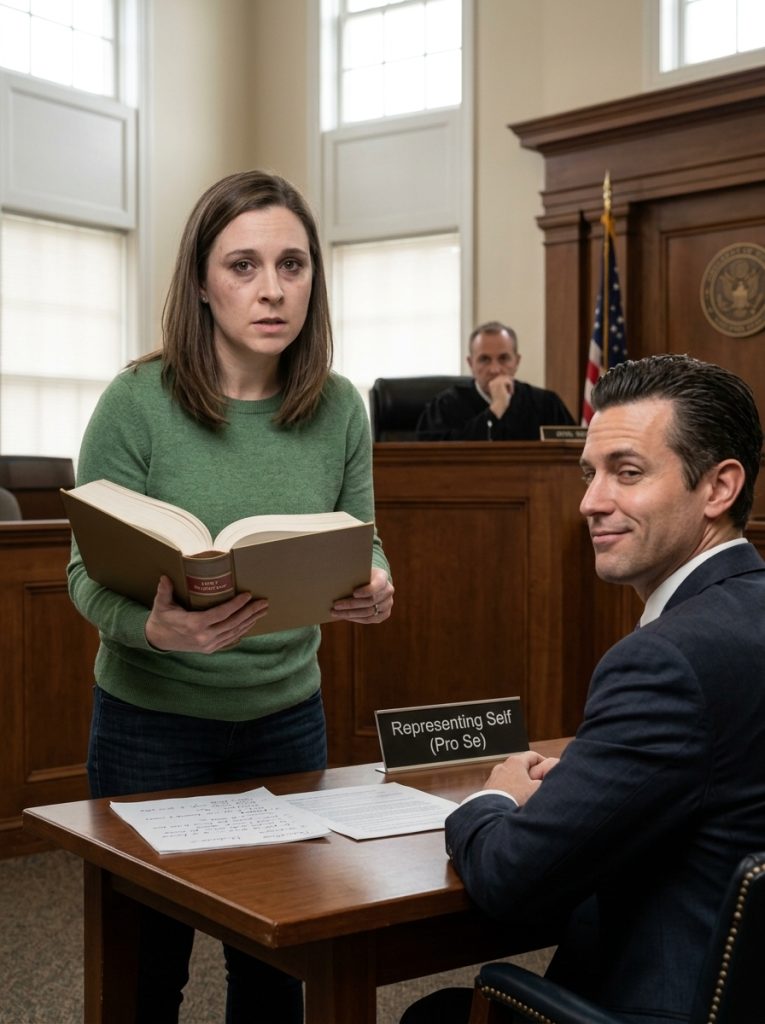
My ex-husband, Richard, had spent the last two years hiding marital assets, draining our joint accounts, and turning our social circle against me. He had hired a ruthless, prestigious law firm whose lead attorney charged a staggering $500 an hour. I had completely exhausted my modest life savings just to pay Evelyn’s retaining fees, and now, at the absolute eleventh hour, I was left utterly exposed and entirely broke.
I couldn’t afford to hire another lawyer. Every professional I called demanded a massive upfront fee that I simply did not have. For twenty-four hours, the paralyzing weight of defeat settled over me. I faced the very real, terrifying prospect of losing primary custody of my teenage daughter and being left entirely destitute after a lifetime of hard work and sacrifice.
But as I looked at my daughter sleeping peacefully in her room that night, a sudden, fierce spark of maternal survival ignited deep within my chest. I realized that no one was coming to save me. If I wanted justice, I was going to have to fight for it myself.
I wiped away my tears, marched down to the local county law library the very next morning, and checked out a towering stack of family law statutes, legal dictionaries, and civil procedure manuals. I was fifty-one years old, with no legal background whatsoever, but I possessed a weapon Richard’s expensive legal team underestimated: a mother’s absolute refusal to back down.
The next three weeks became a blur of midnight coffee, tear-stained pages, and exhaustive legal research. While Richard assumed I was cowering in fear, preparing to sign whatever lowball settlement offer he threw my way, I transformed my living room into a war room.
I stayed up until three o’clock every morning reading dense Ohio family law codes, studying court rules down to the margins, and cross-referencing past case precedents that matched Richard’s financial trickery. I organized months of bank statements, tax returns, and hidden property records into perfectly indexed, legally compliant evidence binders. Every single morning, I stood in front of my bathroom mirror, my voice trembling at first, practicing my opening statement until the words became sharp, confident, and steady.
When the morning of the trial finally arrived, the heavy mahogany doors of the courtroom felt incredibly intimidating. I sat down at the plaintiff’s table, completely alone, wearing my best professional navy suit. Moments later, Richard walked in, accompanied by his high-priced, $500-an-hour attorney, a man named Mr. Vance. Vance adjusted his expensive gold cufflinks and looked across the aisle at me with a smirk that was openly mocking. He treated my solo presence like a pathetic joke, leaning over to whisper something to Richard that made them both chuckle softly. They truly believed they were about to steamroll a defenseless, desperate housewife.
But the moment the judge took the bench and called the session to order, the joke was officially over. When it was my turn to speak, I didn’t stammer, and I didn’t let my emotions take control. I stood up straight, focused my eyes directly on the judge, and delivered my opening statement with a flawless, clinical precision. I submitted my financial evidence binders according to the exact rules of civil procedure I had memorized just days prior. I watched the smirk slowly vanish from Mr. Vance’s face as he realized I wasn’t an easy target; I was an opponent who had come fully prepared to fight.
The true turning point of the trial occurred during the high-stakes cross-examination. Mr. Vance stepped up to the podium, his demeanor shifting from smug amusement to aggressive frustration. He launched into a complex, highly manipulative legal trap regarding child custody and asset valuation, deliberately weaving confusing terminology to trip me up and make me contradict my own filings. Richard watched from his seat, a confident grin returning to his face as his attorney tightened the legal knot around me.
I took a slow, deep breath, anchoring myself against the wooden podium. I refused to let the panic take hold. I waited patiently until Mr. Vance finished his long, theatrical question.
Then, I looked directly at the judge and spoke in a calm, level tone that echoed beautifully in the quiet courtroom. “Your Honor, opposing counsel’s argument relies on an interpretation of asset distribution that was explicitly overturned by the Ohio Supreme Court.
In the landmark case of *Holcomb v. Holcomb* from 1987, the court ruled that a spouse cannot systematically deplete marital equity prior to filing without facing an immediate financial offset. Mr. Vance’s line of questioning directly contradicts that established precedent.”
The courtroom fell into a dead, absolute silence. Mr. Vance froze in mid-stride, his face turning an angry, mottled red as he frantically flipped through his legal pads. He had absolutely no rebuttal.
The judge paused, looked over his glasses at me, and a genuine, highly unusual smile broke across his stern face. He looked down at Richard’s expensive attorney and said, “Mr. Vance, it appears the plaintiff has just corrected your understanding of the law. Please move on to your next point.” In that incredible second, I knew the power dynamic had permanently shifted. I had beaten them at their own game.
When the final judgment was handed down a week later, the victory was more absolute than I had ever dared to dream. The judge ruled heavily in my favor, awarding me primary custody of my daughter, the family home, and a full sixty percent of our total marital assets to compensate for Richard’s financial deception. More than the money or the property, I had won the absolute respect of every seasoned attorney sitting in the gallery that morning.
As I was packing up my evidence binders, the judge called me up to the bench. He looked down at me with a profound, warm sincerity and said words that would permanently re-write the trajectory of my life: “Ma’am, you handled yourself better than half the professionals who argue in this room. You should go to law school.”
I took those words to heart. That very summer, fueled by the realization of my own untapped strength, I took the entrance exams. I started my very first semester of law school that exact fall at the age of fifty-one.
Today, the terror and helplessness I felt when my divorce attorney quit on me feels like a lifetime ago. I am no longer the vulnerable woman who was left broke and abandoned on the eve of a trial. I am a licensed family law attorney running my own dedicated practice, specifically representing older women who find themselves facing the exact same terrifying legal isolation I once endured.
I learned that the worst moments of our lives are often just fierce, painful invitations to discover who we are truly meant to be, proving that sometimes, when the world abandons you in the dark, it only forces you to find your own brilliant light.