“This is my son’s house!” she screamed, left me bleeding on the floor. I didn’t scream or call my husband. I calmly picked up the keys from the floor. By that afternoon, every exterior lock had been changed. And there was only one name on the property deed. Mine.
I didn’t realize then that the joke was a quiet, festering resentment wrapped in a tuxedo.
The real trouble began three years into our marriage, entirely by design, though it was presented as a tragic accident. Mark’s mother, Diane, called us in hysterics one rainy Tuesday evening. She claimed her luxury downtown condo had suffered catastrophic water damage due to a burst pipe on the floor above. The drywall was ruined, the carpets were a biohazard, and she needed a place to stay for “just two weeks” while the contractors gutted the place.
I didn’t hesitate. I prepared the sprawling guest room on the east wing, filling the vases with fresh hydrangeas and putting out the Egyptian cotton towels.
Two weeks bled into two months. Then four. The polite, fragile facade of a displaced, grateful mother-in-law evaporated with agonizing slowness, revealing a chilling, territorial entitlement that made the air in my own home feel thin and difficult to breathe.
Diane didn’t just occupy space; she invaded it. It started small. I would come home from my architectural firm to find my carefully organized kitchen pantry rearranged according to her bizarre preferences. The heavy cast-iron skillets I used daily were shoved into the back of lower cabinets, replaced by her cheap, non-stick pans. Then, she annexed the main hallway coat closet, unceremoniously dumping my winter wool coats into the damp, unfinished basement to make room for her extensive, suffocating collection of vintage furs.
But the true violation, the one that made a cold dread coil in the pit of my stomach, began when she started crossing the threshold of my private sanctuary: the master bedroom.
I am a meticulous person. I know the exact angle of the area rug. I know the precise order of the financial dossiers stacked on my antique mahogany desk. Twice in one month, I returned from work to find the heavy oak door of our bedroom slightly ajar. Twice, I noticed that the neat stacks of tax returns and property documents on my desk had been subtly shifted, as if someone had hastily ruffled through them and tried to put them back from memory.
When I confronted Mark about it in the kitchen one evening, the hum of the refrigerator suddenly seemed deafening. He didn’t even look up from his tablet.
“She’s family, Sarah,” he sighed, the patronizing tone scraping against my nerves like sandpaper. “You’re being paranoid and territorial over nothing. She was probably just looking for a spare phone charger or a pen.”
I wasn’t crazy. I knew exactly how I left my things. And I knew the difference between a mother looking for a charger and a predator searching for a weak point.
So, I did what any sane woman protecting her grandmother’s legacy would do. I waited until they were both out of the house, and I quietly installed a high-definition, motion-activated security camera in the upstairs hallway. It was hidden seamlessly within the crown molding, angled perfectly to capture the master bedroom door.
I told myself I was just looking for peace of mind. I told myself I just needed proof of her snooping so Mark would finally set a boundary. I didn’t expect the camera to trigger an alert so soon. And I certainly didn’t expect to uncover a conspiracy that would rip the foundation of my life down to the studs.
It was a Tuesday afternoon. I had left the office early due to a blinding migraine that made the blueprints on my screen swim. The house was dead quiet when I slipped through the heavy front doors, kicking off my heels to avoid making noise on the parquet floor.
As I crept up the carpeted stairs, pressing my fingers to my throbbing temples, my heart suddenly seized in my chest.
The door to the master bedroom was wide open.
I stepped silently into the doorway. Diane wasn’t looking for a pen.
She was standing over my mahogany desk, the bottom drawer—the one I kept locked, the one holding my passport, my birth certificate, and the original, watermarked deed to Oakridge—pulled all the way out. Her manicured hands were frantically shuffling through a thick manila envelope, her breathing shallow and ragged.
“What the hell are you doing?”
My voice sliced through the silence of the bedroom, sharp and trembling with an adrenaline spike that instantly obliterated my migraine.
Diane jumped violently, spinning around so fast her hip caught the edge of the desk. She nearly knocked over a silver-framed photograph of Grandma Eleanor. Her face, usually powdered to a flawless, porcelain finish, drained of color, then rapidly flushed with an ugly, defensive crimson.
In her left hand, crushed in her panicked grip, was a stack of papers I didn’t recognize. It didn’t look like my deed. It looked like a multi-page bank form, thick with dense, legal typography.
“This is my son’s house!” she snapped, her voice shrill, attempting to mask her absolute terror with unearned, vicious authority. “You don’t get to sneak up on me in my own family’s home! You don’t get to tell me where I can go!”
“Put it down,” I demanded, taking a slow, deliberate step forward. The air in the room felt electric, heavy with the impending collision. I reached out to grab the papers she was attempting to crush behind her back.
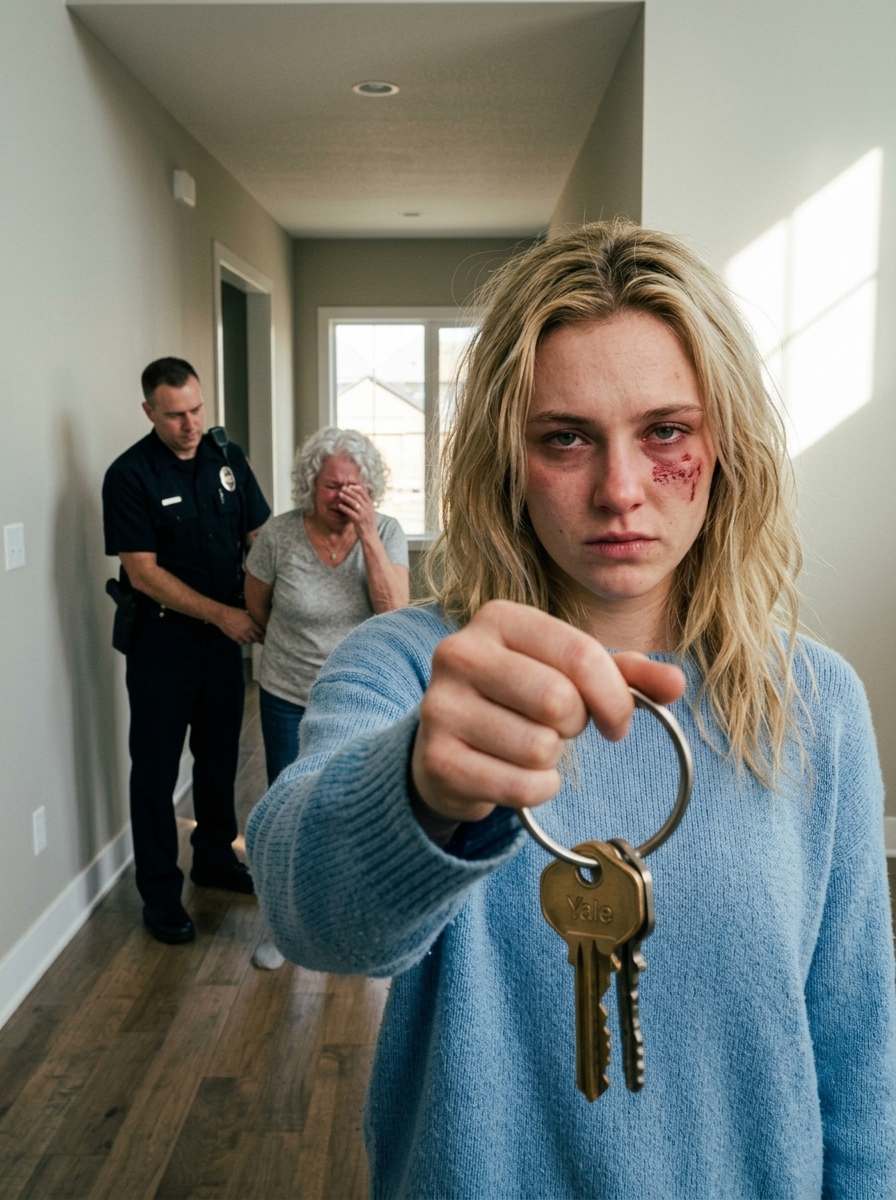
She yanked her hand away with a feral hiss. In her blind panic, her eyes darted to the top of the desk. She reached for the nearest, heaviest object she could find—my solid brass keychain, the one holding the heavy spare deadbolt keys to the estate’s iron gates.
With a guttural sound of pure spite, she hurled the cluster of brass directly at my face.
There was no time to duck. The heavy metal struck my right cheekbone with a sickening, hollow crack. The impact instantly shattered the right lens of my reading glasses. Shards of polycarbonate glass and jagged brass teeth bit deeply into my skin.
I staggered backward, a sharp cry tearing from my throat. A hot, wet ribbon of blood immediately began trailing down my cheek, dripping onto the collar of my silk blouse. My vision swam, tears springing to my eyes not just from the blunt force of the blow, but from the sheer, incomprehensible shock of the violence.
Diane didn’t gasp. She didn’t drop to her knees in apology. She used my moment of blinding disorientation to lower her shoulder and push past me, her heavy perfume filling my nostrils as she sprinted out of the room and thundered down the stairs.
I slumped against the doorframe, pressing my trembling hand to my bleeding cheek. My heart was hammering against my ribs like a trapped bird. As my vision slowly cleared, blinking away the blood and tears, I looked down at the hardwood floor where the keys had landed.
Right next to the brass ring, dropped in her frantic, violent escape, was a single sheet of paper from the stack she had been clutching.
I slowly sank to my knees, my blood spotting the floorboards, and picked it up with shaking fingers.
It was the signature page of a Home Equity Line of Credit application. The primary borrower listed was Mark. The co-borrower listed was me.
At the bottom of the page, on the line designated for my signature, my name was already signed in dark blue ink. It was a perfect, flawless forgery.
The locksmith arrived within forty-five minutes. By the time Mark’s car pulled into the sweeping circular driveway that evening, every single exterior lock on Oakridge had been replaced. The smart-keypad on the back door had a new, randomized cipher.
I stood motionless in the kitchen, a stark white butterfly bandage securing the jagged, throbbing cut on my cheekbone, holding two shiny new keys in my palm.
I watched through the window as Diane paced the driveway, her arms crossed tightly over her chest, locked out in the evening chill. When Mark walked up to the porch, he looked through the glass pane at my bruised, bandaged face, then turned to look at his mother pacing on the asphalt.
He unlocked the old door, found it jammed, and knocked. I opened it.
“Sarah, what is this?” Mark asked, his eyes darting from my bloody blouse to the new deadbolt. “She shouldn’t have thrown anything, I know. But changing every lock in the house? This is extreme, even for you. It was an accident. She tripped and knocked the keys off the desk.”
An accident.
The words echoed in my head, a hollow, ringing sound. I looked at the man I had promised my life to. He hadn’t asked if I needed an ambulance. He hadn’t asked if my eye was permanently damaged. He was only focused on mitigating the consequences for his mother.
I placed his new key flat on the cold granite counter.
“This lets you into your home,” I said, my voice eerily devoid of emotion. “It does not give your mother permission to enter our bedroom. She is no longer welcome to stay here. She needs to pack.”
Mark stared at the key, his jaw tightening into a hard line of defiance. “She’s my mother, Sarah. You’re being paranoid and vindictive over a scratch.”
He snatched the key from the granite and walked out to let her in through the front. That night, Diane slept in the guest room, but the atmosphere in the house had shifted from tense to fundamentally broken.
I didn’t confront him about the forged loan document. Not yet. If Mark was forging my signature to take out massive loans against my grandmother’s estate, I needed to know the full, horrifying extent of the rot before I swung the axe. I knew that if I showed my hand too early, they would shred the evidence and gaslight me into an asylum.
I lay awake in the dark, listening to Mark’s rhythmic, oblivious snoring beside me. The digital clock on the nightstand clicked to 2:00 AM.
I slipped out from under the duvet. I crept downstairs to his home office, retrieving his heavy, silver laptop. I took it into the downstairs powder room, locking the door and turning the screen brightness all the way down.
I knew his password. It used to be the date of our anniversary. I typed it in. Incorrect.
A cold, cynical dread washed over me. I tried his mother’s birthday.
Access granted.
For the next three hours, I sat on the freezing hexagonal tiles of the bathroom floor, the blue light of the laptop illuminating my bruised face as I sifted through his private emails and encrypted messaging apps.
What I found made the blood in my veins run icy cold. It felt as if a fault line had cracked open right through the center of my chest.
Diane’s luxury condo hadn’t flooded. That was a pathetic, easily disprovable lie. It was in active, aggressive foreclosure. Over the past three years, she had accumulated over two hundred and fifty thousand dollars in illicit gambling debts, playing high-stakes baccarat in underground rooms. She had borrowed heavily from unsavory, dangerous lenders who were now threatening to break her legs—and Mark’s—if they didn’t see a massive balloon payment by the end of the month.
I opened his banking app. Mark had been secretly draining our joint savings account, the money we had earmarked for future children, to pay her minimums for eight months. But it wasn’t enough. It was like throwing pebbles into a canyon.
Then, I found the email thread with a shady, unlicensed mortgage broker operating out of a strip mall two towns over.
Mark had applied for a massive, high-interest equity loan against Oakridge to pay off Diane’s debts in full. But because my name—and only my name—was on the deed, the bank required my signature on the application. Furthermore, the underwriter had flagged the application last week. They wouldn’t approve the loan release unless Mark was officially added to the property title.
They needed a Quitclaim Deed.
Diane hadn’t just been snooping for a charger. She was desperately searching for my official government ID and my original property deed to complete a fraudulent notary packet. The paper she had dropped was the master application, complete with my forged signature, ready to be submitted once the deed was altered.
I didn’t cry. The betrayal was too absolute, too profound for tears. It bypassed sorrow and settled directly into a cold, diamond-hard rage.
I took screenshots of everything. Every email, every bank transfer, every frantic text message where Diane told Mark, “She doesn’t deserve that big empty house anyway, she’s just a spoiled brat. Just get the deed signed, Mark.” I forwarded all of it to a secure, encrypted cloud server that only I had access to.
The next morning, I took a half-day off work. I drove downtown, bypassing my office, and walked into the immaculate, glass-walled firm of Rachel Kim, the most ruthless family law and property attorney in the state.
Rachel sat behind a massive slab of a marble desk. She reviewed the forged loan document I had recovered from the floor, scrutinized the high-definition photos of my bruised, bloody face, and methodically read through the printed stack of emails I had liberated from Mark’s hard drive.
She didn’t blink. She didn’t offer hollow sympathies. She just steepled her manicured fingers and looked at me with predatory calm.
“The house is yours, ironclad,” Rachel said, her voice smooth like polished obsidian. “The financial maneuvering is felony wire fraud and attempted mortgage fraud. The physical attack is assault with a deadly weapon. The question is, Sarah, how do you want to play this? Because I can dismantle his life by tomorrow morning.”
“I want them out,” I said, my voice steady, surprising even myself. “And I want him to leave with absolutely nothing. But I want them to know exactly why it’s happening.”
Rachel a slow, terrifying smile. “Then we wait. He’s desperate. The deadline for his mother’s debt is approaching. He’s going to make a clumsy move to get you to sign that Quitclaim Deed. When he sets the trap, we close the jaws.”
I returned to Oakridge and played the part of the traumatized, silent wife for three agonizing days. Diane behaved like a hotel guest who expected to inherit the establishment, slamming cabinets and glaring at me over her morning coffee. Mark was overly attentive, sweating through his shirts, constantly trying to massage my shoulders and talk about “our shared future.”
I endured the psychological warfare, knowing the fuse was already lit.
I didn’t have to wait long.
Friday afternoon, while I was wrapping up a meeting at my firm, my phone vibrated violently against the wood of my desk. An alert from the front doorbell camera.
I opened the app under the table. The live feed showed Mark unlocking the heavy front door. Behind him was Diane, wearing her best pearls.
And trailing behind them both, looking nervously over his shoulder, was a third person—a tall, heavily sweating man in a cheap, ill-fitting suit, clutching a thick leather briefcase to his chest.
A second later, a text from Mark popped onto my screen: “Hey honey. Having a special romantic dinner tonight at the house. Be home by 6:00 sharp. We really need to talk about our family’s future.”
The trap was set. My pulse hammered in my throat.
I pulled my car into the driveway at exactly 5:55 PM. I sat behind the steering wheel for a long moment, the engine ticking as it cooled. I gripped the leather steering wheel until my knuckles turned white, taking deep, measured breaths, letting the cool air conditioning dry the nervous sweat on my forehead.
I wasn’t the victim anymore. I was the architect of their ruin.
When I pushed open the front doors and walked into the dining room, the scene was meticulously, sickeningly staged. A roasted chicken, undoubtedly ordered from the expensive deli downtown, sat in the center of the long mahogany table. It was flanked by two bottles of vintage Cabernet that Mark had paid for with my credit card.
Diane was sitting at the far end of the table, wearing a sickly-sweet, maternal smile that didn’t reach her cold, calculating eyes.
Mark stood up immediately, rushing over to pull out a chair for me at the head of the table. “Sarah, you’re home. You look beautiful. Sit, please.”
I ignored the chair he pulled out and chose the one opposite him. I noticed the stranger sitting adjacent to Mark. The man wiped his sweaty forehead with a linen napkin and offered a tight, nervous nod, avoiding eye contact with my bandaged cheek.
“Sarah, this is Greg,” Mark said, pouring a heavy, trembling glass of wine and sliding it across the polished wood toward me. “He’s an old college buddy of mine. We ran into each other today. He’s also a licensed public notary.”
“A notary,” I repeated flatly, leaving the wine untouched. “How incredibly convenient for a Friday night family dinner.”
“Well,” Mark sighed, putting on his absolute best ‘concerned, loving husband’ face. He sat down and leaned forward, clasping his hands together in a prayer-like gesture. “With everything that’s happened this week… the stress, the fighting, your accident… it made me realize how vulnerable we both are. If something happens to you, Sarah, I have absolutely no legal rights to this house. The state would take it. We’re a team. A marriage is about sharing everything, protecting each other.”
He reached into the breast pocket of his jacket and pulled out a pristine manila folder. He slid it across the table. It stopped right in front of my empty dinner plate.
“This is a Quitclaim Deed,” Mark said softly, his eyes boring into mine, trying to project sincerity. “It just adds my name to the title of Oakridge. It proves that we’re in this together. That you trust me as the man of the house. Greg is here to notarize it tonight, just to save us a stressful trip to the bank on Monday.”
I looked from Mark, to the sweating notary clutching his stamp in his pocket, and finally to Diane. She was leaning so far forward in her chair she was practically salivating over the roasted chicken.
“A wife who truly respects her husband doesn’t keep secrets or hoard assets,” Diane chimed in, her voice dripping with venomous honey. “Just sign the paper, Sarah. Put this ugly business behind us so we can be a real family.”
They had boxed me in perfectly. They thought the social pressure of a stranger sitting at the dinner table, combined with Mark’s emotional manipulation and my recent trauma, would force me to fold. They thought I was the same quiet, compliant girl who just wanted everyone to get along.
I slowly opened the folder. The document was crisp and legally binding. A single line for my signature waited at the bottom. Beside it, a blank space for Greg’s official stamp.
“Mark,” I said softly, tracing the sharp edge of the paper with my index finger. “Did you give your mother a copy of your new key?”
Mark blinked, completely thrown off by the pivot. “What? No, Sarah, this isn’t about the locks—”
“Did you forge my signature on a Home Equity loan application to pay off her two hundred and fifty thousand dollar underground gambling debt?”
The air in the dining room instantly evaporated. The silence that followed was so profound, so heavy, that I could hear the faint ticking of the grandfather clock in the hallway.
Mark’s face went chalk-white. The blood drained from his lips, leaving him looking like a corpse. Greg, the notary, suddenly looked like he wanted the floorboards to open up and swallow him whole. He began slowly, meticulously zipping up his leather briefcase.
Diane slammed her palm flat against the table, rattling the expensive silverware. “How dare you! You snooping, ungrateful little bitch—”
“I asked him a question, Diane,” I snapped, my voice cracking through the room like a bullwhip. I looked back at my husband, pinning him down with my stare. “Did you?”
Mark swallowed hard, his Adam’s apple bobbing in his throat. His mask of the loving husband shattered into a million pieces, replaced by a cornered, desperate animal. “You… you don’t understand, Sarah. Those people were going to hurt her. They were going to come here! I had to do something. We’re married! Your assets are my assets!”
“No, Mark,” I said, my voice eerily calm as I reached into my purse. “My grandmother’s house is my asset. You just tried to steal it to cover her crimes.”
“You are going to sign that paper right now!” Diane hissed, standing up from her chair, her face contorted with a feral rage. “You owe us! We are your family! You have more money than you know what to do with!”
“I don’t owe you a damn thing.”
I picked up the sleek, silver pen Mark had provided. I held it over the signature line. Mark exhaled a shaky, pathetic breath of relief, actually believing I was breaking under the pressure.
But I didn’t press the pen to the paper. Instead, I pulled my smartphone from my purse and unlocked the screen. My thumb hovered over the ‘Cast to Living Room TV’ icon.
“Greg,” I said, looking directly at the sweating notary without breaking eye contact. “I highly suggest you leave this property before the police arrive. Because what happens in the next sixty seconds is going to make you an accessory to federal felony fraud.”
Greg didn’t need to be told twice. He scrambled out of his chair so fast it tipped over backwards, crashing onto the hardwood. He didn’t even apologize. He sprinted for the front doors, his cheap shoes slipping on the rug, and bolted out into the night. The heavy thud of the oak door closing echoed through the house.
Mark jumped up, lunging across the table, knocking over his wine glass in a desperate attempt to grab my phone. “What are you doing? Give me that!”
I took a swift step back, completely out of his reach, and tapped the cast button.
In the adjacent, open-concept living room, the massive 75-inch smart TV flared to life. The audio connected immediately to the ceiling surround sound speakers.
“This is my son’s house! You don’t get to tell me where I can go!”
Diane’s shrill, terrified voice blasted through the entire first floor of the estate. Mark froze mid-lunge. Diane whipped her head around to look at the massive screen in the next room.
There, in crystal clear, high-definition video, was the security footage from Tuesday afternoon. It showed Diane violently rummaging through my desk drawer. It showed her clutching the forged loan application. And then, it showed the violent, terrifying moment she hurled the heavy brass keys directly into my face.
The heavy, sickening sound of the keys hitting my cheekbone, followed by my sharp cry of pain, filled the dining room.
Mark turned to his mother, his mouth hanging open in absolute horror. “You… you told me she tripped. You told me she fell against the edge of the desk!”
“It… it’s a fake! She faked the video!” Diane stammered, backing away from the table, her eyes wide with a manic panic. She looked like a trapped rat.
I tapped the screen again. The video disappeared, replaced by a curated slideshow of screenshots Rachel Kim had helped me organize.
First, Mark’s emails with the predatory lenders, begging for more time. Then, the threatening texts from the loan sharks outlining exactly what they would do to Diane’s kneecaps. Finally, the correspondence with the crooked mortgage broker explicitly discussing the forged signature and the desperate need for the Quitclaim deed to bypass the bank’s security checks.
“You thought I was just some naive, sentimental girl protecting a pile of bricks,” I said, my voice vibrating with adrenaline and a cold, hollow victory. “You thought you could bleed me dry and mortgage my legacy to cover her gambling addiction. But you got sloppy, Mark.”
“Sarah, please,” Mark pleaded. He fell to his knees beside the dining table, holding his hands up in a pathetic gesture of surrender. The arrogance was completely gone, replaced by pure, unadulterated fear. “I was desperate. They were threatening to kill her. I just needed the equity to clear the debt, and I was going to pay it back! I swear on my life I was going to pay you back!”
“You committed wire fraud, identity theft, and attempted mortgage fraud,” I recited, echoing Rachel Kim’s legal assessment word for word. “And your mother committed assault with a deadly weapon.”
“You wouldn’t,” Diane sneered, though her voice was shaking so badly she could barely form the words. “You wouldn’t send your own husband to a federal prison over money.”
Right on cue, the strobing red and blue flashing lights of two local squad cars illuminated the sheer curtains of the dining room windows, casting a chaotic, eerie glow across Mark’s terrified face.
I had called them from my car before I even walked into the house, providing the incident number from the assault report I had quietly filed on Wednesday morning, and notifying the dispatcher that the perpetrator was currently trespassing in my home and attempting financial extortion.
The heavy brass knocker on the front door pounded. It sounded like the gavel of a judge.
“I didn’t do it over money, Mark,” I said softly, stepping over the spilled wine and walking past him toward the entryway. “I did it because this is my home. And neither of you are welcome in it.”
I swung the heavy doors open. Two uniformed police officers stood on the porch, their hands resting cautiously on their belts.
“Ma’am, we received a call regarding a trespasser and a prior aggravated assault?” the lead officer asked, his eyes taking in my bandaged face.
“Yes, officers,” I said, stepping aside and pointing into the dining room, where Mark was still kneeling and Diane was hyperventilating. “The woman by the table assaulted me on Tuesday. I have the video evidence queued up on the television for you. And the man on the floor has been forging my signature on federal financial documents.”
The officers stepped inside, the heavy thud of their boots signaling the end of Mark’s reign. The atmosphere instantly shifted from a domestic dispute to an active crime scene. They separated Mark and Diane immediately. When the lead officer watched the video of the keys striking my face, his professional demeanor hardened into ice.
“Diane, turn around and place your hands behind your back,” the officer commanded, pulling his cuffs.
Diane began to wail, a horrible, high-pitched, scraping sound that grated against the walls. “Mark! Mark, do something! Don’t let them take me! I’m your mother!”
Mark couldn’t look at her. He was busy being read his Miranda rights by the second officer regarding the financial fraud and extortion. As they clicked the steel handcuffs onto his wrists, pulling his arms behind his tailored suit jacket, he turned his head slowly to look at me. His eyes were dark, filled with a sudden, venomous hatred that chilled me to the bone.
“You think you’ve won, Sarah?” Mark spat out, as the officer forcefully guided him toward the door. “We’re still married. Half of everything is still legally mine. I’ll drag you through the courts for a decade. I’ll burn this damn house to the ground before I let you keep it!”
I stood in the doorway, the cool night air rushing over my face, and watched them get shoved into the back of separate patrol cars.
Mark’s threat of burning my life to the ground turned out to be nothing more than the desperate, hollow bluff of a ruined man.
The legal battle was shockingly brief, mostly because Rachel Kim operated like a surgeon with a rusty scalpel, and Mark had handed her the very tools needed to dissect him. The irrefutable evidence of felony fraud, combined with the permanent protective order I easily secured against Diane due to the video of the assault, meant Mark had absolutely zero leverage in the divorce proceedings.
He tried, predictably, to argue that he had contributed to the household financially over the past three years, entitling him to a massive payout of equity. Rachel calmly placed his bank statements on the mahogany conference table during our single mediation session. She traced every penny of his so-called “contributions” straight out of our joint account and directly into the pockets of his mother’s bookies. He hadn’t contributed to the house; he had actively, systematically stolen from our shared assets.
Faced with the very real threat of me pressing federal charges for the forged HELOC application, Mark’s sleazy, overworked attorney advised him to take the absolute bare-minimum deal we offered and run. He walked away with his leased sedan, his heavily depleted 401k, and the crushing, inescapable weight of his mother’s criminal debts.
Diane accepted a plea deal for the assault to avoid serving jail time in a state facility. She was placed on strict probation, hit with heavy punitive fines that she couldn’t pay, and slapped with a permanent restraining order. I heard through the grapevine months later that her condo was eventually seized by the bank, and she and Mark were forced to co-sign on a cramped, dingy two-bedroom apartment on the industrial side of the city.
As for me, I stayed exactly where I belonged.
Six months after the flashing police lights faded from my driveway, Oakridge finally felt like it was breathing again. The suffocating, toxic tension that had seeped into the drywall during Diane’s occupation was scrubbed clean.
I repainted the master bedroom a serene, pale blue, erasing the memory of the blood on the floor. I bought a new, stronger set of reading glasses. The mahogany desk stayed exactly where Grandma Eleanor had left it, the heavy drawers firmly locked, holding my documents safe and secure.
On the first warm, golden Saturday of spring, I called the locksmith back to the estate. There was no emergency this time. I was simply having a modern, biometric smart-lock system installed on the back garden doors to match the front gates.
The locksmith, a burly man with calloused hands and a kind smile, recognized me immediately. He finished installing the sleek black hardware, wiped his hands on a rag, and tested the fingerprint scanner.
“All set, ma’am,” he said, packing his tools into his canvas bag. He paused and looked at me, a knowing, respectful glint in his eye. “How many user profiles do you need programmed into the system this time?”
I stood in the sunlit hallway, the warm breeze drifting in from the garden, carrying the scent of blooming jasmine. I listened to the absolute, beautiful silence of my home. No slamming cabinets. No whispered conspiracies. No footsteps that didn’t belong to me. Just absolute peace.
I smiled, feeling the faint, faded scar on my cheekbone stretch slightly—a badge of survival.
“Just one,” I replied, my voice strong and clear.
He nodded, handing me the master control fob. “For now?”
I looked around the house, my fortress, my legacy. I had fought for it, bled for it, and won. The coup d’état was over, and the queen remained on the board.
“For now, one is perfect.”