PART 1“If you tell your mom what happened, it might be the last time you ever see me.”
I didn’t hear that recorded sentence until the following morning. But when my seven-year-old daughter, Elena, walked through my front door that afternoon, her small body was already telling me that something terrible had taken place.
Her father, Julian, dropped her off after what he had promised would be a “special father-daughter day.”
“She fell off a swing,” he explained with a calm, casual tone that made the hairs on my arms stand up. “Nothing serious.”
Elena didn’t say a single word.
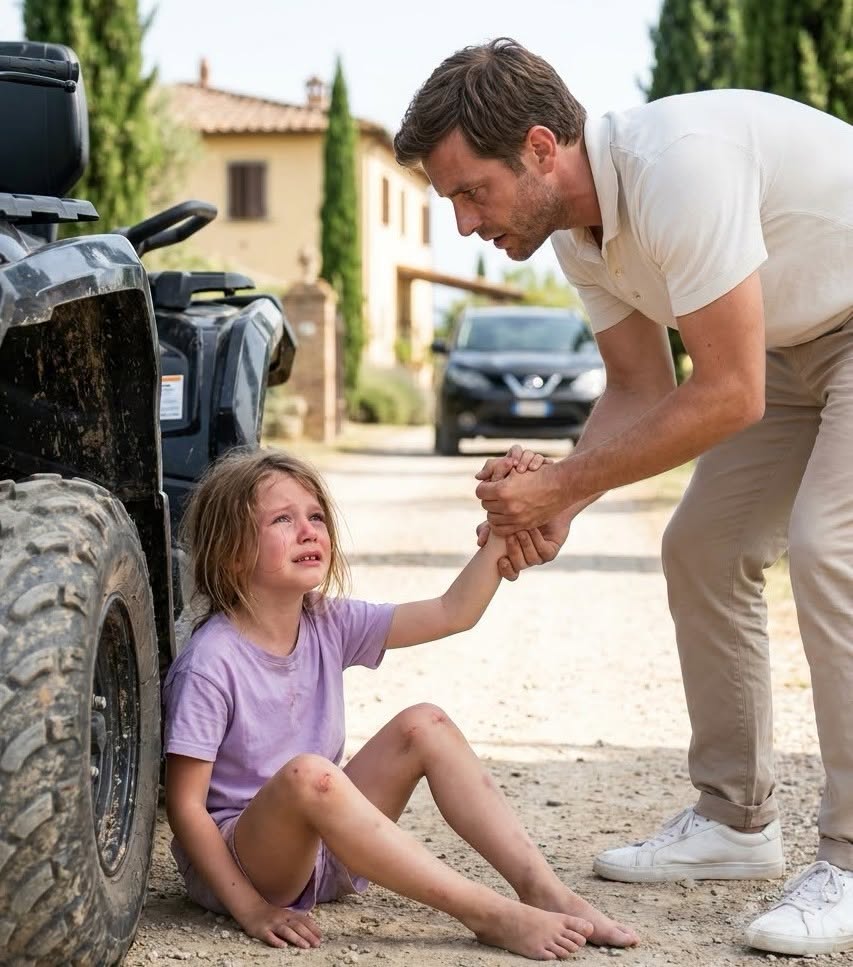
That was the first detail that didn’t fit. Normally, she came back from her weekend visits talking non-stop—what they had eaten, what songs played in his truck, what silly joke he had told. But that afternoon, she wore a oversized gray hoodie even though it was warm outside.
“Are you okay, sweetie?” I asked gently.
She nodded silently, looking straight down at the floor.
Julian placed a firm hand on her shoulder. “She’s totally fine, right, El?”
Elena went completely rigid beneath his touch.
That was when I noticed the dark bruise on her leg. When she adjusted her backpack, the collar of the hoodie slipped slightly, revealing another dark mark near her collarbone.
“What happened there?” I asked, stepping closer.
“I told you,” Julian interrupted quickly. “She fell off a swing.”
“A fall off a swing caused all of that?”
Julian’s fake smile vanished instantly. “Chloe, kids get bumped up. Don’t turn every minor scraped knee into a criminal investigation.”
Ever since our divorce, that had been his favorite weaponized phrase: I was dramatic, I was controlling, I created problems where none existed.
Julian had recently filed a court motion requesting expanded overnight visitation with Elena. For months, he had been telling family members and attorneys that I was an alienating mother trying to keep him from being a father.
So I measured every word carefully. I didn’t want to interrogate him in front of our daughter.
Julian handed me her backpack. “She arrived on time, and she’s fine. That should be enough for you.”
Before walking away, he leaned down toward Elena. “Remember what we talked about.”
Elena nodded silently again.
I waited until I heard his truck pull out of the driveway and disappear down the street. Then I locked the door and dropped to my knees in front of my daughter.
“Elena, you’re not in trouble.”
Her eyes immediately filled with heavy tears.
“Did you fall off a swing?” I asked softly.
“Dad said it was an accident.”
“That’s not what I asked you, sweetie.”
She pulled her hands deep into her sleeves. “I didn’t do it right.”
“Didn’t do what right?”
She shook her head, refusing to answer.
I guided her to her bedroom and carefully helped her lift the oversized hoodie. My stomach dropped.
She had deep, purplish bruises across her hip, her side, and both thighs. There were severe scrapes on her shins, and around her upper arms were distinct marks that matched the exact shape of adult fingers gripping her tightly.
None of it looked like a simple fall from a playground swing.
I immediately called a local pediatric urgent care clinic. The intake nurse told me to bring her in right away.
The medical evaluation ruled out fractures and internal injuries, but the examining physician was unequivocal: the trauma patterns did not align with a single fall off a swing.
While we were sitting in the examination room, Julian began spamming my phone with text messages:
“You’re making a huge drama out of nothing.”
“This is exactly why I need full custody.”
“You’re teaching our daughter to be afraid of everything.”
Not once did he ask how his daughter was doing or if she was in pain.
That night, as I tucked Elena into bed, I sat beside her and stroked her hair. “If an adult does something wrong, telling the truth never makes the problem your fault.”
She stayed quiet for a long time. Then she looked up at me with wide, terrified eyes.
“Mom… if I tell you what happened… are they going to take Dad away from me?”
A cold chill ran straight down my spine.
The next morning at 6:30 AM, a automatic cloud notification popped up on my laptop screen:
“New video files uploaded from Elena’s action camera.”
Julian had bought Elena a small body camera for her birthday weeks earlier to record her outdoor adventures.
I clicked on the first uploaded file.
There was no park.
There were no swings.
There was a massive adult gas-powered ATV.
And my seven-year-old daughter was sitting on top of it alone.
PART 2
The first video recording began inside Julian’s truck.
Elena was smiling brightly into the lens. “Dad says today I’m going to prove how brave I am.”
Julian chuckled from the driver’s seat as he navigated down a rural dirt road toward a property outside of town. “Much braver than your mom thinks you are.”
I sat frozen in front of my laptop screen.
The next scene showed the full-sized ATV. It was far too heavy and powerful for a seven-year-old child to control.
“Am I really going to drive it?” Elena asked, her voice laced with nervous hesitation.
“Of course,” Julian replied.
“I’ve never driven one before.”
“That’s why I’m here.”
Julian put a oversized helmet on her head, gave her a fifteen-second explanation of the throttle and hand brake, and then stepped back to record her with his phone while leaving her to operate the vehicle alone.
For a few seconds, the footage showed her moving slowly down a gravel path. But as she approached a sharp curve, she lost control of the throttle.
The camera angle flipped violently.
Sky.
Dirt.
Gravel.
Then came her piercing scream.
Julian ran into the frame, grabbing the ATV off her. “You’re fine. You’re fine.”
“My leg hurts!” Elena sobbed.
“You just got scared. That’s all.”
“I don’t want to do this anymore!”
“We just started, Elena.”
“I want my mom!”
There was a heavy pause. Julian set the action camera down on the hood of his truck, unaware that it was still actively recording wide-angle video and crystal-clear audio.
He pulled a cold beer out of a cooler in the truck bed, took a long drink, and reviewed the footage on his smartphone.
“That recording got ruined,” he muttered, annoyance clear in his voice. “We need another clean run for the video.”
“I don’t want another run!” Elena cried.
“Elena, stop it!” Julian snapped.
My daughter stopped crying instantly. I recognized that sudden, eerie stillness—it was the exact same silent, rigid child who had walked through my front door yesterday afternoon.
Julian pointed firmly toward the ATV. “Get back on.”
I immediately called my family law attorney, Valerie.
“Valerie, I have raw video footage,” I said, my hands shaking.
“Does Julian know you have it?” Valerie asked quickly.
“No. The body camera automatically backed up to my home cloud storage when her backpack reconnected to my Wi-Fi.”
“Don’t say a word to him,” Valerie instructed. “Export the raw, unedited files with full metadata and email them to my office right now.”
I obeyed, then opened the second video file.
Elena was back on the ATV, walking with a visible limp due to the pain in her leg.
The vehicle accelerated down the dirt track toward the same curve. A front tire slammed into a concealed drainage ditch.
My daughter was thrown violently over the handlebars.
This time, she hit the hard-packed dirt with immense force.
“My legs hurt! My side hurts!” she shrieked in agony.
Julian rushed over and yanked her up off the ground by both upper arms. His fingers dug directly into the exact spots where the pediatric doctor had documented deep thumb bruises hours later.
“You’re hurting me!” Elena screamed.
“Then stop squirming!” Julian barked.
“I want a doctor!”
“No!”
“I want Mom!”
“We are not calling your mother!”
Then came the third video file—the one that destroyed any possible excuse he could ever make in a court of law.
The camera had been tossed onto the passenger seat of his truck. The video feed was dark, but the cabin audio was flawless.
“If your mom asks what happened,” Julian’s voice echoed clearly, “you fell off a swing at the park.”
“But there wasn’t a swing,” Elena whimpered softly.
“It doesn’t matter. It’s easier. It keeps things simple.”
“That’s lying.”
“No,” Julian replied coldly. “It’s protecting our family.”
Elena remained silent.
Julian leaned closer to her. “If your mom finds out about the ATV, she’s going to tell the family court judge. And then the judge might never let you see me again.”
“Never?” Elena whispered, her voice cracking with terror.
“It depends on what you tell her.”
A wave of nausea hit me so hard I had to grip the edge of my desk. I finally understood why my seven-year-old daughter had been carrying the unbearable weight of believing that telling the truth would make her father disappear forever.
When Elena woke up an hour later, I gently sat her down and explained that the camera had automatically uploaded the videos to my computer.
Her face drained of color. “All of them?”
“All of them, sweetie.”
She burst into tears, burying her face in her hands. “I’m sorry, Mommy! I’m so sorry!”
“Why are you apologizing to me?”
“Because Dad told me to delete the bad videos… but I didn’t know how to do it.”
That detail wasn’t in any recording. Julian hadn’t just constructed a cover-up—he had actively instructed a terrified seven-year-old child to destroy evidence.
My attorney called me twenty minutes after reviewing the files.
“Chloe,” Valerie said, her voice dropping into a razor-sharp legal tone, “I am filing an emergency ex-parte motion to suspend all unsupervised visitation immediately.”
Within forty-eight hours, Julian was going to have to explain to a family court judge why his bruised daughter returned home wearing an oversized hoodie to hide her arms… and why he had explicitly coached her on how to lie about it.
What he did next to try to save himself was even worse.
PART 3
When Julian received the emergency court order, he called my phone eleven times in twenty minutes. I didn’t answer.
Then came the stream of frantic text messages:
“You’re stealing my daughter from me!”
“You’ve been planning this setup since the divorce!”
“She begged me to let her drive it!”
“It was just a minor accident!”
“When Elena grows up and realizes what you did, she will never forgive you!”
That last text stung deeper than I wanted to admit. Not because I doubted my actions, but because I knew Elena still loved her father deeply. Protecting her meant accepting that she might miss him, cry for him, or even be confused and angry with me in the short term.
Bi-monthly unsupervised visits were immediately suspended by the family court pending a full evidentiary hearing, a court-ordered child psychological evaluation, and a forensic review of the video files.
Julian treated the court order as an declaration of war. He hired a high-profile family attorney and filed affidavits accusing me of parental alienation, claiming I had manipulated our daughter into exaggerating a routine playground scrape.
Then he submitted his own piece of evidence to the court: a edited ninety-second video clip.
The video opened with Elena stepping out of his truck, smiling. Then it showed her standing proudly beside the ATV while Julian put a helmet on her head. Finally, it showed her driving slowly across a flat grassy lawn while Julian cheered: “That’s it, champ! Great job!”
And then the video abruptly ended.
It didn’t show the first crash.
It didn’t show Elena crying that she wanted to stop.
It didn’t show Julian drinking a beer on the hood of his truck.
It didn’t show the second, high-speed crash into the drainage ditch.
It didn’t show him grabbing her roughly by her upper arms.
It didn’t show her crying for a doctor or her mother.
And it certainly didn’t include the audio inside the truck where he coached her to lie about a swing set.
If a judge had seen only Julian’s edited clip, they would have believed he was a fun, attentive father sharing a supervised milestone with his daughter.
That was precisely his talent. For years, Julian had been a master of curated appearances: polished social media posts, weekend park photos, and performative fun. I was the parent who managed the pediatrician appointments, school schedules, homework routines, and discipline. He produced the visible memories; I sustained the invisible reality.
The court’s forensic IT expert audited the raw video files uploaded directly to my cloud server. They verified that the metadata was intact, unedited, and timestamped precisely during his scheduled visitation hours. They also audited Julian’s submitted clip, formally concluding that it was an deliberately edited fragment designed to present a misleading narrative to the court.
Next, Elena met with a certified child court advocate for a private interview. I was not permitted in the room.
The specialist explained the protocol beforehand: “Your daughter doesn’t have to choose between parents. She doesn’t have to declare anyone good or bad. We simply need to hear what she remembers in a safe, neutral space.”
I waited in the clinic hallway for nearly an hour.
When the interview concluded, the specialist informed me that Elena had spoken with the innocent clarity typical of a seven-year-old child: no grand legal speeches, no rehearsed phrases, and no understanding of court consequences.
She remembered that the ATV was loud.
She remembered being excited at first.
She remembered falling off.
She remembered saying she wanted to stop.
And she remembered that her father “got really serious and mad” when she asked to call her mom.
When the advocate asked her why she had told me she fell off a swing, Elena replied: “Because Dad said Mom would use the truth to take him away from me.”
I felt no triumph hearing those words. Only a profound, aching sadness that a seven-year-old child had been forced to carry an adult’s manipulative burden.
During the final evidentiary hearing, Julian took the stand under oath.
His attorney attempted to frame the incident as a routine father-daughter recreational activity that went awry.
“Did Elena want to ride the vehicle?” his attorney asked him.
“Yes,” Julian replied confidently. “She was thrilled.”
That was true—at the beginning. But as my attorney, Valerie, pointed out during cross-examination, initial enthusiasm does not erase a child’s right to stop when they are frightened or in pain.
Valerie stepped up to the podium. “Mr. Vance, after your daughter crashed the second time, cried in pain, and requested medical attention, why did you put her in an oversized long-sleeve hoodie on a warm afternoon?”
Julian paused, adjusting his tie. “She said she was chilly.”
“And why did you explicitly tell her to keep her sleeves pulled down over her wrists when delivering her to her mother?”
“I don’t recall saying that.”
Valerie played the raw audio file directly through the courtroom speakers. Julian’s recorded voice filled the room:
“Remember to keep your sleeves pulled down.”
Julian stared blankly at the defense table.
“Why did you instruct a seven-year-old child to state that her injuries occurred on a swing set?” Valerie pressed.
“Because Chloe panics over everything,” Julian answered bitterly. “I knew she would turn a minor scrape into a court battle.”
“I didn’t ask for your opinion of my client,” Valerie said coldly. “I asked why you taught a false narrative to your seven-year-old daughter.”
“It wasn’t false,” Julian stammered. “She fell while playing outside.”
“Was there a swing set on that property, Mr. Vance?”
Silence filled the courtroom.
“No,” Julian finally admitted.
“Then it was false.”
Valerie flipped to the next page of the transcript. “Did you also inform your daughter that if she told her mother the truth, she might never see you again?”
“I was explaining the reality of custody litigation to her,” Julian claimed.
Even the judge turned to look at Julian in disbelief.
Valerie asked: “Do you consider it appropriate to tell a seven-year-old child that her relationship with her father depends on her lying to her mother?”
Julian realized too late the trap he had walked into. “That’s not what I meant—”
Valerie played the final cabin audio recording:
“If your mom finds out about the ATV, she’s going to tell the family court judge. And then the judge might never let you see me again.”
“Never?”
“It depends on what you tell her.”
Then Valerie played the raw footage of the second crash. The courtroom watched as the ATV flipped, throwing Elena into the ditch. They heard her scream in pain, saw Julian yank her up forcefully by her upper arms, and heard her beg for a doctor while he refused.
Valerie delivered her closing question: “Mr. Vance, when your daughter asked for a doctor and was visibly bruised, why didn’t you take her to urgent care?”
Julian lowered his head and muttered: “Because I knew Chloe would use it against me.”
There was the ultimate truth. He didn’t avoid the emergency room because he believed Elena was fine. He avoided it to protect himself from the consequences of his own negligence.
The judge’s ruling was comprehensive and decisive.
The court noted that while accidents can happen to any parent, Julian’s actions after the initial fall—forcing a terrified child back onto a vehicle, refusing medical care for visible injuries, physically mismanaging her, forcefully coaching her to lie, and attempting to destroy video evidence—demonstrated a severe failure of parental responsibility and protective capacity.
Julian’s petition for expanded custody was denied.
Primary physical and legal custody remained entirely with me. All future visitation between Julian and Elena was ordered to take place exclusively at a court-monitored visitation center under professional supervision. Furthermore, Julian was ordered to complete a mandatory fifty-two-week parenting course, an alcohol evaluation, and individual counseling focused on emotional accountability.
The judge emphasized that these measures were not designed to reward me or punish Julian, but to ensure that adult accountability was restored.
As we walked out of the courthouse, Julian approached me in the hallway.
“You got what you wanted,” he sneered bitterly. “You controlled everything.”
I looked at him with quiet detachment. “I wanted you to bring our daughter home safe, Julian. That’s all I ever wanted.”
“It was an accident!” he shouted.
“The falls were accidents,” I replied firmly. “Everything you did afterward was a deliberate choice.”
His face contorted in anger. “Someday Elena is going to realize what you did to our family.”
“I hope someday she understands what both of us did,” I said softly.
He walked away without another word.
Months later, the supervised visitation structure became a permanent routine. Julian attended his monitored sessions, though he continued to complain to relatives that I had “engineered” his downfall.
Elena also began working with a pediatric child psychologist to process her anxiety. She learned a vital lesson that no seven-year-old should ever have to learn, but one that protected her for life:
Loving a parent does not mean you have to absorb their mistakes.
Saying “no” when you are scared or hurt is not being disloyal.
And telling the truth never makes an adult’s consequences a child’s fault.
For almost a year, Elena’s body camera remained tucked away inside a closet drawer.
Then, one sunny Saturday afternoon, Elena walked into the living room and asked quietly, “Mom… do you still need the camera for the court?”
“No, sweetie,” I smiled. “All the important videos are saved safely.”
“Can I use it again?”
“Of course you can.”
She took the small camera out to the backyard and spent two hours recording robins in the grass, the wind blowing through the oak trees, and our golden retriever chasing tennis balls across the lawn. When she showed me the footage later that evening, she laughed until her belly hurt.
That innocent laughter meant more to me than any court order ever could. The camera was no longer a tool of survival—it was just a camera again.
A few weeks later, we walked together to a neighborhood park down the street. Elena carried her camera in her small backpack, but she barely touched it.
As we walked along the paved path, she stopped in front of a row of empty playground swings.
She froze for a second, staring at them. I felt my chest tighten, wondering if she wanted to leave.
Instead, she reached up and took my hand. “Mom… can I go on the swing?”
“Only if you want to, sweetie,” I said gently.
“I want to.”
She chose the middle swing, and I stepped up behind her.
“Push me?” she asked, looking back with a soft smile.
“Tell me when you’re ready.”
“Ready!”
I gave her a gentle push.
“A little higher?”
“You got it.”
I pushed her again, watching her pump her legs into the clear blue sky.
After a few minutes, she called out: “Okay, stop pushing now!”
I stepped back immediately.
Elena began pumping her legs on her own. She chose how high she went. She chose her speed. She chose when to let the swing slow down.
And when she finally slowed to a stop and said, “I’m ready to get off now,” no one called her weak. No one forced her to take another turn. No one demanded that she prove her bravery.
I stepped forward and helped her steady the swing as her feet touched the woodchips.
The lie her father had chosen because it seemed easy had finally lost every bit of its power.
The swing set didn’t belong to Julian.
It didn’t belong to the family court file.
It didn’t belong to that terrible afternoon.
It belonged to Elena.
And this time, when my daughter said “I’m ready to stop,” the adult standing beside her actually listened.