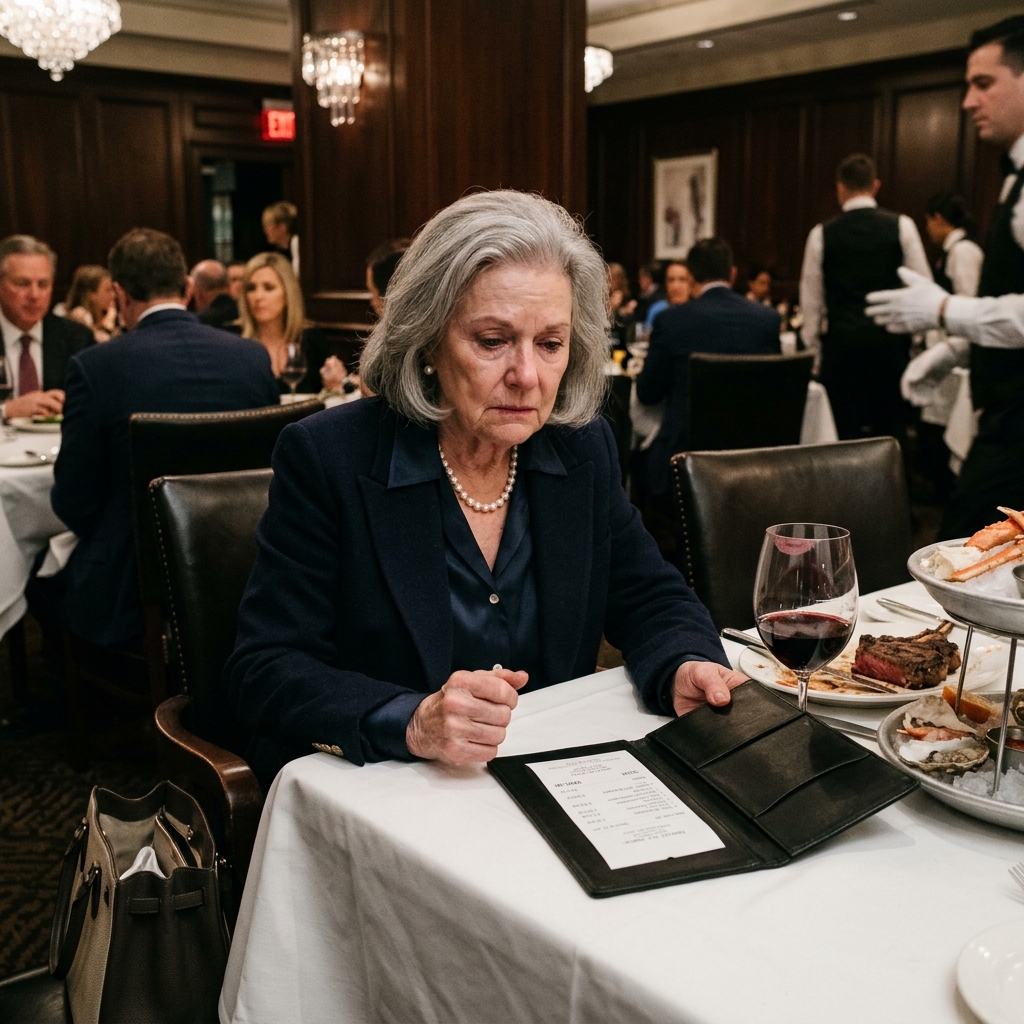
My son and his wife walked out of an upscale Chicago steakhouse and stuck me with an $845 bill, absolutely certain I would just quietly pay it like I always did. But one phone call later, a bank representative asked, “Mrs. Hayes, did you recently authorize a $450,000 credit line?” I stared at their two empty chairs and realized that dinner bill was the absolute least of what they had stolen from me…
I pulled out my phone and dialed the 1-800 number printed on the top of the loan document.
After navigating several automated menus, a bank representative verified my identity and asked me to confirm the account number.
“I’m calling to inquire about a HELOC connected to my son’s residential property,” I said, keeping my voice steady. “The paperwork I’m currently looking at shows a credit limit of $450,000.”

There was a heavy pause on the line, followed by the clacking of a keyboard.
“Mrs. Hayes, are you fully aware that a secondary limit increase was officially approved on this account last month?”
The bustling restaurant seemed to fade into white noise.
Julian was wiping down a table a few feet away, casting worried glances in my direction.
“How much was it increased to?”
“The current approved credit limit is $550,000.”
My mouth went instantly dry.
“How much of that has actually been drawn against?”
The representative politely asked to place me on a brief hold.
I stared blankly at Marcus’s empty leather chair while generic elevator music played in my ear.
When she finally clicked back on the line, her cheerful customer-service voice had completely vanished.
“The current outstanding balance drawn is $528,410.”
I pressed my palm flat against the cold restaurant table to steady myself.
The $845 bill was sitting open right next to me.
Less than an hour ago, that dinner bill had felt like a cruel, humiliating slap in the face.
Now, it looked like absolute child’s play.
“I did not legally approve either of those increases,” I said, my voice dropping an octave.
“Ma’am, did you physically visit our downtown branch to execute the modification documents?”
“No.”
“Did you officially authorize a proxy or power of attorney to sign on your behalf?”
“Absolutely not.”
She immediately transferred me to the elite fraud investigations unit.
A stern-soundingman named Agent Miller asked me a series of highly specific questions, speaking slowly and giving me ample time to process each one.
Had Marcus ever utilized my personal online banking login?
No.

Did he possess physical copies of my state identification?
Possibly.
After Arthur died, Marcus had stepped up to help me organize the messy mountains of paperwork for life insurance, probate, and the estate taxes. For several months, he had unrestricted access to my driver’s license, my Social Security card, and my most sensitive financial files.
Had I ever, under any circumstances, given him verbal or written permission to borrow capital in my name?
Never.
Agent Miller initiated an immediate, hard lockdown on the entire account.
No outgoing checks. No wire transfers. No further credit draws.
“Do not alert the co-borrowers tonight under any circumstances,” he instructed me. “Preserve every single text message, email, and document. A senior investigator will contact you tomorrow morning.”
When I hung up the phone, I immediately called Richard.
He listened in grim silence as I relayed the secondary increase and the catastrophic half-million-dollar balance.
For a long time, he didn’t say a word.
When he finally spoke, his ruthless, corporate banker persona had taken the wheel.
“Take clear photographs of every single page. Text the images to me right now. I’m also texting you the personal cell number of a bulldog litigator I know.”
“Richard—”
“Do not drive over to Marcus’s house. Do not engage in an argument with either of them over the phone. And Sarah… do absolutely not apologize for a single thing.”
That final instruction almost broke me in half.
Apologizing had become my default setting.
I apologized when Marcus completely forgot my 70th birthday and showed up three days later with wilted gas station flowers.
I apologized when Chloe unilaterally changed our Thanksgiving plans at the last minute, after I had already spent two days cooking a turkey for fourteen people.
I apologized for calling during “dinner time,” for asking too many questions about the grandkids’ schooling, or for wanting to see them on a weekend that wasn’t “convenient.”
I had spent a decade shrinking myself down so small that nobody could ever accuse me of being a burden.
That night, I slapped my own credit card down and paid the steakhouse bill in full.
Not because Marcus and Chloe deserved a free meal.
Because leaving the restaurant without paying would only create a messy legal problem they could somehow spin to blame on me.
I tipped Julian 30% in cash, requested a printed, itemized receipt, and jotted down the exact timestamp my son and daughter-in-law had walked out the door.
Before I could stand up to leave, Julian returned holding a small, folded envelope.
“My manager printed out the point-of-sale transaction log for you,” he said quietly. “It officially documents the exact minute your daughter-in-law requested we combine the table’s checks.”
“Why are you going out of your way to help me, Julian?”
He glanced sadly at the empty chairs across from me.
“My grandma raised me, ma’am.”
Outside, the Chicago wind felt like ice against my cheeks.
I sat in my locked sedan in the parking garage and emailed the high-resolution photos of the loan document, the dinner receipt, and the POS log straight to Richard.
Then, Marcus started blowing up my phone.
He called seven consecutive times before I even pulled into my driveway.
At 10:14 p.m., a text popped up.
Mom, the banking app keeps crashing. Did you accidentally lock something?
Five minutes later, Chloe chimed in from her number:
You are really scaring the kids with this erratic behavior.
The kids were toddlers. They were fast asleep. They knew absolutely nothing.
At 10:27 p.m., Marcus tried one last time.
We had a legitimate family emergency. You happily offered to pay for dinner. Why are you suddenly retaliating against your own blood?
He didn’t bother to ask if I had made it home safe in the snow. He didn’t bother to ask if I had enough money in my checking account to cover the massive bill.
He only cared about the locked bank account.
I screenshot and saved every single message.
At 7:00 a.m. sharp the next morning, a high-powered attorney named Jessica Sterling called my cell.
Richard had already briefed her and forwarded the documents.
Jessica didn’t mince words. She didn’t use that condescending, overly-sweet tone people often use with elderly women before questioning their cognitive abilities.
“I need you to locate the original wet-ink agreement from 2021,” she demanded. “Do you still have the hard copy?”
I dug the file out of my heavy fireproof safe.
My authentic signature was clearly stamped on a highly restricted, capped guarantee for $150,000.
The subsequent modification documents were entirely different beasts.
They legally upgraded my status to a primary co-borrower and completely obliterated the protective cap. They also included a photocopy of my state driver’s license that had technically expired three years ago.
The forged signature was just close enough to pass a casual glance by a bank teller who had never seen me sign a check.
But I spotted the blatant discrepancies immediately.
The ‘S’ in Sarah looped entirely too far to the right. The cursive ‘h’ at the end of Hayes lacked the sharp tail I had used since grade school.
Jessica reviewed the first modification line by line over a secure video call.
Then, she stopped dead.
“This notary block states that you physically appeared before a licensed notary public at 3:10 p.m. on June 18th.”
I knew exactly what I was doing on that specific date.
“That is a physical impossibility.”
“Why?”
“I was sedated at Northwestern Memorial Hospital.”
That entire afternoon, I had been undergoing an invasive cardiac stress test. My next-door neighbor, Brenda, had driven me to the hospital at 1:00 p.m. and didn’t drop me back off at my house until well after 5:00 p.m.
There would be an ironclad medical paper trail. Check-in logs. Vitals charts. Nurse sign-offs. Potentially even hospital lobby security footage.
Someone had deliberately chosen to execute the fraud on a date they knew I was heavily medicated and completely unreachable by phone.
The lead bank investigator, a sharp woman named Maria Lopez, called me later that afternoon.
She asked if I recognized the name of the notary who stamped the document.
Evelyn Vance.
At first, it didn’t ring a bell.
Then, Jessica gently reminded me that Evelyn was Chloe’s older cousin.
I had awkwardly met her at two boring family barbecues. She was a flashy real estate agent who wore giant Gucci sunglasses indoors and constantly bragged about building generational wealth through “creative paperwork.”
By noon that day, the bank officially froze the entire HELOC account.
Several massive, automated payments instantly bounced.
One was the monthly lease payment for Marcus and Chloe’s brand-new luxury SUV. Another was a massive installment for the kids’ elite private academy.
At 12:30 p.m., Chloe’s car pulled into my driveway.
I watched her through the Ring doorbell camera app on my iPad.
She was wearing crisp white trousers, a camel hair coat, and the exact same plum lipstick she had worn at the steakhouse.
She aggressively laid on the doorbell three times.
“Sarah, open this door right now.”
I stayed perfectly still in the kitchen.
Jessica had strictly instructed me not to have any unrecorded contact with either of them.
Chloe leaned in close to the camera lens.
“You signed those legal papers,” she said, her voice dripping with venom. “You might be losing your mind and forgetting things, but you signed them.”
Her tone was chillingly calm, almost patronizing.
“Marcus is just trying to protect you from legally embarrassing yourself.”
I didn’t make a sound.
She dropped her voice to a harsh whisper.
“If you keep pushing these insane accusations, the kids are going to grow up knowing their grandmother maliciously tried to steal their childhood home away from them.”
For the last ten years, the mere threat of losing access to my grandchildren would have had me throwing the door wide open.
It would have opened my checkbook, too.
But that afternoon, I just let the camera silently record her threats.
I forwarded the video file straight to Jessica’s office.
The bank’s comprehensive digital forensics report arrived late that evening.
The mandatory two-factor authentication security codes for both massive credit limit increases had been texted directly to Marcus’s iPhone.
The final electronic signature approval had originated from an IP address hardwired to the router inside Marcus and Chloe’s house.
A burner email account bearing my name had been created just 72 hours before the first modification was submitted. It was used exactly once to verify the document, and then permanently abandoned.
The bank also pulled the surveillance footage from the downtown branch.
I was nowhere to be seen in the lobby.
But Chloe was.
The 4K video showed her strutting into the bank clutching a thick manila folder, and walking out twenty-three minutes later shoulder-to-shoulder with her cousin, Evelyn Vance.
On Wednesday morning, federal investigators and a heavily armed process server descended on Marcus’s house.
After that, everything went dead silent.
No frantic phone calls. No manipulative text messages. No vile accusations about me ruining the grandchildren’s lives.
At 11:00 a.m., Marcus finally sent a pathetic, four-word text.
Can we fix this?
Jessica arranged a highly secure, recorded meeting at the bank’s regional corporate headquarters.
Marcus arrived ten minutes early.
His bespoke suit jacket was heavily wrinkled. His eyes were bloodshot and swollen. For the very first time in his adult life, he didn’t look like the arrogant, successful CEO he desperately portrayed to the world. He just looked like the terrified little boy who used to call me from summer camp crying because he lost his spending money.
“Mom,” he choked out.
Jessica pointed a manicured finger toward the chair across the conference table.
“Please take a seat, Mr. Hayes.”
Chloe strutted in three minutes later, flanked by a sleazy-looking defense attorney.
Her contour makeup was absolutely flawless. But the hand gripping her iPhone was shaking violently.
Maria Lopez laid the original, authentic guarantee flat on the mahogany table, followed by the two fraudulent modifications, the devastating digital authentication report, my verified hospital records, and the glossy printouts of the bank’s security footage.
Chloe arrogantly leaned back in her leather chair.
“Sarah signed them,” she insisted stubbornly. “She’s old. She forgets things constantly.”
Marcus slowly turned his head to look at her.
It was a microscopic shift in body language, but it was the very first indicator that they were no longer a united front.
Maria swiveled a large monitor toward the table.
The crystal-clear video showed Chloe walking into the branch at 2:43 p.m. on June 18th.
At that exact, verified minute, I was strapped to a cardiac monitor six miles across town.
Chloe’s defense attorney leaned in and frantically whispered something in her ear.
She completely ignored him.
“Sarah gave us verbal permission to handle it!” she shrieked. “Maybe she wasn’t physically sitting in the lobby, but she knew exactly what we were doing! We’re family!”
Jessica calmly closed her legal folder.
“Verbal permission to commit felony forgery is not a recognized legal defense, ma’am.”
Maria tapped the digital authentication report.
“The required 2FA security codes were routed directly to your personal cell phone, Mr. Hayes.”
Marcus stared blankly at the wood grain of the table.
“Did you have prior knowledge that your mother was falsely listed as being physically present at the branch to sign these documents?”
He pressed his lips together until they turned white.
Chloe aggressively grabbed his forearm.
“Marcus, don’t say a word.”
He violently yanked his arm out of her grip.
“Yes,” he whispered, his voice cracking. “I knew.”
Chloe’s chair scraped loudly as she jolted backward.
Marcus broke down and confessed everything. They had completely drained the original $150,000 credit line within six months.
His boutique firm had lost two massive corporate retainers. But their extravagant spending habits continued as if he was bringing in millions.
The $80,000 custom kitchen remodel. The heated infinity pool. The exorbitant private school tuition. The first-class trips to Cabo. The matching luxury SUVs.
When the well ran dry, Chloe pressured him into increasing the line of credit.
When the bank demanded my physical signature for approval, her cousin Evelyn conveniently offered to “handle the annoying paperwork.”
Marcus knew damn well I hadn’t stepped foot in that branch. He knew the signature was a blatant forgery.
He had desperately convinced himself that his firm would magically land a massive contract and he could quietly repay the stolen money before I ever found out it was missing.
I looked across the table at my only son.
“That is exactly what you believed at the steakhouse too, isn’t it?”
His face flushed bright red with shame.
“You honestly believed you could stick me with that massive dinner bill and humiliate me, because you knew I would just quietly pay it to avoid a scene.”
“Mom, that dinner was 100% Chloe’s idea.”
Chloe let out a sharp, hysterical, bitter laugh.
“But you happily agreed to it, Marcus!”
They had actively conspired in the car to leave before dessert was even served.
Marcus had casually folded his napkin while his wife lied to the hostess, claiming I was covering the entire extravagant spread.
Then he had kissed my forehead and walked out the door.
The bank’s legal department officially purged the two unauthorized increases from my liability record and forwarded the forged documents straight to the FBI and local law enforcement.
The original $150,000 debt still belonged squarely on Marcus and Chloe’s shoulders.
With their primary accounts frozen by the feds and an active fraud investigation looming over them, absolutely no lender in the country was willing to refinance their bloated mortgage.
They were forced to list the house six agonizing weeks later.
The Zillow listing showcased the pristine white kitchen, the sparkling blue pool, and the massive bay windows overlooking the lush foothills.
The realtor’s description boasted: A stunning property meticulously designed for gracious family living.
I stared at the photos and vividly remembered the tiny, rustic lake cabin in Michigan that Arthur and I had once owned.
I had tearfully sold it just to help Marcus and Chloe scrape together the original down payment for that very house.
Arthur had absolutely loved that little cabin. He kept a chipped blue enamel coffee pot permanently resting on the vintage stove, and spent his quiet summer mornings patching up the wooden dock.
I had traded the last remaining pieces of my husband’s sanctuary to fund my son’s fragile ego.
There was never a formal loan agreement for the money I had given them from the cabin sale.
Only blind trust.
Jessica advised me that we could sue to recover it, but I actively chose not to waste the remaining years of my life battling in court over a gift I had freely given.
I did, however, demand full repayment of my mounting legal fees and every single dollar directly connected to the fraudulent HELOC documents.
The rushed sale of the house barely covered the primary mortgage, the original credit line, and a fraction of what they still owed the contractors.
Marcus was forced to sign a legally binding repayment agreement for the remaining balance.
Chloe’s cousin, Evelyn, permanently lost her notary commission and faced severe fines.
Chloe eventually accepted a plea deal that involved heavy financial restitution and years of supervised probation to avoid jail time.
Marcus fully cooperated with the federal investigators, but rolling over on his wife didn’t magically erase his complicity.
Their punishment wasn’t cinematic.
There were no dramatic SWAT teams waiting outside a fancy family dinner. There was no packed courtroom erupting in gasps.
It was just the crushing reality of frozen bank accounts, endless meetings with defense attorneys, mounting legal bills, cramped rented bedrooms, and the agonizingly slow, public stripping away of every single expensive status symbol they had used to convince the world they were important.
They were forced to move into a dingy rental complex miles outside of the elite school district Chloe had once arrogantly claimed her children “could never leave.”
I continued to see my grandchildren.
But the rules fundamentally changed.
I paid their new school tuition or pediatric bills directly to the institutions when I actively chose to help.
I never, ever handed their parents a dime of cash.
For several grueling months, Marcus only spoke to me regarding custody schedules and restitution payments.
Then, one quiet Sunday morning, he showed up alone on my front porch.
He didn’t bring a bouquet of flowers. He didn’t bring a cheesy apology gift picked out by his wife. He didn’t have a rehearsed, manipulative speech prepared.
“I kept lying to myself, swearing I was only doing it to protect the kids,” he muttered, his voice hollow.
I waited patiently.
“But the truth is, I was only trying to protect the fake, glamorous life I wanted everyone to think I was living.”
He refused to lift his eyes from the porch floorboards.
“I knew exactly what Chloe was doing with those legal papers, Mom. And I knew exactly what we were doing to you at that restaurant.”
He swallowed hard.
“I really thought you would just pay the bill because you literally always did.”
“That is absolutely true,” I said quietly.
He looked up at me, clearly shocked by my response.
“I have always paid the bill, Marcus. I just didn’t realize until now that I was paying for it with more than just my money.”
I didn’t offer him my forgiveness that afternoon.
Forgiveness handed out too quickly would have just been another free handout placed in front of him.
But I did listen to him.
Months later, I returned to that exact same Chicago steakhouse with Richard, Jessica, and my neighbor Brenda.
Julian, the young server, recognized me before we even reached our booth.
“Black coffee for the table?” he asked with a warm smile.
“Only after dessert, Julian.”
We ordered modest, simple food.
No towering seafood platters. No vintage bottles from the private cellar. And absolutely nobody informed the waitstaff that I loved “spoiling” everyone.
When the check finally arrived, Richard instinctively reached for his wallet.
I firmly placed my hand over the black leather folder.
“This one is on me.”
The bill was completely ordinary. The people sitting around my table were genuine and honest. And every single chair remained occupied until the evening naturally came to an end.
I paid the bill without a single ounce of anger or residual shame.
Not because anyone at the table expected me to.
But because for the very first time in a decade, the choice to pay belonged entirely to me. THE END