
My parents invited me to christmas dinner after 5 years of no contact. i was so happy. when i arrived, all the lights were off. my mom laughed: “we just wanted to see if you’d still come running.” my sister burst out laughing. her phone was already recording. i didn’t cry. i just reached into my coat and said: “very funny. because…”
My name is Ren Fenwickart. I grew up in a small town in Virginia, in a house where love was always conditional and silence was always a punishment. I want to be honest about that from the start, not to make anyone feel sorry for me, but because the rest of the story only makes sense if you understand where it began.
My mother, Sylvia, ran our household like a performance. Everything was about how things looked—to the neighbors, to the church, to the extended family at the holidays. She had two daughters: me, the older one, and my sister Addison, who was three years younger and had been my mother’s favorite from the time she was old enough to know what that meant.
I don’t say that bitterly anymore. It is simply the truth.
Addison got the car at sixteen. I got driving lessons from our uncle when I was seventeen. Addison got her college tuition paid without a single conversation about it. I got a handshake and a “You’ll figure it out.”
When I graduated summa cum laude from a state university, which I paid for myself through student loans and a part-time job at a campus coffee shop where I worked double shifts during finals, my mother told her book club that Addison was the smart one who just needed more time to find herself.
I found myself pretty early.
I found a small apartment two states away in North Carolina. I found a career in financial compliance that I built from scratch, working my way up from an entry-level position to a senior analyst role in five years. I found a therapist named Dr. Okafor who helped me understand, slowly and patiently, that what I had grown up in was not normal, that it had a name, and that the name did not make it my fault.
The money thing was the part that took the longest to untangle.
For four years, from the time I was twenty-two until I was almost twenty-eight, I sent money home every single month. Not because anyone asked directly. My mother was far too skilled for direct requests. There was always a story. The furnace was failing. The car insurance had gone up. A medical bill had arrived.
She had a way of mentioning these things at the exact moment I was most exhausted, most vulnerable, most desperate to believe that if I helped enough, eventually something would shift. That there would be a Christmas where she looked at me the way she looked at Addison.
My therapist helped me understand that there was no amount of money that would ever buy that.
So one month, quietly, without a speech or an announcement, I stopped sending it.
That was when the calls started. The cold ones. The clipped ones. The calls where my mother’s voice went flat and measured and she asked me, with that particular patience that was not patience at all but calculation, what exactly I thought I was doing.
I tried to explain twice. Both conversations ended the same way, with her telling me I had always been selfish, always been difficult, always been the daughter who didn’t understand what family truly meant.
The last call ended with her telling me not to bother coming home.
So I didn’t.
For five years, I didn’t.
I worked. I got promoted. I moved into a better apartment, one with a proper bedroom and a spare room I turned into an office. I stopped spending Christmas alone, eating takeout on my couch. I found people worth celebrating with. I stopped measuring my worth by whether or not my mother picked up the phone.
It wasn’t easy. I want to be clear about that. There is nothing clean or simple about cutting yourself off from the idea of a family, even when that family has already cut you off in every way that actually matters.
There were nights I missed them. Not who they actually were, but who I had spent twenty-some years hoping they might become. I grieved that, and then I moved forward.
Then, in early December, five years after that final phone call, a letter arrived.
Handwritten. My mother’s cursive, which I would recognize anywhere. A single page on cream-colored stationery.
“Ren, it’s time to stop this. We miss you. Come home for Christmas dinner at six.”
I read it fourteen times.
My therapist and I spent two full sessions talking about it. My closest friend, Bashi, told me flatly not to go, that nothing good could come from walking back into that house. My coworker and closest confidant, a man named Fletcher Ames, told me something different.
He said, “If you need to go for your own closure, go prepared. Don’t go hoping. Go ready.”
I went ready.
What was in my coat pocket that night was not just a document. It was the conclusion of eight months of very careful, very quiet work. Work that had started when a woman named Ruth, a neighbor who had lived across the street from my family for over twenty years, sent me a short private message through a mutual acquaintance in April.
Her message said, “Ren, there are things you deserve to know. Call me when you’re ready.”
I called her the next morning.
But I will get to Ruth. First, I need to tell you about the night my mother turned me into a punchline.
I pulled onto Maple Drive at 5:47 on Christmas Eve. The street looked exactly the way it had every Christmas I could remember, warm and ordinary and glowing from the inside.
The Hendersons still had their inflatable snowman by the driveway. The Pharaohs next door had string lights along the roofline, white and steady as a heartbeat. Across the road, someone had clipped a small American flag by their mailbox, snapping in the cold wind.
My childhood home was the only dark one.
I noticed it. My stomach tightened.
I told myself: circuit breaker, burned-out bulb, something practical with a practical explanation.
I parked at the curb. I walked up the path I had walked a thousand times before, past the oak tree my father had planted the year I was born, past the cracked third flagstone that had never been repaired, past the porch railing I used to lean against on summer nights.
I had a bottle of wine in one hand and a bakery box of almond cookies in the other. My fingers were going numb inside my gloves.
I knocked.
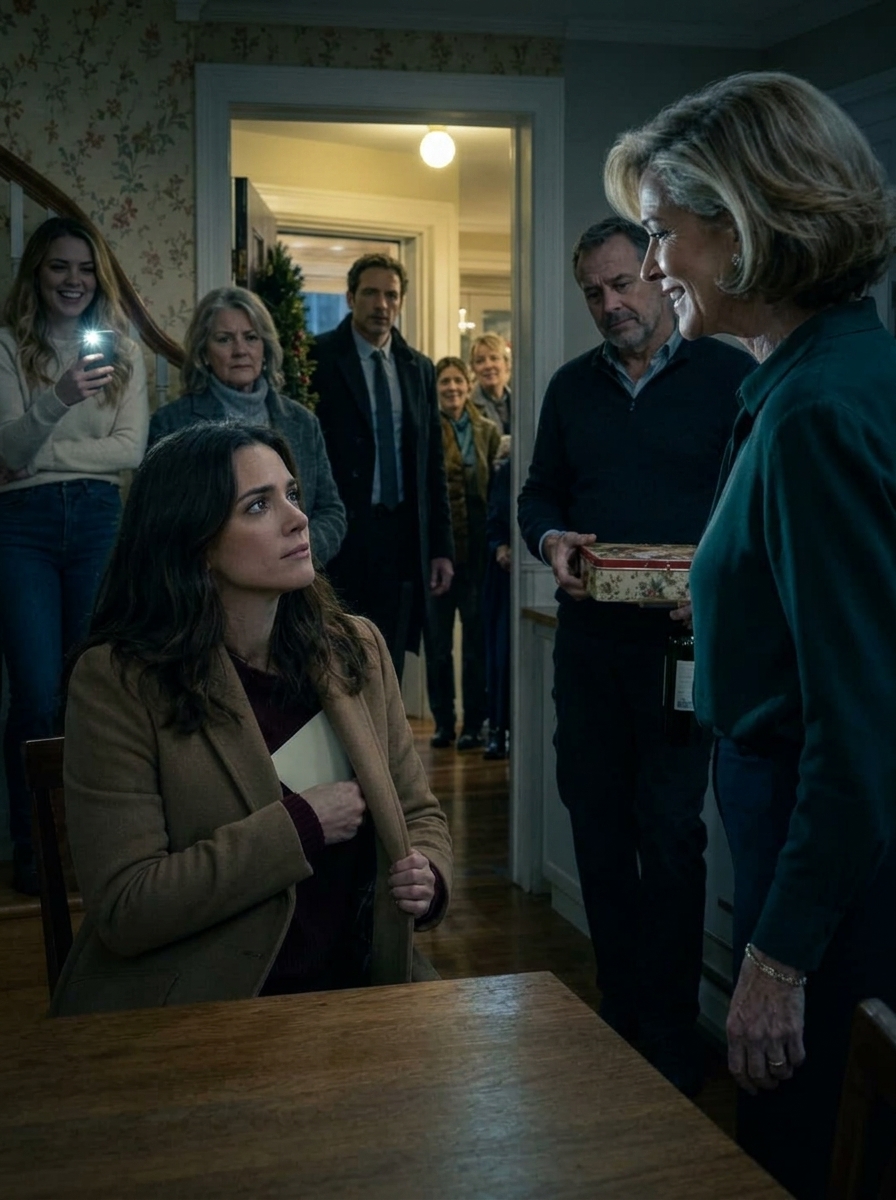
The door opened almost immediately, not because someone had been waiting to welcome me, but because someone had been watching from the window, waiting for their moment.
My mother, Sylvia, stood in the doorway wearing her good blouse, the dark green one she wore when she wanted to be looked at. Behind her, the hallway was completely dark. No table set. No coats on the rack. No warmth coming from inside. No smell of anything cooking.
“Well, well,” she said, and folded her arms across her chest. “She actually came.”
From upstairs came a burst of laughter, sharp and practiced.
Addison leaned out from the top of the stairs, phone raised and already recording before I had even fully processed what I was looking at.
“I told you she would,” Addison called down. “She always comes running.”
I looked at the phone screen. I looked at my mother’s face. I looked past her shoulder at the empty hallway.
And then I looked at the yard.
Six neighbors stood there in the cold like they had been arranged, which I would later understand they had been. George Hanley from across the street, the Pharaohs from next door, two women I recognized from my mother’s church committee, a man I didn’t know holding a phone with the screen glowing blue near the bushes.
And Ruth, standing by the mailbox in her gray wool coat, buttoned to the chin, jaw set. Not laughing. Not recording. Just watching me with an expression I couldn’t read yet.
My mother stepped onto the porch, close enough that I could smell her perfume, the same one she had worn my entire childhood.
“We just wanted to see,” she said, her voice pitched slightly louder than necessary, shaped for an audience, “if you’d still show up the second we called. After all that pride. After five years of acting like you don’t need us.”
Addison called from upstairs, “She’s still recording, Mom. Keep going.”
My mother smiled.
“Look at her,” she said, gesturing toward me like I was an exhibit. “No husband. No children. Driving back here on Christmas Eve because Mommy wrote one little letter. What does that tell you about all that independence she loves to talk about?”
I stood very still.
I want to tell you that in that moment I cried. I want to tell you I turned around, walked back to my car, and drove home. That I said something sharp and devastating that silenced the yard.
None of those things happened.
What happened was quieter than that.
My mother’s boyfriend, Denny, stepped forward from the driveway with his hands half raised.
“Sylvia,” he said, “maybe that’s enough.”
She didn’t even turn around.
“Denny, stay out of it.”
He stopped. One step forward, one step back. A man who had spent enough time in that house to know exactly how far he was allowed to go.
The yard was quiet except for the wind.
I looked at the wine bottle, at the cookies, at my boots leaving wet marks on the porch boards I had stood on as a child.
I had imagined a lot of versions of this night. An awkward dinner where nobody knew where to put their hands. My mother pretending nothing had happened, which would have hurt, but at least it would have been real. A hard conversation at a kitchen table with something genuine underneath it, even if that genuine thing was painful.
I had not imagined this.
The letter was bait. The dark house was a stage. The good blouse. Addison’s phone. The neighbors in the yard. Every piece of it had been arranged before I ever turned onto the street.
My mother had spent time planning this. She had made phone calls. She had invited an audience, and she had waited.
“Are we done with this part?” I said.
My mother blinked. Addison lowered the phone by half an inch.
“What?” Addison said.
I didn’t answer her.
I placed the wine bottle carefully on the porch step. Not dropped. Not thrown. Placed. Then I held out the bakery box toward Denny.
“Merry Christmas, Denny,” I said.
He took it like it might break in his hands.
Then I reached into my coat pocket.
Not for the envelope. Not yet.
I pulled out my phone and opened my messages. I found the contact saved under Fletcher Ames and typed two words.
Come now.
I put the phone back in my pocket.
Addison had seen the screen flash. “Who are you texting?” she said. “Someone to come rescue you?”
I didn’t answer that either.
I looked at my mother.
“You’re right about one thing,” I said. “I did come here tonight for a reason.”
Then I stepped past her into the dark hallway.
My shoulder brushed her sleeve, and for once, for the first time I could remember in my entire life, she moved back first.
The light switch was exactly where it had always been.
Click.
Weak yellow light filled the hallway. Old wallpaper with the faded stripe pattern. The stair runner. The coat rack with nothing on it. The narrow kitchen at the far end, cold and bare.
No plates on the counter. No food. No dinner.
Only a table, an audience, and one envelope waiting in my coat.
I sat down in the chair by the window. My mother followed, slower than before. Addison stood in the doorway with the phone raised, but there was something uncertain in her face now. The laughing had stopped.
Denny stayed near the stairs with the cookie box. Ruth stepped quietly across the threshold and stood near the wall. The neighbors outside had moved closer to the door.
Nobody had left.
I rested one hand flat on the table.
“You wanted to talk about family,” I said.
The doorbell rang.
Every face in that room turned toward the door.
I stood up, and this time I was the one smiling.
What they didn’t know—I need to back up eight months.
In April, Ruth Kellerman, the woman who had lived across the street from my family for over twenty-two years, sent a message through a mutual acquaintance.
She was not a woman given to drama or interference. She had watched me grow up. She had watched me leave. And for the years I was gone, she had watched something else, something she felt I deserved to know.
I called her the morning after she reached out.
What she told me took about forty minutes. I said very little. I just listened.
After I stopped sending money home five years ago, my mother had not struggled the way she had told people she was struggling. In fact, she had done quite well because she had been telling two completely different stories to two completely different groups of people at the same time.
To our extended family, she had maintained that I was still sending monthly support and that she was managing with my help. This version of the story painted her as a woman keeping things together with modest but steady assistance from her older daughter.
To a regional family assistance organization, one that provided grants and support payments to households experiencing financial hardship, she had filed a formal claim stating that I had abandoned all contact and provided zero financial support, leaving her alone and without resources.
Both stories could not be true.
Neither was based on the false hardship claim. She had received assistance payments over roughly three years. Based on the false story she told the family, our Aunt Loretta and two cousins had collectively sent her over $12,000, money they gave because they believed she was already stretched thin and just needed extra help getting by.
Ruth had pieced this together slowly. A comment dropped at a neighborhood gathering. A document she had glimpsed once while helping my mother with something. A conversation she had overheard.
She had kept notes—careful, dated, specific—for almost two years before she decided to contact me.
When she forwarded her notes, I sat with them for two weeks.
Then I did what I do professionally.
I work in financial compliance. I know what documentation looks like. I know what the formal reporting channels are for misrepresentation to a charitable assistance organization. I know what a civil attorney does with a set of financial records and a clear timeline.
I know the difference between what can be resolved privately through acknowledgment and voluntary repayment and what cannot.
Over the following months, carefully, quietly, without announcing it to anyone except Fletcher and my attorney, I built a case.
I want to be precise about my intent because it matters.
I was not building a weapon. I was not planning a scene.
What I wanted was simple. I wanted to sit across from my mother and give her one genuine opportunity to tell the truth, to acknowledge what had happened, to agree to repay the organizations that had been misled, and to stop pretending.
If she took that opportunity, we would handle it privately and move forward.
If she didn’t—if she chose performance over honesty, even when faced with documentation—then the next conversation would be with people outside this family.
Fletcher Ames had agreed to be nearby that night, not as protection, but as a witness. He had helped me verify and organize every document in that envelope, and he understood exactly what was in it.
When I texted him from the porch, he was already parked two streets over, engine running, waiting for exactly that message.
And Ruth, standing by the mailbox in her gray coat, not laughing, had driven to Maple Drive that night not as part of my mother’s audience.
She had come because she had decided she was done being a bystander.
When Fletcher knocked and stepped into that hallway, my mother looked at him the way she looked at anything that disrupted her script—with a confusion she couldn’t quite hide.
“Ren,” she said. “Who is this?”
“This is Fletcher,” I said. “He’s here because what I need to say tonight should be said with a witness present.”
I opened my coat. I took out the envelope.
I did not slam the papers on the table. I placed them in front of her carefully, the way you handle something that matters.
Addison had gone completely still. Her phone was pointing at the floor. Denny had set down the cookie box on the counter and was standing with both hands in his pockets. Ruth was near the wall. Fletcher stood near the doorway.
The neighbors who had crept inside were quiet in a way that was entirely different from the quiet of the yard. This was the stillness of people who realized they had come to watch one kind of show and had walked into something else entirely.
“I know about the hardship filing,” I said.
The room changed.
There is no other way to describe it.
Something shifted in the air of that hallway. Something that had been loose and performative snapped into something tight and real.
My mother’s face moved through several expressions in about four seconds. Surprise. Calculation. Dismissal.
And then it settled into something I recognized.
The controlled voice. The measured tone. The version of herself she deployed when she needed to manage a situation.
“I don’t know what you think you found,” she said, “but you are not going to come into this house and—”
“You filed a hardship claim stating that I had abandoned all contact and provided no financial support,” I said. “That documentation was false. At the same time, you were telling our family that I was still sending regular support, which is why Aunt Loretta and two of our cousins sent you money over three years because they believed you were already getting help from me and still struggling.”
Silence.
Not a performed pause. The real kind. The kind that happens when a truth lands and there is nowhere for it to go.
“You were receiving support from two directions at once,” I said, “based on two stories that contradicted each other. I have the records from both sides.”
My mother opened her mouth.
“I also have Ruth,” I said.
Ruth stepped fully into the light.
My mother looked at her, and it was the first time I had ever seen my mother look at another person the way people usually looked at my mother: uncertain, off-balance, without the upper hand.
“Ruth,” she said, and the performance was gone from her voice. Just her underneath it. “You don’t understand the full picture here.”
“Patricia,” Ruth’s voice was quiet and completely firm, “I understand exactly what I saw. I wrote it down. I kept the dates.”
George Hanley, who had been standing just inside the doorway with his hands in his jacket, looked down at the floor. The woman from the church committee had put her phone in her bag.
Nobody was filming anymore.
Addison had not moved. She was staring at the papers on the table.
“Mom,” she said.
Sylvia turned.
“Mom.” Addison’s voice was very quiet. “Is it true?”
My mother said nothing.
And that nothing, that particular weighted nothing, was the only answer any of us needed.
I had not come to that house to destroy my mother in front of her neighbors. I want to be absolutely clear about that.
What I had in that envelope was real and fully documented, and I had already spoken with an attorney about the formal options available to me. But the reason I had arranged everything the way I did, the reason I came in person on Christmas Eve with Fletcher as a witness and Ruth already present, was because I believed my mother deserved one genuine chance.
One chance to choose truth over performance. To acknowledge what had happened. To commit to repaying the organization that had been misled. To stop maintaining two separate stories about her own life.
So I told her that directly.
“I’m not here to make this worse than it has to be,” I said. “What is in that envelope exists whether you acknowledge it tonight or not. I have already spoken with an attorney, but I would far rather resolve this quietly, with you agreeing to correct what can be corrected, than take the next step. What happens from here is your choice.”
My mother sat down.
I had never once in my life seen my mother sit down in a situation like this.
She was a woman who commanded rooms through posture, who stood, who projected, who managed every space she occupied through sheer force of presence.
She sat down the way a building settles when the foundation finally gives. Not dramatically, but with a kind of inevitability.
Addison pulled out the chair beside her and sat down, too.
Not to defend her.
I could see from Addison’s face that she was genuinely shocked. Whatever she had signed on to for this Christmas Eve performance, it had not included this. She sat beside her mother because she was still, underneath everything, her daughter.
Denny stayed near the counter. Ruth stayed near the door. Fletcher stayed near the entrance.
And I sat down across from my mother.
Not because I had won, but because I was finished standing in a dark hallway pretending.
The conversation that followed lasted almost two hours.
It was not a movie scene. My mother did not weep and confess dramatically. There were long silences. There were moments when she tried to reframe things. Circumstances. Misunderstandings. Technicalities. The way things had felt from her side of them.
Fletcher was patient and precise every time. Ruth was steady.
By the end, my mother agreed to two things.
First, she would contact the family assistance organization in January, disclose the situation voluntarily, and arrange a repayment plan. Fletcher had already confirmed with my attorney that voluntary disclosure, coming forward before any formal report was filed, was significantly preferable to the alternative.
She understood that.
Second, she would personally write to Aunt Loretta and our cousins. Not to make excuses. Not to manage the story. To tell them the truth about what had happened and why, and to begin repaying what she could.
She did not apologize to me that night.
I did not ask her to.
An apology that is extracted in a moment of pressure is just another form of performance. I had had enough performance to last the rest of my life.
What I asked for, the only thing I asked for, was this: that we stop pretending.
That if there was ever going to be anything real between us, it would have to be built on honesty. Even if that honesty was uncomfortable. Even if it changed things between her and people she had spent years managing.
She didn’t say yes.
She didn’t say no.
She just looked at me for a long moment in a way she had never looked at me when I was a child being measured against Addison, or a young woman sending money every month to earn something that was never on sale.
And I think, for the first time, she actually saw me.
Not the daughter she had managed. Not the one she used to fill a role in a story she was telling about herself.
Just me.
Addison walked me to my car.
We stood together on the dark curb for a moment. The neighbors had all gone home. The street was quiet. Someone across the road had left their porch light on, and it caught the ice crystals in the air and made them look like something almost beautiful.
“I didn’t know,” Addison said. “About the filing. About any of it.”
I looked at her.
I thought about the phone, about the laughter, about five years of being on the outside while she was on the inside.
“I believe you,” I said. “About the financial part.”
She understood what I meant.
There was a long quiet.
“What happens now?” she asked.
“I don’t know yet,” I said honestly. “But it starts somewhere true. And that’s more than we’ve ever had.”
I drove home on empty roads. The ice from the morning had cleared. The sky was dark and enormous and full of stars.
I didn’t turn on the radio.
I just drove and thought about the version of myself that had stood on that porch two hours ago, the one holding cookies and wine and a letter she had read fourteen times.
And I felt something for her that I hadn’t expected.
Not pity. Not anger.
Tenderness.
She had tried for a long time. She had believed in something that kept not being real. And she had finally, quietly, stopped waiting to be chosen and chosen herself instead.
I spent years believing that the way back to my family ran through doing more, giving more, being quieter about what hurt me and louder about what I was willing to offer.
I was wrong.
The path, if there is one, runs through honesty.
Not cruelty. Not revenge for the sake of watching someone suffer. But the particular kind of honesty that refuses to protect someone else’s comfort at the permanent cost of your own dignity.
What I brought to that porch on Christmas Eve was not a weapon.
It was evidence that I had been paying attention. That I had done the work. That I was no longer a woman who would drive for hours through ice just to be handed a script she had never agreed to perform.
Accountability is not the same thing as punishment.
Asking for the truth is not the same thing as asking for an apology.
Sometimes the most powerful thing you can do is simply refuse to pretend and let the truth be present in the room, even when everyone in the room would have preferred the comfortable version.
I don’t know what my family looks like from here.
Maybe my mother follows through and something real gets built on the other side of this. Maybe she doesn’t, and I make the next decision accordingly.
Addison and I have exchanged a few careful texts since that night. Nothing big. Just something. A beginning that might go somewhere or might not, but at least starts from a real place.
What I know is this: I am not going to stand on a dark porch anymore and wait for someone else to turn the light on for me.
I know where the switch is, and I know how to use it.
If you have ever been the person in your family who gives the most and is expected to ask for the least, the one who is supposed to show up, forgive, and never ask for anything real in return, I want you to know that wanting honesty is not being difficult.
It is being human.
Tell me in the comments: Have you ever had to hold someone accountable for something your family refused to admit was real? What did you do?
And if this story meant something to you, subscribe to Valyra Payback. New story every single day, every one of them for people who are done waiting for permission to stand up for themselves.
I’ll see you in the next one.
THE END