Part One: What the Porch Revealed
“You don’t get to make my children stand on the porch of a house I helped you keep.”
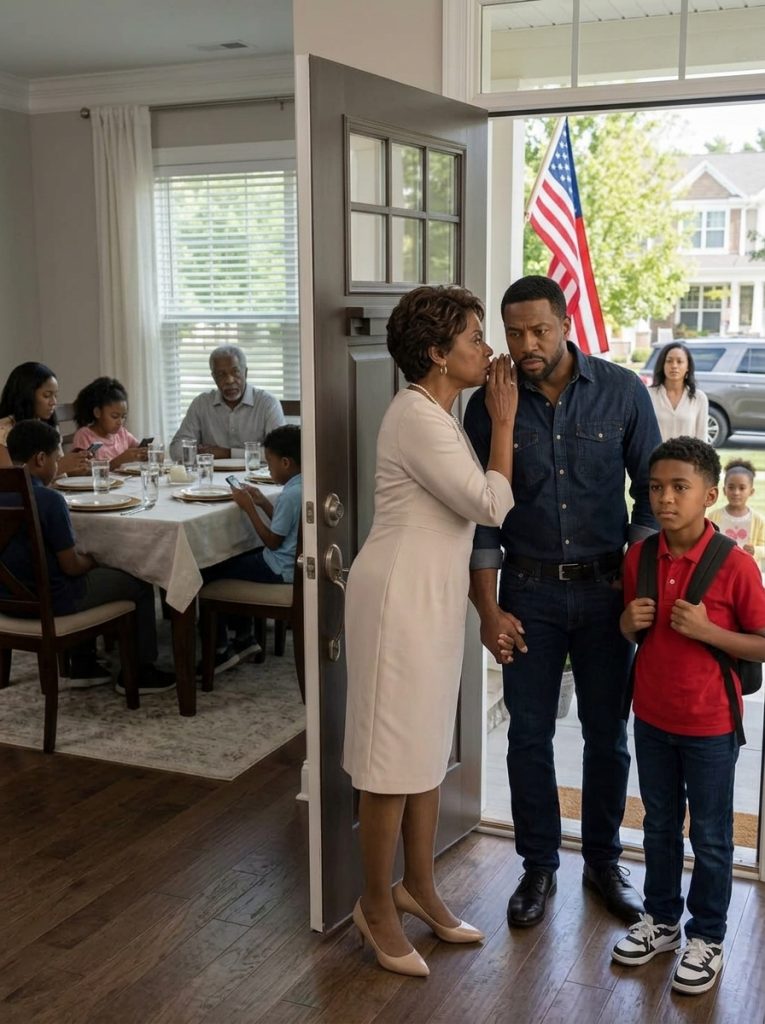
The words left my mouth calmly enough that, for one strange second, absolutely nobody moved. My mother stood halfway inside the open front door, one hand still wrapped around the brass knob, her church dress smoothed perfectly, her smile locked into that particular careful expression she reserved for whenever neighbors might happen to be watching. Behind her, through the narrow gap between her shoulder and the doorframe, I could see the dining room table already fully set. White plates. Folded cloth napkins. Crystal glasses they only ever brought out for expected company. My father sat at the head of the table. My sister Brianna sat close beside him, her own three children already settled comfortably into their chairs.
My two kids stood behind me on that porch holding a chocolate cheesecake, a handmade card, and the particular kind of hopeful innocence children carry when they still genuinely believe grandparents are supposed to feel like a safe place.
Dylan was nine, tall and lanky, all elbows and quiet watchfulness. He’d held that bakery box carefully on his knees for the entire drive over, like it was something genuinely precious. Nora was seven and had covered a piece of construction paper with foam hearts, crooked stars, and a purple marker message reading I love you Grandma, the G written backward. She’d shown it to me proudly at breakfast that morning, like she was presenting actual treasure.
Now that card simply dangled at her side.
My mother glanced down at it, then looked away entirely. “Jack—” She caught herself, then leaned close enough that her perfume cut sharp through the spring air. “There just isn’t enough room.”
Some sentences don’t sound particularly loud when spoken aloud, yet they echo for years afterward regardless. That was exactly one of those sentences. Not enough room. Not for my own children. Not at the table where I’d eaten Thanksgiving turkey, birthday cake, dry pot roast, and every quiet family judgment of my entire childhood. Not inside the house whose mortgage I’d been silently helping cover for almost ten straight years.
I looked past my mother toward my father instead. Howard Thompson had always known exactly how to dominate a room without ever once standing up from his chair. At sixty-seven, he’d gone grayer and thicker around the middle, but he still carried that old foreman’s posture — heavy arms crossed tight over his chest, chin tilted up like the entire world was simply a work crew waiting patiently for his next order. His fork hovered motionless above his plate. Brianna glanced my way and rolled her eyes before turning back to her youngest, as though my children’s humiliation were simply one more inconvenience I’d apparently decided to exaggerate for effect.
“Dad?” Dylan asked quietly, behind me.
That single word settled something deep inside me, all at once.
For thirty-eight years I’d been carefully taught to explain things away, smooth over hard edges, rescue people, apologize freely, pay whatever was owed, and act as though the responsibility had always naturally belonged to me alone. I knew exactly how to swallow discomfort so completely that people genuinely called me easygoing. I knew how to laugh off remarks that left invisible bruises underneath. I knew how to send money over with one hand while typing no problem, Mom with the other, simultaneously.
But I genuinely didn’t know how to look at my own son’s confused face and honestly call that particular scene family.
I shifted my body slightly, placing myself firmly between my children and the open doorway. “We’re leaving.”
My mother blinked hard. “Don’t be ridiculous.”
“I’m not being ridiculous.”
“Jack, it’s simply a seating issue.”
“No,” I said evenly. “It’s a pattern.”
Her eyes narrowed at that. She’d always genuinely hated it whenever I used calm, measured words she couldn’t easily dismiss out of hand.
Nora slid her small hand into mine. Dylan tightened his own grip around the bakery box. Behind my mother, Brianna let out a small laugh — the exact same one she’d used since high school, whenever she wanted the whole room to decide I was simply being too sensitive before I’d even finished my own sentence.
“Over chairs?” Brianna called out from the dining room.
I looked over at her, then back at the table itself, where her own children had full plates already waiting while mine hadn’t even been properly counted for.
“This was never actually about chairs.”
My father shoved his own chair back hard. The legs scraped loudly across the hardwood floor — a sound that once would have made my shoulders tense automatically. I felt the old familiar instinct rising in me, the one telling me to lower my own voice and smooth the whole moment over before his anger could fill the room completely. But my son was watching me closely. My daughter stood holding a card nobody inside that house apparently wanted. And for the very first time, I genuinely understood that if I softened this particular moment, I’d simply be teaching both of them to do exactly the same thing themselves, someday down the line.
My father stepped out into the hallway. “What did you just say to your own mother?”
I looked directly at him and felt something close to genuine peace pass through me. “I said we’re leaving,” I answered evenly. “And starting today, I’m no longer sending another mortgage payment your way.”
The whole room changed instantly. Not loudly. Not all at once, either. It shifted in careful layers instead. My mother’s hand fell away from the doorknob. Brianna’s laugh died before it could ever fully form. My father’s face tightened — not with any real pain, but with the fast, cold calculation of a man who’d just heard the numbers finally turn against him.
And there it finally was. The actual, real place at that table. Not love. Not genuine belonging. Simple access.
My parents’ house sat on a quiet suburban street where every single lawn looked trimmed by someone genuinely terrified of judgment. Their split-level home carried beige siding, dark green shutters, and rose bushes my father treated like actual family heirlooms. When I was twelve, I’d once hit a baseball straight into those roses and spent the rest of that entire afternoon listening to him describe carelessness like it was some kind of permanent character defect I now carried forever. Years later, when Brianna backed his own truck straight into the mailbox after borrowing it without permission, my mother simply said accidents happen sometimes.
That’s exactly how it always worked between us. Brianna’s mistakes simply became weather, passing through and forgotten. Mine became evidence instead, filed away and referenced forever.
She was three years younger than me, and somehow still remained the child everyone instinctively protected. I was the oldest son — the responsible one, the one who could always manage somehow. When Dad lost steady work for a stretch, I handed over money from my own mall food-court job at sixteen years old, because Mom insisted property taxes didn’t wait around for anyone’s pride. When Brianna needed help after switching colleges yet again, I delayed saving for my own first apartment, because family stepped up for each other, apparently. When Mom wanted dental work she claimed our insurance wouldn’t cover, I emptied the small account I’d started specifically for my own wedding.
Christine and I postponed buying our first house together for three full years. My parents simply called that a rough season. Their particular rough season lasted twenty-two years running.
I’d built a solid career in pharmaceutical sales. Not glamorous work, exactly, not the kind that impressed my father’s friends at backyard cookouts, but steady and genuinely demanding regardless. I drove across three separate states, memorized hospital parking lots by heart, ate gas-station sandwiches between client calls, and climbed steadily into the top tier of my entire region, purely because I worked considerably harder than anyone actually expected of me. My parents told relatives I’d simply gotten lucky along the way. They claimed my old college roommate’s father had opened doors for me, which genuinely wasn’t true at all, but it let them accept my growing income without ever having to admit my own actual effort behind it.
The money left our household in pieces, over and over. A utility bill here. A roof repair there. A mortgage shortfall. A car repair. A medical balance. A family emergency that always arrived with a specific number attached, a firm deadline, and a tone that somehow made me sound cruel the instant I dared ask a single question about any of it.
Christine saw the whole pattern long before I ever actually did myself.
She’d stopped attending my parents’ dinners months before that particular Sunday. At first she’d offered simple excuses — work commitments, a headache, the kids’ bedtime schedule. Then one evening, after my mother remarked that Nora seemed “overly attached” to me, and my father spent a full twenty minutes correcting Dylan’s little league batting stance right there at the dinner table, Christine sat on our bed folding laundry and finally said plainly, “Jack, I genuinely can’t keep watching them make our own children feel like mere visitors in that house.”
I told her, honestly, that she was entirely right about it. Then I went right back the following month regardless.
That’s precisely the part people simply don’t understand about family pressure, unless they’ve genuinely lived inside it themselves. It doesn’t always feel like straightforward fear. Sometimes it feels instead like duty, speaking fluently in your own voice. It tells you plainly that a good son never keeps score. It tells you your parents genuinely did their best under difficult circumstances. It tells you your sister simply needs more help, because she’s always struggled more than you have. It tells you, quietly, that handing over money is always considerably easier than actually surviving real conflict.
By the time we finally turned into my parents’ driveway that particular Sunday, Christine had already decided exactly where she personally stood on the whole matter. “I’ll wait out here in the car,” she said from the passenger seat, staring at the house with genuinely exhausted eyes. “If things start feeling weird in there, we leave immediately.”
The kids barely registered what she’d said. They were far too excited already. Nora wondered aloud whether Grandma would actually put her card up on the refrigerator. Dylan asked whether Grandpa might want the very first slice of cheesecake. I noticed Christine’s face carefully when he said that particular thing — that brief flicker of real sadness she tried hard to cover over quickly.
“Remember our signal,” I told them both before we climbed out of the car.
Dylan nodded and lightly touched his own earlobe. Nora immediately copied the exact same gesture. We’d created that particular signal after our last visit there, when Dylan rode home the entire way staring silently out the window, because Grandpa had openly compared him to Brianna’s oldest son in front of the whole family. My own son hadn’t actually cried until bedtime that night. Somehow, that particular fact felt considerably worse than if he’d cried right away. He’d kept it locked inside himself, because he genuinely thought being visibly hurt might end up disappointing me somehow.
I should have stopped absolutely everything, right then. Instead I simply convinced myself the very next visit would surely turn out different.
The next visit turned out to be that same porch.
My mother’s careful whisper made my own children into outsiders in under five full seconds, and suddenly every single excuse I’d made for years looked genuinely humiliating in that clear afternoon light. I could see the good china sitting inside. I could see Brianna’s brand-new Audi parked at the curb, the exact one my mother had always insisted she could never possibly help pay for. I could see the cheesecake box trembling slightly in Dylan’s own careful hands.
Then I finally said that particular sentence about the mortgage payments, and everyone in that doorway suddenly, genuinely listened.
My mother dropped her own voice low. “You don’t actually mean that.”
“I genuinely do.”
“Jack.” My father’s tone turned entirely flat. “You need to think this through very carefully.”
“I’ve genuinely been thinking carefully about this for years now.”
Brianna was standing now, one hand gripping tight to the back of her own chair. Her hair sat perfectly smooth, her nails freshly done, her expression full of that familiar, practiced disbelief. She’d always mistaken my own patience for solid proof that she was simply smarter than me. “So you’re genuinely going to punish Mom and Dad because your kids can’t sit exactly where you personally wanted them to?”
“My kids weren’t actually counted for at all.”
“It was simply a misunderstanding, Jack.”
I looked back at that table one more time. Seven full plates. Seven folded napkins. Seven crystal glasses set out.
“No,” I said. “It was basic arithmetic.”
I took Dylan’s hand firmly in mine. Nora leaned in tight against my side. My mother glanced quickly toward the street, likely worried some neighbor might witness the whole scene playing out on her own front porch. That was Marilyn Thompson’s actual, deepest religion — appearances, carefully maintained above all else. Church dresses for ordinary family dinners. A spotless entryway at all times. Sympathy cards artfully arranged whenever guests happened to stop by. A bright smile for the room, a considerably sharper voice reserved strictly for the hallway.
“Come on,” I told my children gently. “Let’s go get some burgers instead.”
Nora looked down at her own card. “Should I leave this here for her?”
I watched my mother’s face closely, genuinely waiting for even a hint of softness, one single second of real grandmotherly instinct, one moment where she’d finally say, No, sweetheart, I’m so sorry, please come inside.
She didn’t say it.
“Take it home with you instead,” I told Nora quietly.
Dylan carried the cheesecake box carefully back toward our SUV. Christine saw our faces well before we’d even reached the car itself. She got out immediately and met us halfway down the driveway.
“What happened in there?” she asked softly.
“Not here.”
Her own eyes moved from my mother still standing in the doorway, to Nora’s card, to Dylan’s white-knuckled grip around that bakery box. She genuinely didn’t need the entire story spelled out. She wrapped one arm around Nora and pulled open the back door for her.
As I buckled my daughter carefully into her car seat, she looked up at me with an expression I still genuinely see on sleepless nights, even now. “Daddy,” she asked quietly, “why doesn’t Grandma actually like us?”
Some questions cut an entire life cleanly into before and after. Before that particular question, I was still genuinely a son trying his best to remain fair to everyone involved. After it, I finally became a father who understood exactly what that fairness had actually been costing my own children all along.
I breathed in slowly and brushed her hair gently back from her forehead. “It isn’t actually about you at all, sweetheart. Some grown-ups carry problems they simply never learned how to fix properly.”
Dylan looked over at me from the other side of the back seat. He didn’t ask a single thing. He simply held the cheesecake carefully between both hands, like bringing it safely home somehow genuinely mattered.
Christine reached across the center console and placed her own hand gently over mine. “We’re done with this,” I said quietly.
She nodded once. “Okay.”
That was genuinely all she said. No lengthy speech attached. No “I told you so” delivered smugly. No visible pleasure in simply being right about it. Just okay, plain and steady. I was slowly learning that real, genuine support often sounded exactly like that. Not a lecture delivered from on high. Not some kind of performance staged for effect. Simply a steady hand resting over yours, while you finally, actually chose yourself for once.
Part Two: What Was in the Envelopes
We ate burgers in the parking lot afterward, purely because the kids voted for it, and because grease on paper bags genuinely felt considerably better than crying alone in some driveway. Nora handed her grandmother’s card over to Christine, who taped it carefully to our own refrigerator once we finally got home. Dylan insisted we cut into the cheesecake that same night. We ate it straight off paper plates in the living room, some movie playing that none of us actually watched closely. The kids calmed down gradually, piece by piece, like small animals slowly realizing the storm had genuinely passed by them.
My phone stayed entirely quiet until Wednesday. Then Brianna finally started in. Her texts arrived one after another while I sat in a clinic lobby between scheduled appointments. The first message came dramatic but reasonably measured. Mom is devastated. The second landed sharper. You embarrassed everyone there. The third reached back for old, familiar language. After everything they’ve ever done for you? By the fifth text, she’d blamed Christine entirely. By the seventh, she’d rewritten that entire Sunday so thoroughly that my own children became rude, I became unstable, and my parents became elderly victims of my own selfishness.
I read every single message carefully. Then I took clean screenshots of each one.
Christine had told me for years to keep careful records. Not because we ever planned on actually using them, but because families exactly like mine had a genuine talent for revising history before the day itself had even properly ended. I created a folder on my phone labeled Sunday Dinner. Into it went Brianna’s messages, a photo of Nora’s card taped proudly to our fridge, and a screenshot of the scheduled bank transfer I’d set up that month toward my parents’ mortgage payment.
Then I canceled that transfer entirely. My thumb hovered above the confirmation button for nearly a full minute straight. Cancel recurring payment? The words looked far too small, honestly, for exactly what they actually meant. Twenty-two years of established habit. Ten straight years of mortgage assistance. Every single moment I’d chosen silence, purely because it always seemed considerably less expensive than open conflict. Every single time my mother had called me dependable, using the exact same tone other people generally reserved for saying simply available.
I pressed yes. Nothing exploded. The phone itself didn’t tremble. The walls certainly didn’t crack open around me. The world simply, quietly let me stop. That was genuinely the first real surprise of the whole ordeal.
The following week passed in a silence so complete it actually felt somewhat suspicious. My mother never called. My father never called either. Brianna, once I’d blocked her number outright, switched over to email instead, then stopped entirely once I refused to respond to any of it. Christine and I ate dinner with the kids every single night at our own table, where absolutely everyone had a proper seat, because we always counted heads first, before ever inviting anyone else to join us.
On Friday, Dylan brought home a school drawing. It showed our whole family seated together at one long table, spaghetti piled in the center, our dog sleeping contentedly underneath. He’d drawn Uncle Patrick sitting in one corner, even though Patrick hadn’t actually eaten dinner with us in months by that point.
“Why’d you draw Uncle Patrick in there?” I asked him.
Dylan simply shrugged. “He looks sad, whenever we’re over at Grandma’s house.”
Children genuinely see exactly what adults so carefully explain away.
Patrick was my younger brother, thirty-two years old, the one nobody ever really fought over, purely because nobody had invested quite enough in him to properly claim him as their own. He’d moved back into my parents’ basement after a difficult divorce, supposedly just for a few months. Two full years later, he was still living down there, working remotely in web development while my parents casually called his career “computer stuff” and constantly interrupted his workday for random errands.
I called him that same night. He picked up on the fourth ring. “You doing okay?” he asked immediately.
It was such a genuinely simple question, so different from the way the rest of my own family typically opened a conversation, that I very nearly laughed out loud. “I think so,” I said. “You?”
A pause followed. “Depends entirely on who’s actually asking.”
“Your brother is asking.”
Another pause, considerably longer this time. “Then no,” Patrick said honestly. “Not really, if I’m being truthful.”
That marked the very start of the first genuinely honest conversation the two of us had ever actually shared together. Not because we’d disliked each other previously, but because our parents had always carefully arranged us like completely separate financial ledgers. Brianna needed help constantly, and I gave it freely. Patrick simply stayed invisible the whole time. We were siblings by birth, technically, but rivals entirely by design, each one of us carefully taught our own particular flavor of scarcity.
Patrick told me our mother had spent the entire week telling everyone I’d abandoned the whole family. Our father had been pacing furiously around the house, genuinely outraged that I’d “made a financial decision emotionally” — a remarkable accusation, honestly, coming from a man who’d accepted my money for years running without ever once calling any of it emotional himself. Brianna had come by twice that same week, both times crying openly in the kitchen and leaving afterward with sealed envelopes in hand.
“What envelopes, exactly?” I asked, genuinely curious now.
Patrick went quiet on the line.
I stood in our own bedroom, phone pressed against my ear, watching Christine read quietly to Nora down the hallway. The house smelled faintly of lavender shampoo and fresh laundry detergent. It felt impossibly far removed from that split-level basement, where Patrick was probably speaking softly right then, careful that nobody upstairs might actually overhear him.
“Patrick,” I said. “What envelopes?”
He released a slow, tired breath. “Money, mostly. Cashier’s checks sometimes. Mom genuinely thinks I don’t notice any of it, but I actually do.”
“For what purpose, exactly?”
“I honestly don’t know the full extent of it. Brianna’s behind on things — credit cards, her car payment, some online spending mess she keeps insisting is only temporary. Jack, a genuinely significant amount of the money you sent specifically for the mortgage wasn’t actually going toward the mortgage at all.”
The room shifted around me in a quiet, oddly ordinary way. Nothing particularly dramatic happened in that moment. Christine simply turned a page in the kids’ room down the hall. A car passed by outside our window. The small digital clock on my nightstand quietly ticked over from 8:43 to 8:44.
“How exactly do you know that for certain?” I asked.
“Dad leaves paperwork scattered everywhere whenever he’s angry,” Patrick explained. “There are official notices. Bank transfers. Handwritten notes from Mom herself. The roof repair last month? That was actually Brianna’s car down payment instead. The water heater before that? Credit card minimum payments. They were genuinely behind on the mortgage the entire time, because they were quietly using your own money to cover for her instead.”
I sat down slowly on the edge of our bed. For years running, my parents hadn’t simply been taking money from me alone. They’d been taking it, indirectly, from my own wife, from my own children, from our repeatedly delayed vacations, our postponed home repairs, the college savings account I’d built slowly while simultaneously sending considerably larger amounts to people who treated my own kids like merely optional guests at their own dinner table. They’d taken my genuine trust and quietly turned it into Brianna’s own personal financial cushion.
“Do you actually have copies of any of this?” I asked.
“I can probably get some together.”
“Don’t put yourself in a difficult position over this, Patrick.”
He gave a weary, exhausted laugh. “I think I was honestly born into one already.”
Three days later, he showed up at my own front door carrying two duffel bags, his laptop backpack, and a manila folder tucked firmly under one arm. He looked genuinely exhausted — not in the temporary way people look after simply one bad night’s sleep, but in the considerably deeper way that comes from living far too long underneath somebody else’s constant weather. Christine opened the door and said simply, “You’re just in time for pizza,” as though a brother arriving with his entire life packed into duffel bags was something our own home could easily hold without ever making a real scene about it.
He stood there in our entryway a little too long, visibly overwhelmed. Then Nora ran past me and asked brightly, “Uncle Patrick, do you want cheese or pepperoni tonight?”
His whole face shifted at that. “Pepperoni,” he said, voice rough with emotion.
Part Three: What the Folder Proved
That same night, once the kids had finally gone to sleep, Patrick opened that manila folder at our kitchen island. Inside sat printed emails, bank statements, handwritten notes in our mother’s own script, a past-due mortgage notice, and receipts telling an entire story my parents would never have willingly offered up themselves. The dates all lined up perfectly. My own transfers arrived on schedule. Payments went straight out to Brianna instead. The mortgage itself stayed consistently behind. New requests kept arriving my way, each one dressed up under a different name.
Roof. Dental work. Water heater. Emergency.
Each individual word had sounded entirely reasonable, every single time my mother said it with genuine panic edging her voice. On paper, laid out plainly, they simply looked like elaborate costumes instead.
Christine sat beside me, one hand pressed over her own mouth. She didn’t interrupt once. Patrick walked us carefully through every single page, pointing out specific amounts, exact dates, small penciled arrows he’d drawn in himself connecting one document to another. He carried the tense precision of someone who’d spent years being told his own observations genuinely didn’t matter, and had finally brought concrete proof that they actually did.
When he finally finished, the kitchen sat silent except for the low hum of our refrigerator. I looked down at the final page in the stack. It was a copy of a text message sent from our mother directly to Brianna. Don’t worry about Jack. He always comes around eventually.
I read that particular line through three separate times. Something about it hurt considerably more than the actual money involved. Not because it genuinely shocked me. Because it sounded so entirely confident. My own mother had built an entire informal financial strategy around my fundamental inability to ever say no to her.
I set that page carefully back inside the folder and closed it. Patrick watched me closely. “What are you actually going to do about all this?”
I thought about Dylan’s small hand in mine, back on that porch. Nora’s abandoned card. Christine waiting patiently in the car. That canceled bank transfer. My father’s fork freezing motionless in midair, the exact instant I’d mentioned the mortgage out loud.
“I’m going to let the truth become entirely their problem to solve now.”
My parents’ first genuine phone call came the following Monday. My mother’s voice sounded strained, sweet around its careful edges, and urgent throughout. She said Brianna had been “treated unfairly” at her own job and desperately needed family support. She said the mortgage payment was due that coming Thursday. She said my father’s blood pressure had been acting up dangerously. She said absolutely everything except the simple words I’m sorry.
“No,” I said flatly.
Silence followed. “What exactly do you mean, no?”
“I mean I’m no longer sending any money your way.”
“Jack, this genuinely isn’t some small matter.”
“I’m well aware of that.”
“We could actually lose the house over this.”
“Then you’ll need to speak directly with your lender about it.”
Her breath caught sharply, like I’d said something genuinely obscene to her. “We are your parents, Jack.”
“Yes.”
“You don’t speak to us this particular way.”
“I’m speaking to you entirely clearly, actually.”
Then she began crying, or perhaps simply performing the sound of crying convincingly. I’d genuinely heard both versions from her over the years. Real tears always made her go quiet. These particular ones only made her louder.
“How can you possibly do this, after absolutely everything?”
I looked through our glass patio door toward the backyard, where Dylan and Nora were kicking a soccer ball back and forth while Patrick sat on the deck steps, laptop open, pretending not to smile every single time Nora missed the ball and laughed helplessly at herself.
“Mom,” I said evenly, “you always had room for Brianna’s own children at that table. You had room in your budget for all her bills. You had room for every single excuse that made me feel genuinely useful to you. You never once had room for my own children, though. That’s precisely the part I’m finished explaining to you.”
She stopped crying abruptly. Her voice turned cold instead. “Christine has clearly changed you.”
“No,” I said quietly. “My own children changed me.”
I hung up the phone.
A week later, my father suffered a genuine health scare, and my mother called at 10:30 that night sounding thoroughly frantic. Some old instincts simply don’t disappear entirely, just because you’ve finally learned to name them properly. I grabbed my car keys before I’d even fully processed what she was actually telling me. Christine stepped into the hallway, robe tied loosely around her waist, eyes sharp with genuine concern.
“What happened?” she asked.
“Dad’s genuinely unwell. She says it might be serious this time.”
“Did she actually call for medical help first?”
I repeated that exact question back into the phone. My mother paused. “I thought perhaps you could simply drive him yourself.”
Christine closed her eyes at that.
“Call for emergency help right now,” I told my mother firmly. “I’ll meet the two of you at Mercy General.”
The hospital lobby sat bright, cold, and crowded with people quietly living through their own ordinary emergencies beneath harsh fluorescent lighting. A toddler slept soundly against a grandmother’s shoulder nearby. A man in a business suit paced restlessly near the vending machines. My mother sat clutching a tissue, looking noticeably smaller than usual, though certainly no gentler for it. The instant she spotted me, she stood up immediately.
“They took him back for testing.”
“That’s good news, then.”
“You took genuinely long enough to get here.”
I very nearly answered that. I very nearly stepped straight back into our old familiar fight. Instead I sat down three chairs away from her and simply waited.
An hour later, the attending doctor came out and told us my father was stable. It hadn’t turned out to be the worst possible outcome. Stress combined with elevated blood pressure had caused a genuinely serious scare, but they’d monitor him carefully overnight, and he’d likely be released the next day with follow-up instructions. Relief reached me before resentment could manage to block it entirely. He was still, undeniably, my father. That remained the genuinely difficult part throughout all of this. Boundaries didn’t actually erase our shared history together. They simply stopped that history from dictating every single choice I made going forward.
While I helped sort through paperwork, since my mother had forgotten her insurance card entirely, she touched my elbow gently. “The mortgage payment is due tomorrow.”
I looked at her steadily. We stood together in a hospital hallway, beneath a television mounted too high on the wall, beside a vending machine stocked with pretzels and orange soda. My father lay behind double doors somewhere, wearing a plastic hospital bracelet. A doctor had just used the word stress in roughly half a dozen different ways. And my own mother had found room, right in the middle of this genuine emergency, to bring up the bill.
“No,” I said simply.
Her face collapsed into anger so quickly it barely brushed against actual hurt first. “You would genuinely let us lose absolutely everything?”
“I’m not actually the reason you’re behind on payments.”
“You stopped helping us.”
“I stopped covering for you.”
“That’s exactly the same thing.”
“No,” I said. “It genuinely never was the same thing at all.”
I paid only what was strictly necessary for that particular hospital visit, purely because I couldn’t stand watching the billing clerk see my mother dig frantically through her purse while turning genuine panic into visible theater. I paid it fully knowing it would be the very last time I handled any crisis simply because she’d placed it directly in front of me. On the drive home, Christine stayed on speakerphone the whole way, until I finally pulled into our own driveway. The porch light was on. Two mugs waited patiently on the front steps, steam still curling gently into the night air.
She’d made tea for me. It was such a genuinely small thing. It felt exactly like being chosen.
The formal foreclosure notice reached my parents’ house two weeks later, and my mother texted me a photograph of it, accompanied by four simple words. See what you’ve done.
I forwarded the whole thing straight to my attorney, a practical step Christine had suggested once Patrick came to stay with us permanently. Then I saved it carefully in the folder alongside everything else we’d already gathered. Evidence never actually needed to be used loudly, I was learning. Sometimes it only needed to genuinely exist, a clean and permanent record standing against every future attempt at rewriting the past.
My attorney sent my parents a formal letter stating plainly that any future financial requests needed to be submitted in writing, and that no further informal support would be provided going forward. The wording stayed entirely polite throughout. That particular fact made it genuinely impossible to dismiss as merely emotional overreaction on my part.
My father called within the hour. “I raised you considerably better than this,” he said.
I stood in my own office parking lot, late afternoon sun flashing sharp off the surrounding windshields. For years, that exact sentence would have opened a trapdoor straight beneath my feet. This time, I simply leaned back against my car and looked up calmly at the open sky.
“You raised me to pay bills I never actually created myself.”
He went quiet on the line. Then he said, “Your sister genuinely needs help.”
“So did my own children, that Sunday.”
“That’s an entirely different situation.”
“Exactly right,” I said. “It is.”
He had absolutely nothing left to say back to that, because the plain truth of it was simply too straightforward to bend into any other convenient shape.
Part Four: The Folder in Patrick’s Hands
The final real confrontation didn’t unfold in some grand, dramatic setting at all. It happened instead on an ordinary Saturday morning at my own front door, while swim towels dried out across the deck railing and Nora’s sneakers sat still wet from her lessons earlier. Christine was making sandwiches in the kitchen. Patrick sat at our table showing Dylan how to build a simple webpage featuring a blue header and a photo of our family dog. Our house looked messy in exactly the particular way my mother always hated — crayons scattered across the counter, a school flyer stuck under a refrigerator magnet, a half-folded blanket draped over the couch.
The doorbell rang. My mother stood outside entirely alone.
Her hair, usually flawless, had been brushed carefully into place but hadn’t quite convinced itself of the effort. She wore beige slacks, a pale cardigan, and the particular expression of someone who’d rehearsed several different versions of herself during the entire drive over and genuinely liked none of them in the end. In her hand she carried a folder.
Not flowers this time. Not a bakery box, either. A plain folder.
“We need to talk,” she said.
I stepped out onto the porch and pulled the front door mostly closed behind me. Her eyes darted quickly toward the narrow gap, trying hard to see inside our home. “Is Patrick actually here right now?”
“Yes, he is.”
“He needs to come back home with me.”
“No, he genuinely doesn’t.”
Her mouth tightened hard. “You’ve clearly turned him against us too, now.”
I very nearly smiled at that. Not because any of it struck me as funny, exactly, but because the accusation itself had grown so old it had simply become lazy over time. Christine had changed me. I had turned Patrick against them. The children had somehow complicated an ordinary family dinner. Everyone else apparently created these consequences except the actual people making the original choices themselves.
“Patrick is making his own decisions now.”
“He’s genuinely confused about things.”
“He’s thirty-two years old, Mom.”
“He is still our son.”
“So am I,” I said quietly.
That particular reply stopped her cold.
For a long moment, the street around us stayed quiet, except for a lawn mower running somewhere around the corner. A small American flag on our neighbor’s porch shifted gently in the breeze. My mother looked past me again, and this time I understood clearly exactly what she was seeing through the narrow window beside our door — my son laughing at the kitchen table, my daughter running across the hallway, Patrick sitting comfortably in a chair nobody had ever made him earn first, Christine setting out plates on the kitchen island, because in our particular house, anyone who arrived genuinely hungry simply got fed, no questions asked.
My mother’s eyes glistened wet, though I’d genuinely learned by then not to assume every single tear automatically meant real tenderness underneath it.
“We’re going to lose the house entirely,” she said.
“I already know that.”
“Your father isn’t doing well.”
“I know that too.”
“Brianna is gone.”
That particular detail was genuinely new information.
I said nothing back right away. “She left for a different state,” my mother continued, voice thinning noticeably. “Said she genuinely couldn’t handle the pressure anymore. She took whatever she could carry and simply left.”
The old version of me would have moved immediately toward her. The old version would have heard the collapse buried inside those particular words and rushed straight to prop up the nearest crumbling wall. The old version had always mistaken being needed for actually being loved.
Instead, I simply waited. My mother opened her folder with visibly shaking hands. Inside sat formal notices, bank statements, numbers arranged like a neat row of consequences. She pushed the whole stack toward me, as though mere paper might somehow make me responsible for it all over again.
“I genuinely have nowhere left to go.”
That particular sentence should have broken something inside me completely. It genuinely didn’t. It hurt, certainly. But it no longer commanded me the way it once always had.
“I can give you information for a senior living community over on Elmwood,” I said evenly. “It’s clean. It’s safe. I’ll cover the first three months directly through their office, while you both figure out a longer-term plan.”
Her whole face shifted through several emotions at once. Shock first. Then genuine offense. Then something bordering on real fear. “Three months?”
“Yes.”
“We are your parents, Jack.”
“I heard you say that already, the first time.”
“Your father will genuinely never forgive you for this.”
I looked down at the folder still in her hands, then back up at her face. “For what, exactly? For finally refusing to let you use my children’s own future to protect Brianna from hers?”
Her lips parted at that, though nothing came out. I genuinely hadn’t meant to actually say Brianna’s name in that particular moment. Not right then, anyway. But once it was spoken aloud, the whole porch seemed to hold its collective breath around us.
My mother’s eyes sharpened instantly. “You genuinely don’t understand what your sister has actually been through.”
“No,” I said. “I understand exactly what I personally was asked to quietly cover for, this entire time.”
The front door opened behind me right then. Patrick stepped outside. He held the same manila folder he’d brought to my kitchen weeks earlier. Not dramatically. Not with any real pride, either. Just firmly, gripped in both hands, as though it genuinely carried real weight.
My mother went visibly pale. “Patrick.”
He didn’t answer her right away. He simply stood beside me instead, not behind me, and for the very first time in my entire life, I understood exactly what it might have felt like, if the two of us had simply been allowed to become real brothers considerably sooner than this.
“I made copies of everything,” Patrick said quietly.
Her mouth moved silently around words that genuinely never actually arrived.
Christine appeared in the doorway then, one hand resting lightly against the frame, Nora peeking curiously from behind her hip. Dylan stood just inside the front hallway. Nobody said a single word. The whole house seemed to gather quietly behind me in that moment, not as some kind of audience, but as living proof instead.
My mother looked at the folder resting in Patrick’s hands. Then at me directly. Then finally at the children watching from inside. And in that small, bright morning — swim towels drying on the railing, chalk dust scattered across our driveway, my whole family safe together inside a home where every single chair genuinely belonged to somebody — my mother finally, truly understood that the old arrangement between us had permanently ended.
I didn’t raise my voice once. I genuinely didn’t need to. “Mom,” I said, “you taught me that family means showing up whenever there’s a real need. You simply never once taught me that my own family actually counted too, in that equation.”
She closed her folder slowly. For once in her life, she genuinely had no ready sentence waiting.
Epilogue: The Extra Place Card
Three months later, my parents moved into the Elmwood facility together. I paid exactly what I’d promised, sent directly to their office itself, never routed through my mother, never handed over in cash, never in any form that could later be redirected or conveniently rewritten. After that, they managed on benefits, a considerably smaller household budget, and assistance programs my mother had once considered thoroughly beneath her. My father’s health stayed fragile overall, but stable enough that he could still complain regularly about the food served there. My mother called every few weeks at first, always armed with some fresh problem that sounded suspiciously like a deliberate test. I let most of those calls simply go to voicemail. Sometimes I actually listened to them afterward. Sometimes I genuinely didn’t bother.
Brianna stayed away considerably longer than anyone had actually expected. Patrick heard through a cousin that she’d found steady work out west somewhere and was still blaming me openly for “dividing the whole family.” I genuinely wished her no real harm. That remained the most honest feeling I could actually offer her. I didn’t particularly wish for her rescue, either, though.
Patrick eventually got his own apartment downtown, then a considerably better job, then a girlfriend who came to our regular Sunday dinners carrying a homemade pie and asked Nora genuine questions about her artwork, like the answers actually mattered to her. He comes over most weeks now without fail. Dylan thinks he’s the smartest person alive, purely because he can write actual code and reliably fix our Wi-Fi whenever it acts up. Nora calls him the fun uncle, because he lets her stick decorative stickers all over his laptop case without complaint.
Our own dinner table isn’t expensive at all. The chairs don’t perfectly match each other, because two came originally from Christine’s own parents and one came from a neighborhood yard sale years back. There are visible scratches worked into the wood, faint marker stains near one edge, and a small dent from the year Dylan decided a spoon made a genuinely excellent drumstick.
But absolutely everyone at that table has their own proper place. That particular fact matters to me considerably more than I can honestly ever fully explain to anyone.
Sometimes, while loading our dishwasher after Sunday dinner winds down, I find myself thinking back to my mother’s own dining room — the good china, the missing chairs entirely. I think about the cheesecake Dylan carried carefully back to our car that day. I think about Nora’s handmade card still stuck to our own refrigerator, that purple backward G slowly fading in the sunlight streaming through our kitchen window.
I kept it hanging there for months afterward. Not because I genuinely wanted to keep reliving the actual pain of that day. Because I wanted, instead, to remember clearly the exact moment I finally chose, once and for all, exactly who I was actually responsible for in this life.
My parents didn’t actually lose me on that particular porch, if I’m being entirely honest. That loss had already happened slowly, year after year, one request at a time, every single instance they treated my genuine love like an open line of credit and treated my own children like a mere afterthought. The porch itself was simply where I finally stopped pretending the account between us was somehow still open.
I genuinely don’t call any of this revenge. Revenge would mean I actually wanted them to suffer for it. I wanted something considerably simpler than that instead.
I wanted my son and my daughter to grow up inside a house where love never had to be carefully earned through sheer usefulness. I wanted my own brother to know, finally, that he could sit at a table without constantly being measured against someone else. I wanted my wife to stop watching me return home from rooms that always sent me back smaller than I’d left. I wanted to genuinely hear my own word no out loud, and actually believe it myself for once.
And I genuinely do believe it now, every single time.
Every Sunday, before dinner properly starts, Nora still makes small place cards for everyone. She writes each name out carefully in marker, decorates the corners with little hearts or stars, and sets them carefully around our table like some kind of tiny private ceremony. Mine usually gets a crooked smiley face drawn beside it. Dylan’s gets a soccer ball. Patrick’s gets a small laptop sketched in. Christine’s always gets little flowers.
A few weeks back, Nora accidentally made one extra card. She held it up and asked simply, “Who should this particular one be for?”
The old familiar ache moved through me briefly, though softer now, considerably less like an open wound and more like an old scar warmed gently under running water. I took the blank card carefully from her hands and slid it into a kitchen drawer for safekeeping.
“That one,” I told her, “is for absolutely anyone who ever comes here carrying love with them.”
She nodded at that like it made perfect, obvious sense to her.
May you like
My Daughter “Went to School” Every Morning—Then Her Teacher Called to Say She Hadn’t Been There All Week. The Next Morning, I Followed Her…
My Daughter “Went to School” Every Morning—Then Her Teacher Called to Sa…
My daughter “went to school” every morning — then her teacher called and told me she’d been skipping for a whole week, so I follow…
My Best Friend Spent Years Caring for My Sister With Down Syndrome—Then He Said a Few Words That Turned Everything I Believed Upside Down
My Best Friend Spent Years Caring for My Sister With Down Syndrome—Then…
I Found My Ex, Gone for 6 Years, Sleeping at JFK With 2 Kids Who Had My Eyes—Then My Mother Whispered, “Their Mother Should’ve Known Her Place.” I Canceled My Biggest Deal, Only to Find a Legal Document Bearing My Signature and a Secret My Family Had Hidden for 6 Years.
I Found My Ex, Gone for 6 Years, Sleeping at JFK With 2 Kids Who Had My…
Part One: The Notch in His EyebrowI discovered I was very likely the father of five-year-old twin boys while standing on the cold…
In our particular house, it genuinely does.
— THE END —