
Part 2 Three newborn babies screamed so desperately on a first-class train that passengers began asking to be moved2 005
Roman Vale placed the baby into my arms as though he were handing me something more fragile than glass.
For one second, I forgot the people staring through the half-open door.
I forgot the armed security men.
I forgot the expensive watches, the polished wood, the champagne glasses trembling faintly with the movement of the train.
All I saw was a newborn.
Jude was impossibly small.
His cheeks were flushed from crying, his dark hair damp against his forehead, his tiny fists clenched beneath his chin.
“Hey,” I whispered.
The sound that came out of me was the same soft voice I used with my daughter, Mia, when she woke at two in the morning and the whole apartment seemed to belong only to the two of us.
“You’ve had a rough day, haven’t you?”
Jude’s crying faltered.
Not stopped.
Just faltered.
Roman noticed.
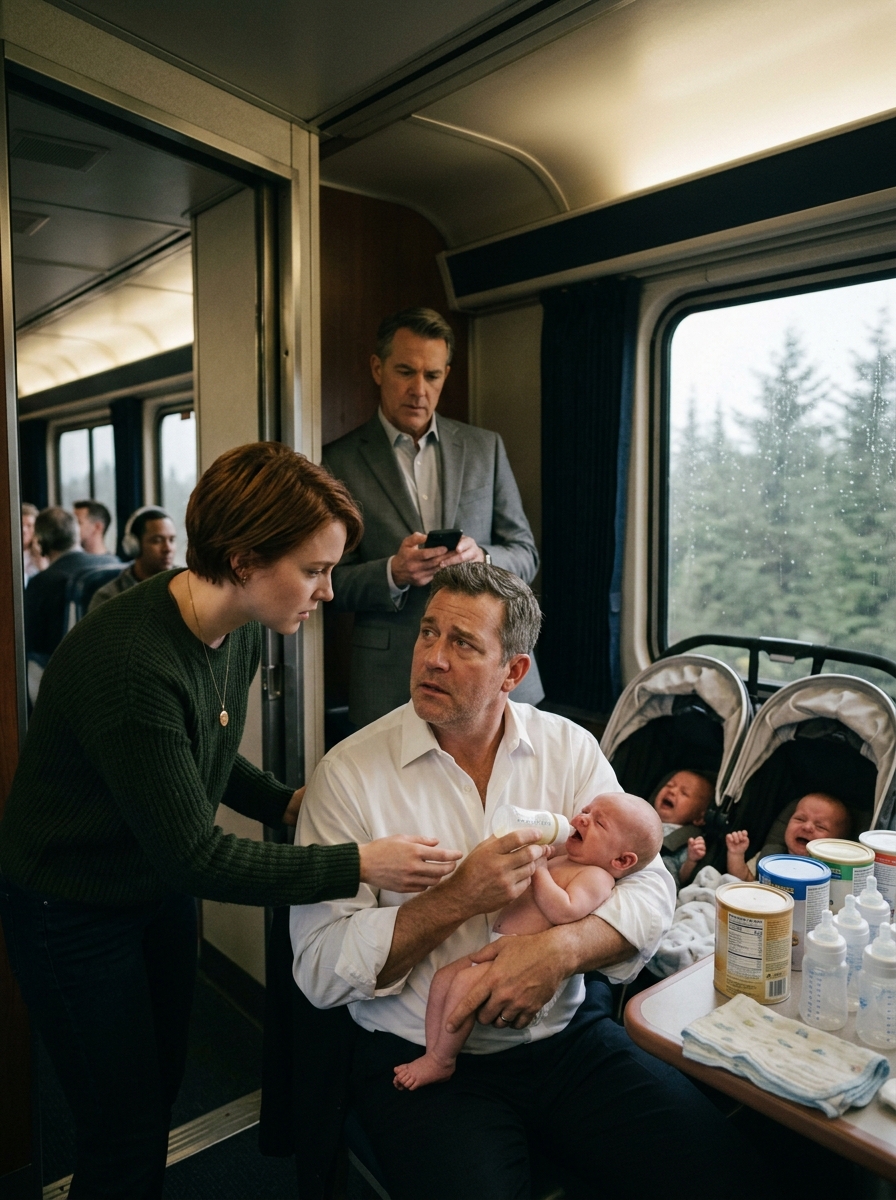
His entire expression changed.
“Why did he do that?”
“Babies respond to voices.”
“He’s heard voices all day.”
“Maybe not one that isn’t afraid of you.”
The sentence escaped before I could stop it.
Roman stared at me.
His right-hand man looked down sharply, as though expecting the carpet to split open beneath my feet.
Then, astonishingly, Roman almost smiled.
Almost.
It disappeared so quickly I wondered whether I had imagined it.
“What’s your name?” he asked.
“Claire.”
“Claire what?”
“Mercer.”
“And your baby?”
I glanced toward my seat.
Mia was asleep in her carrier beneath the careful watch of an elderly woman who had introduced herself earlier as Mrs. Alvarez. She lifted two fingers toward me reassuringly.
“Mia.”
Roman followed my gaze.
Something softened behind his eyes.
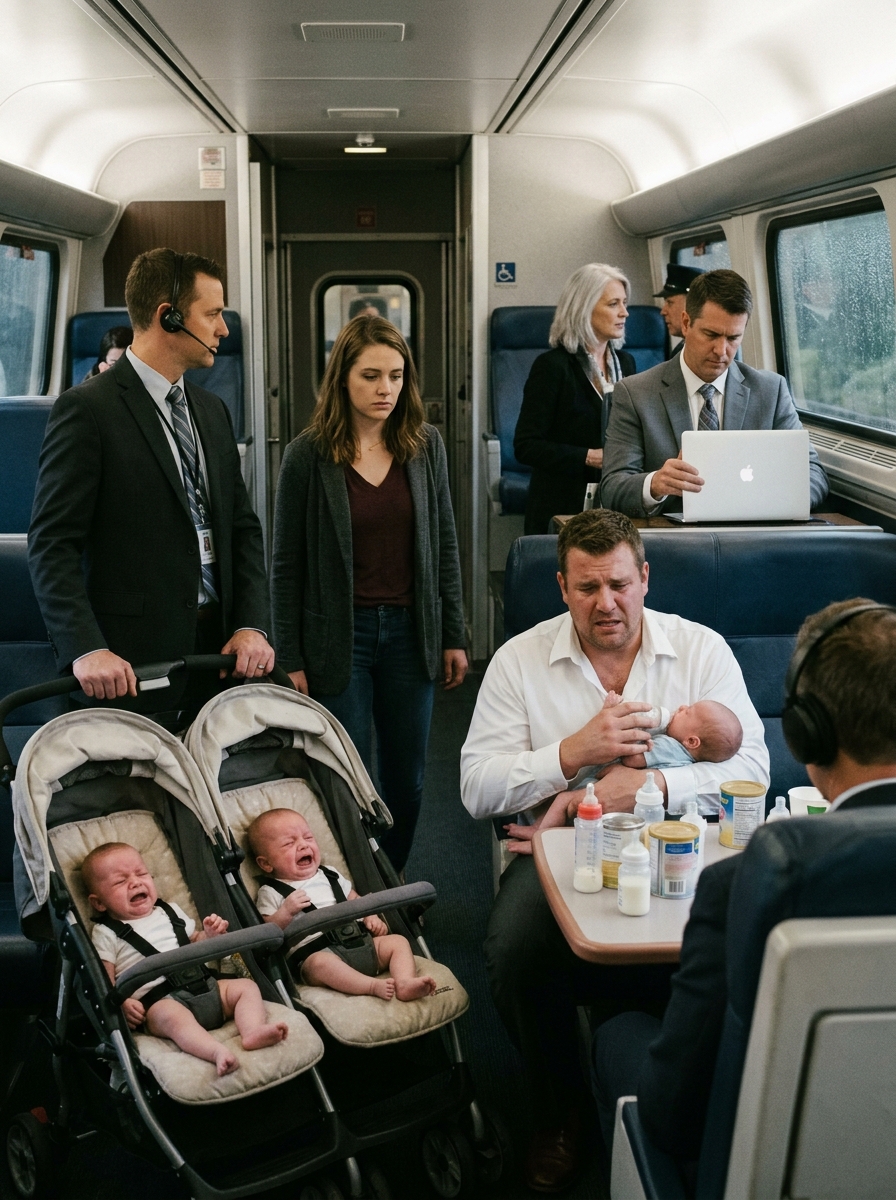
“You’re traveling alone?”
“Yes.”
“To Washington?”
“Richmond eventually.”
“For work?”
I looked at Jude.
“Do you interrogate everyone who offers to help you?”
His right-hand man coughed into his fist.
Roman actually did smile this time.
A small, tired thing.
“No,” he said. “Usually I have people for that.”
That, at least, sounded like the Roman Vale I had heard about.
But the man in front of me was wearing dried formula on the cuff of a shirt that probably cost more than three months of my rent.
One of the other babies cried from the stroller.
Roman’s smile vanished.
“Can you really help him?”
“I can try.”
There were practical things to consider.
Privacy.
Cleanliness.
Whether Jude had any medical restrictions.
Whether there was a reason the triplets had suddenly refused formula.
I asked the questions one by one.
Roman answered most of them.
The babies had been born six weeks early but were now medically stable.
Their pediatrician had cleared travel.
Their mother had breastfed briefly after delivery, then supplemented with formula.
Since her death two weeks earlier, they had become increasingly difficult to feed.
That last sentence caught me.
“Two weeks?”
Roman’s jaw tightened.
“Yes.”
I looked down at Jude.
So that was the grief inside this room.
Not something theatrical.
Not the sort of grief that announced itself.
Just three infants who had lost a familiar heartbeat, a familiar scent, a familiar voice.
And a father trying to replace all of it with bottles lined up like soldiers.
“I’m sorry,” I said.
Roman gave a single nod.
No dramatic answer.
No explanation.
Just a man who had apparently heard those words too many times.
I asked the attendant whether there was somewhere private we could sit. She immediately offered the family lounge at the end of the carriage.
Roman dismissed his men to the corridor.
He did it without argument.
That surprised me most.
He stood outside the door.
I sat inside with Jude.
And for several minutes, nothing happened.
Jude fussed.
Turned away.
Cried again.
I almost gave up.
Then something changed.
Maybe it was warmth.
Maybe it was instinct.
Maybe hunger finally overpowered confusion.
His tiny body relaxed.
The crying stopped.
Outside the door, the train seemed to become quieter.
A few minutes later, I heard Roman ask softly through the wood.
“Is he all right?”
I laughed under my breath.
“He’s eating.”
Silence.
Then:
“He is?”
“Yes.”
Another silence.
Longer this time.
When I eventually opened the door, Roman was standing exactly where I had left him.
His hands were in his pockets.
His shoulders had dropped several inches.
Jude slept against me with the absolute peace only a full newborn could achieve.
Roman looked at his son.
Then at me.
Then back at Jude.
For a man who supposedly controlled half the docks on the East Coast, Roman Vale seemed incapable of forming a sentence.
“He ate,” he finally said.
“He did.”
“All of it?”
I almost smiled.
“There isn’t exactly a measuring line.”
That confused him for half a second.
Then he understood.
“Right.”
His right-hand man turned away, suspiciously interested in the passing countryside.
Roman reached for Jude.
I shifted the baby carefully into his arms.
The moment Jude settled against his father’s chest, Roman closed his eyes.
Only for a second.
But I saw it.
Relief.
Pure and complete.
Then another cry rose from the stroller.
Roman opened his eyes.
We both looked toward it.
He looked at me.
I looked at him.
“You have three,” I said.
“I’m aware.”
“You say that like you’ve only recently discovered the problem.”
His right-hand man coughed again.
Roman glanced at him.
“Daniel.”
“Yes?”
“If you laugh, you’re walking to Washington.”
Daniel’s face became perfectly solemn.
“Yes, sir.”
I fed the second baby too.
His name was Elias.
He had a tiny crease between his eyebrows and the suspicious expression of an old professor forced to attend an unnecessary meeting.
The third, Noah, took longer.
He cried until my shoulder was damp, then finally relaxed with a tired sigh.
By the time all three boys were fed, the atmosphere of the carriage had changed entirely.
Nobody complained anymore.
The woman in pearls had returned to her magazine.
The businessman had put on headphones.
Mrs. Alvarez rocked Mia gently in her carrier and gave me a knowing smile.
Roman stood beside the stroller, looking down at his sons as though someone had switched the world back on.
Then his phone rang.
Daniel handed it to him.
Roman moved several feet away.
His voice changed immediately.
Not louder.
Colder.
Controlled.
“Yes.”
A pause.
“No. Tell Kincaid the meeting begins when I arrive.”
Another pause.
“No concessions.”
Then he looked toward the sleeping babies.
“Push it thirty minutes.”
Daniel raised an eyebrow.
Roman ended the call.
“You postponed your meeting?” I asked.
“For thirty minutes.”
“I thought you couldn’t.”
“I was mistaken.”
It was the first thing Roman Vale said that made me reconsider everything I thought I knew about him.
Not because he had changed the meeting.
Because he admitted he had been wrong.
Men like Roman Vale, according to every story I had ever heard, didn’t admit mistakes.
Maybe stories were easier than people.
Roman gestured toward the seats.
“Sit.”
“That sounds like an order.”
He seemed surprised.
Then he corrected himself.
“Please.”
“Better.”
Daniel looked like he wanted very badly to be somewhere else, presumably before his employer developed an entirely new personality.
I sat.
Roman remained standing.
“How much?”
I stared at him.
“For what?”
“For helping my sons.”
My spine stiffened.
“I’m not charging you.”
“I didn’t say charging.”
“You asked how much.”
“There’s a difference.”
“No, there really isn’t.”
Roman studied me.
I could almost see him recalculating.
“Everyone needs something.”
“That’s a depressing way to see the world.”
“It’s an accurate way.”
“You don’t know me.”
“No.”
“Then don’t decide what I need.”
His eyes narrowed slightly.
Not angry.
Interested.
I stood.
“I should get back to Mia.”
“Claire.”
I turned.
His gaze dropped toward my coat.
The sleeve was frayed near the wrist.
My shoes were two winters past respectable.
My paperback had come from a hospital waiting room because the library copy had been overdue and I couldn’t afford the fee until Friday.
Roman Vale noticed things.
That much was obvious.
He lowered his voice.
“You helped three children you didn’t know.”
“Yes.”
“I don’t forget that.”
“I didn’t do it so you’d remember.”
“That doesn’t mean I won’t.”
I should have walked away.
Instead, I said, “Then remember it as something that didn’t cost you anything.”
For the first time since I had entered the cabin, Roman looked genuinely unsettled.
Perhaps generosity without an invoice was the one language no one had taught him.
I returned to my seat.
Mrs. Alvarez handed Mia back to me.
“You have courage,” she murmured.
“I have bad judgment.”
“Sometimes they dress alike.”
That made me laugh.
Across the carriage, Roman Vale watched me.
Not constantly.
Not obviously.
But enough that I noticed.
Twenty minutes later, the attendant came to me.
“Mr. Vale would like to know whether he may speak with you.”
I looked toward the rear cabin.
“He knows he can walk over here, right?”
The attendant looked horrified.
I immediately regretted it.
“Sorry. Yes.”
Roman came himself.
He stopped beside my seat.
The entire first-class car seemed to become intensely interested in laptops and newspapers.
“Would you join us until Washington?”
I glanced at Mia.
“Why?”
“Because Elias is awake.”
As if on cue, a faint cry came from the rear.
I closed my eyes.
Roman waited.
“I can’t feed your children all the way to Virginia.”
“I understand.”
“They need a pediatrician.”
“One is meeting us in Washington.”
“That should have happened before the trip.”
His mouth tightened.
“Yes.”
There it was again.
No excuse.
No defense.
Just acceptance.
I stood.
“Bring the stroller.”
Roman blinked.
“You want me to—”
“Yes.”
Daniel looked away.
Roman pushed the triple stroller through first class himself.
It may have been the strangest thing I saw all year.
The King of Crown Street maneuvering around luggage with three sleeping newborns while apologizing to a man whose briefcase he accidentally nudged.
We moved to a private family compartment.
Mia woke shortly afterward.
She stared at Roman.
Roman stared back.
Most adults smiled automatically at babies.
Roman seemed uncertain of the protocol.
Mia solved the problem by grabbing his finger.
He froze.
Her entire fist barely closed around the first joint.
“She does that,” I said.
Roman didn’t move.
“What do I do?”
“Nothing.”
“She’s holding me.”
“I can see that.”
“What if I pull away?”
“She’ll survive.”
He looked offended by my lack of seriousness.
Mia grinned toothlessly.
Roman’s expression altered.
It wasn’t softness exactly.
It was recognition.
Like he had forgotten babies could smile.
“My sons don’t do that much,” he said.
“They’re younger.”
He nodded.
Then, quietly, “Their mother used to make them stop crying just by humming.”
I waited.
He looked toward the window.
“Isabelle had a terrible voice.”
The memory brought the faintest curve to his mouth.
“She couldn’t carry a tune. But the boys liked it.”
I adjusted Mia against me.
“What did she sing?”
“I don’t know.”
“You don’t know?”
“I was usually working.”
The answer seemed to hurt him more than he expected.
He looked down at Mia’s hand around his finger.
“I thought there would be time.”
There was nothing useful to say to that.
So I said nothing.
Sometimes silence was more respectful than comfort.
We reached Washington just before four.
Union Station was busy, bright, echoing.
Roman’s men moved efficiently around us, but there was none of the dramatic scene I had feared.
No confrontation.
No shouting.
Just a black car at a private entrance and a pediatrician named Dr. Serena Patel waiting with a medical bag.
She examined the boys inside a lounge.
I stayed only because Roman asked me to.
Dr. Patel was practical and calm.
“They’re stable,” she said after checking all three. “A little dehydrated, but nothing alarming. Their refusal may be partly gastrointestinal, partly transitional.”
“Transitional?” Roman asked.
She glanced at me.
“They’ve experienced enormous changes. Feeding is comfort as much as nutrition.”
Roman’s face closed slightly.
Dr. Patel continued.
“We can work with this. Different nipple, slower feed, expressed milk if available. Possibly a milk-bank option temporarily.”
Roman looked at me.
I knew what he was thinking.
“No,” I said.
“I didn’t say anything.”
“You were about to.”
Dr. Patel hid a smile.
Roman sat back.
She handed him a feeding plan.
Then she asked who the boys’ primary caregiver was.
Roman hesitated.
“My household staff.”
Dr. Patel waited.
Roman seemed irritated by the silence.
“Two night nurses. A nanny. My sister visits.”
“And you?”
His expression sharpened.
“I’m their father.”
“That wasn’t my question.”
I pretended not to listen.
Roman noticed.
“Claire.”
“What?”
“You’re pretending not to listen.”
“I’m being polite.”
“You’re bad at it.”
Dr. Patel looked between us.
“Mr. Vale, newborns benefit from consistency. Familiar voices, familiar arms, familiar routines. Staff can provide wonderful care. But after losing their mother, your presence matters too.”
“I’m present.”
“How many nighttime feedings did you do this week?”
Roman said nothing.
Dr. Patel closed her notebook.
“Being in the house is not the same as being present.”
I looked away.
That sentence landed.
Hard.
When the examination ended, I gathered my bag.
My connecting train to Richmond left in fifty minutes.
Roman stood.
“Where are you going?”
“Richmond.”
“I know. Why?”
I stared at him.
“My life is there.”
“Work?”
“Hopefully.”
“Hopefully?”
I hesitated.
I hated explaining my finances.
Especially to people who would never understand why nineteen dollars mattered.
But something about that afternoon had stripped away embarrassment.
“I have an interview tomorrow.”
“For what?”
“Medical billing.”
“You’re traveling overnight with a baby for an interview?”
“My cousin has a room for us. If I get the job, Mia and I can stay with her for a few weeks.”
“And if you don’t?”
“I go back to Newark.”
“To your current job?”
“I don’t have one.”
Roman was quiet.
I saw the machine inside his mind start moving.
“No.”
I pointed at him.
“Whatever you’re thinking, no.”
His eyebrows lifted.
“You don’t know what I’m thinking.”
“You’re thinking you can fix something with money.”
“I can fix many things with money.”
“My point exactly.”
Daniel appeared behind him.
“Car’s ready.”
Roman nodded.
Then turned back to me.
“I have a house outside Richmond.”
I laughed.
Of course he did.
“Congratulations.”
“My sister lives there with her family. The boys were supposed to remain there after Washington while I handled business.”
“And?”
“And I need someone who understands what happened today.”
“You need a lactation consultant.”
“I have one.”
“A nanny.”
“Three.”
“A pediatric nurse.”
“Two.”
I folded my arms.
Roman looked at me.
“I need someone my sons are calm around.”
“I’ve known them four hours.”
“They’ve known half my staff longer than that and screamed at all of them.”
“They were hungry.”
“And now they associate you with not being hungry.”
That was annoyingly logical.
“No.”
“Claire—”
“No.”
Roman stopped.
It occurred to me then that people did not often tell him no.
He didn’t know what to do with it.
“Thank you for the offer,” I said. “But I have an interview.”
“I could employ you.”
“That’s exactly why the answer is no.”
His face became unreadable.
“You think working for me would be dangerous.”
I thought about the newspapers.
The whispered names.
The guarded doors.
But that wasn’t what frightened me most.
“I think working for you would make me dependent on someone who believes every problem has a price.”
That went deeper than I intended.
Roman absorbed it without flinching.
Then he nodded once.
“Fair.”
I expected that to be the end of it.
It wasn’t.
He walked me to my platform.
No entourage except Daniel, who stayed several steps back.
Roman carried one of my bags.
I protested twice.
He ignored me twice.
At the gate, he set it down.
“Thank you,” he said.
It sounded different from the earlier thank-you.
Less formal.
More difficult.
“You’re welcome.”
“For Jude, Elias and Noah.”
“I know.”
“And for telling me I was wrong.”
I smiled.
“I think Dr. Patel handled that.”
“You started it.”
My train was announced.
I adjusted Mia against my shoulder.
Roman glanced at her.
“Good luck tomorrow.”
“Thank you.”
I walked toward the gate.
Then he called my name.
I turned.
Roman held out a business card.
Nothing flashy.
Just thick white paper.
ROMAN VALE.
A number.
No title.
“Not money,” he said.
I hesitated.
“What is it?”
“If you miss your connection. If the babies create another mutiny. If you need something practical.”
“That sounds dangerously close to help.”
“It is.”
I took the card.
“Thank you.”
His expression softened.
“Goodbye, Claire Mercer.”
“Goodbye, Roman Vale.”
I expected never to see him again.
By noon the next day, I had been rejected from the job.
The interview lasted nineteen minutes.
The hiring manager was kind.
That somehow made it worse.
“We’re looking for someone with current certification,” she explained.
“I can renew it.”
“I understand, but we need somebody immediately.”
“I could start Monday.”
She looked genuinely sorry.
“We’ve already selected another candidate.”
I walked out carrying Mia and pretending my throat didn’t hurt.
My cousin, Jenna, was working a double shift.
Her roommate wasn’t expecting us until evening.
I sat in a coffee shop across from the clinic, ordered the cheapest tea, and counted the money in my wallet.
Forty-three dollars.
My return ticket was already paid.
Rent was due in six days.
The refrigerator at home contained eggs, half a carton of milk, carrots, rice, and three containers of baby food.
I stared at Mia.
She smiled.
Babies had no respect for financial despair.
I smiled back.
“We’ll figure it out.”
My phone rang.
Unknown number.
I nearly ignored it.
Something stopped me.
“Hello?”
“Claire Mercer?”
A woman’s voice.
“Yes?”
“This is Elena Vale.”
I sat straighter.
Roman’s sister.
“I hope I’m not disturbing you.”
“How did you get my number?”
A pause.
“My brother gave it to me.”
I closed my eyes.
Of course.
“I’m sorry,” Elena said quickly. “I told him he should ask permission before sharing it.”
“That would’ve been nice.”
“He is not accustomed to asking permission.”
“I’ve noticed.”
Elena laughed.
Unexpectedly.
Warmly.
“He said you would say that.”
“What can I do for you?”
“It’s more what I might be able to do for you.”
My shoulders tightened.
“Ms. Vale—”
“Please. Elena.”
“Elena, if Roman asked you to offer me money—”
“He didn’t.”
I stopped.
“He asked me not to call.”
That surprised me.
“Then why are you?”
“Because my nephews slept six hours last night.”
I looked down at Mia.
Elena continued.
“And because my brother sat on the nursery floor for two of those hours.”
Something inside me shifted.
“He did?”
“He refused to leave.”
I remembered Dr. Patel.
Being in the house is not the same as being present.
“He said they needed to recognize his voice.”
I smiled despite myself.
“That sounds like progress.”
“It is.”
There was a pause.
Then Elena said, “Claire, I run a family-services foundation in Richmond.”
I waited.
“We coordinate postpartum support, infant nutrition services, housing assistance and job-placement programs for mothers returning to work.”
I frowned.
“Roman told you I lost my job.”
“He told me almost nothing. Daniel told me more.”
That sounded believable.
“I’m calling because you have a background in medical billing.”
“Yes.”
“We happen to have an administrative coordinator going on maternity leave.”
My stomach dropped.
“No.”
Elena sighed.
“You sound exactly like my brother said you would.”
“This is charity.”
“It’s an interview.”
“Arranged because I helped your nephews.”
“Yes.”
At least she was honest.
“That’s still charity.”
“No. Charity would be handing you money. I’m asking whether you can do a job we need done.”
I said nothing.
Elena continued.
“You are allowed to be qualified and fortunate at the same time, Claire.”
That sentence stayed with me.
“I don’t want special treatment.”
“Good. I don’t give it.”
“You’re his sister.”
“Yes.”
“And you want to help him.”
“Usually I want to strangle him.”
I laughed before I could stop myself.
Elena’s tone softened.
“Come in. One interview. I’ll have two other managers present. If they don’t think you’re right, I won’t hire you.”
I looked through the coffee-shop window.
People hurried along the sidewalk.
My reflection floated faintly in the glass.
Tired.
Scared.
Proud.
Maybe too proud.
“What time?”
“Three.”
The Vale Family Resource Center occupied a renovated brick schoolhouse near Church Hill.
It did not look like anything Roman Vale would own.
There were children’s drawings in the lobby.
A receptionist wearing sneakers.
A bulletin board covered in information about housing clinics, breastfeeding support, community college programs and food assistance.
Elena Vale met me downstairs.
She was nothing like her brother.
Where Roman seemed carved out of restraint, Elena moved like someone who had never once learned to hide what she felt.
She hugged me.
I went stiff.
She released me immediately.
“Sorry. I hug.”
“I noticed.”
She looked at Mia.
“Oh.”
One word.
Completely defeated.
“May I?”
I handed Mia over.
Elena immediately became a different person.
“Well, hello, beautiful girl.”
Mia grabbed her necklace.
“She likes jewelry,” I warned.
“Finally, someone in this family with taste.”
The interview lasted an hour.
Elena barely spoke.
The other managers asked difficult questions.
I answered them.
Some well.
Some not.
I admitted where my certification had lapsed.
Explained how I could renew it.
Described the billing software I had used at St. Matthew’s.
When it ended, I felt wrung out.
Elena walked me to the lobby.
“No promises,” she said.
“Good.”
“But I think you did well.”
“Thank you.”
As I turned to leave, a familiar crying sound came from a room down the corridor.
I froze.
Elena smiled.
“The boys are here.”
“Why?”
“Roman’s meeting ran long. He didn’t want them at the hotel.”
A nanny came through the doorway carrying Elias.
He saw me.
Or smelled me.
Or simply recognized something.
His crying stopped.
Elena stared.
“Oh, you have got to be kidding.”
I laughed.
“This is coincidence.”
Then Noah started crying.
Elena looked at me.
“Do not say it.”
“Coincidence.”
Roman appeared in the doorway.
He had removed his jacket.
His sleeves were rolled.
A burp cloth hung over one shoulder.
“You came.”
“I had an interview.”
“With my sister.”
“Yes.”
His eyes narrowed at Elena.
“You called her.”
“I’m an adult.”
“I told you not to.”
“You also told me I needed to stop interfering in your life when you were seventeen.”
“And yet here we are.”
The rhythm between them was so normal that I almost forgot who he was.
Elena handed him Mia.
Roman looked alarmed.
“Why are you giving me this baby?”
“Because Claire is going to show your nanny what worked on the train.”
I stared at her.
“I am?”
“Yes.”
“No.”
Roman looked down at Mia.
Mia patted his cheek.
Everyone became quiet.
Roman’s expression softened.
Elena smiled.
“See?”
“What?”
“You’re human.”
Roman gave her a look.
For the next hour, Dr. Patel joined us by video call.
We adjusted bottles.
Tried paced feeding.
Changed the nursery lighting.
Reduced the number of people moving in and out.
I showed the nanny how I held the boys against my chest before offering the bottle.
Elias took half an ounce.
Then another.
Noah followed.
Jude resisted longest, but Roman sat with him.
No phone.
No assistant.
No instructions.
Just his voice.
“Come on, son.”
Jude fussed.
Roman waited.
“Take your time.”
I watched from across the room.
Something had changed since the train.
Roman wasn’t trying to force the solution anymore.
He was learning to stay through the problem.
Finally, Jude accepted the bottle.
Roman looked up at me.
The pride in his face was almost boyish.
“He’s drinking.”
“I see.”
“I did it.”
“You did.”
Elena stood beside me.
Quietly, she said, “He hasn’t looked that happy since before Isabelle died.”
I glanced at her.
She immediately regretted saying it.
“Sorry.”
“It’s okay.”
“No. It wasn’t fair to put that on you.”
That small apology told me something about Elena.
She noticed emotional debts.
Roman did too, though he seemed less practiced at naming them.
The following morning, Elena offered me the job.
Not because of the babies.
At least, not officially.
The salary was modest but steady.
Benefits.
Health insurance.
A schedule that could be adjusted around daycare.
And, because the foundation operated a licensed childcare program, reduced tuition for Mia.
I read the offer three times.
Then I cried in Jenna’s kitchen.
Not dramatically.
Just quietly.
The kind of tears that came from having held yourself together too long.
Jenna found me sitting at the table.
“You got it?”
I nodded.
She screamed.
Mia screamed because Jenna screamed.
Then all three of us laughed.
I accepted.
My temporary move to Richmond became permanent.
The first months passed faster than I expected.
I worked.
Renewed my certification.
Found a tiny apartment with crooked floors and a maple tree outside the bedroom window.
Mia started crawling.
Then standing.
I saw Elena almost every day.
Roman less often.
At first.
The triplets became regular visitors to the foundation because Elena insisted her brother needed to learn that “children do not dissolve when exposed to ordinary people.”
Roman claimed this was scientifically unproven.
He came anyway.
He became better at bottles.
Terrible at diaper bags.
Excellent at bedtime stories, strangely enough.
He read everything as though delivering sworn testimony before Congress.
“The rabbit crossed the meadow,” he would say gravely.
I once told him he made Peter Rabbit sound like a federal witness.
Elena laughed so hard she spilled coffee.
Roman stopped reading whenever I entered after that.
For three days.
Then I caught him doing voices.
He denied it.
The triplets grew.
Jude became serious.
Elias smiled at everyone.
Noah discovered that throwing spoons produced fascinating adult reactions.
And gradually, something else changed.
Roman began coming to the foundation even when the boys were not with him.
Sometimes for board meetings.
Sometimes to speak with Elena.
Sometimes, apparently, for no reason.
One evening, I was working late when he appeared in my office doorway.
“You’re still here.”
“So are you.”
“I own part of the building.”
“You donate to the foundation.”
“Same difference.”
“No, it isn’t.”
He leaned against the doorframe.
“You always argue definitions.”
“They matter.”
He held up a paper bag.
“Dinner.”
“I didn’t order anything.”
“I did.”
“That’s a dangerous habit.”
“What?”
“Assuming people want what you’ve decided they need.”
He looked at the bag.
Then at me.
“You’re right.”
He turned to leave.
I blinked.
“Wait.”
He stopped.
“What did you order?”
“Soup.”
“What kind?”
“Chicken.”
I stared at him.
“That’s it?”
“And bread.”
I sighed.
“Fine.”
He came back.
We ate at my desk.
For fifteen minutes we talked about nothing important.
Traffic.
A leaking roof at one of Elena’s community centers.
Mia’s determination to eat crayons.
Then I asked, “What happened to the meeting?”
Roman’s hand paused.
“What meeting?”
“The one on the train.”
His expression shifted.
“Kincaid.”
“Yes.”
“Nothing.”
“That doesn’t sound true.”
He leaned back.
“You don’t want to know.”
“Because it’s dangerous?”
“No.”
“Illegal?”
A faint smile.
“You ask questions like a prosecutor.”
“Occupational side effect of medical billing.”
He looked toward the window.
“Kincaid wanted a shipping contract.”
“And?”
“I didn’t give it to him.”
“What happened?”
“He found another partner.”
“That’s all?”
“That’s all.”
I stared.
“The way you talked on the train made it sound like the world would end.”
Roman was quiet.
Then he said, “I thought it would.”
There was something important beneath the words.
I waited.
“I had spent fifteen years building my life around the belief that if I surrendered one inch, everything would collapse.”
His voice was calm.
“Then my wife died. My sons wouldn’t eat. And I sat on a train holding a bottle I couldn’t make work.”
He looked at me.
“The meeting suddenly became less important.”
My chest tightened.
“You changed.”
“No.”
“A little.”
He considered that.
“Maybe.”
That was the closest he came to admitting it.
Months passed.
Then a year.
Roman’s reputation still followed him.
But the man I knew did not match the stories cleanly.
There were questionable pieces of his past.
Business practices he refused to discuss.
Relationships built in neighborhoods where legal and illegal power had always blurred.
But by the time I knew him, he was slowly selling off several businesses and consolidating the legitimate parts of his company.
Elena told me he had promised Isabelle he would.
“He started before she died,” she said.
“Why?”
“Because she was tired of never knowing which stories were true.”
That line stayed with me.
One afternoon, while organizing archived family-assistance files, I found a folder with my mother’s name.
MARTHA MERCER.
I stared at it.
At first, I assumed coincidence.
Then I saw my old Newark address.
The apartment above the laundromat.
The place I had lived from age nine to fourteen.
My hands went cold.
I opened the file.
I shouldn’t have.
I knew that.
But it was my name.
My family.
Inside were records from seventeen years earlier.
Emergency rent assistance.
Food vouchers.
A payment to St. Joseph’s Clinic.
A handwritten note from a caseworker.
“Client referred through IV Fund.”
IV.
Isabelle Vale.
I read further.
Another note.
“Mrs. Mercer declined additional assistance. Requested confidentiality from daughter.”
I sat down.
My mother had never told me.
She had always said we survived because she worked two jobs and because neighbors helped.
She had never mentioned a foundation.
Never mentioned the Vales.
I carried the file to Elena.
She was in her office.
The moment she saw it, her face changed.
“Where did you get that?”
“Archive cabinet.”
“Claire—”
“You knew?”
Elena stood.
“I knew there was a Mercer file. I didn’t know it was you until after the train.”
My stomach dropped.
“After the train?”
“Yes.”
“And you hired me anyway.”
“You earned that job.”
“That’s not what I asked.”
Elena came around the desk.
“I didn’t tell Roman.”
“Why not?”
“Because your mother requested privacy.”
“She died eight years ago.”
“I know.”
“How?”
Elena looked suddenly tired.
“Because Isabelle knew.”
The room became very quiet.
“Roman’s wife?”
Elena nodded.
“Isabelle started the first version of this program when she was twenty-three. Before Roman funded the center. Before any of this existed.”
I looked at the folder.
“My mother knew her?”
“Not personally.”
“Then why help us?”
Elena hesitated.
“Because someone once helped Isabelle.”
That answer only created more questions.
“Who?”
“I don’t know.”
I didn’t believe her.
“Elena.”
“I truly don’t.”
She walked to a locked cabinet.
Opened it.
Removed a thin envelope.
“After Isabelle died, she left instructions. Certain files were to be reviewed once the boys turned one.”
She handed me the envelope.
My name was written across it.
Claire Mercer.
In handwriting I had never seen.
I stared.
“What is this?”
“I don’t know.”
“You’ve had this?”
“For three weeks.”
“And you didn’t tell me?”
“I was trying to decide how.”
My anger came fast.
Not loud.
But sharp.
“You don’t get to decide that.”
“I know.”
“Everyone in this family keeps deciding what other people can handle.”
Elena flinched.
“You’re right.”
I almost laughed because the Vales had developed an infuriating habit of agreeing with me when I wanted to argue.
“Does Roman know?”
“No.”
I looked at the envelope again.
The paper was slightly yellowed.
Sealed.
Untouched.
On the back, Isabelle Vale had written one sentence.
If Claire Mercer ever comes into our lives, please give her this.
My pulse quickened.
“She knew my name.”
“Yes.”
“How?”
Elena shook her head.
“I was hoping the letter would tell us.”
I opened it.
Inside was a single page.
Claire,
You probably will not remember me, and perhaps you should not. But many years ago, before I married Roman, I volunteered at St. Joseph’s Clinic in Newark.
Your mother came there one winter night with a frightened little girl in a red coat.
You were nine.
I read the line again.
A red coat.
A memory stirred.
Snow.
A clinic hallway.
My mother asleep in a chair.
A young woman giving me crackers from a vending machine.
I looked up at Elena.
“I remember her.”
My voice sounded distant.
The letter trembled in my hand.
I kept reading.
Your mother was proud. Fiercely so. She would accept medical help for you but almost nothing for herself. I arranged several months of rent support anonymously because she told me she was afraid you would grow up believing survival was something another person had purchased for you.
She wanted you to believe in your own strength.
I hope she succeeded.
She had.
Until that moment, I had thought she had done it alone.
But maybe that was never the truth.
Maybe nobody did.
The letter continued.
Years later, when Roman and I began discussing the kind of family we hoped to build, I told him about people I had met at St. Joseph’s. People who possessed almost nothing but still shared whatever they had.
I told him about your mother.
I told him about you.
And I told him that real security was not having enough power to make people obey.
It was becoming the kind of person others could trust when they were vulnerable.
I stopped reading.
That sounded too close to the man on the train.
A man surrounded by everything money could buy and unable to make his sons eat.
At the bottom was another paragraph.
I do not know whether our paths will ever cross again. Life is strange that way.
But if they do, please know that your family affected mine long before mine ever affected yours.
My mother once said kindness does not move in circles.
It moves in spirals.
We meet it again, but never in quite the same place.
—Isabelle
I lowered the letter.
Elena was crying silently.
I wasn’t.
Not yet.
My mind was fixed on one detail.
“You said Roman doesn’t know.”
“He doesn’t.”
“But Isabelle told him about my mother.”
“Yes. Years ago.”
“Did she tell him my name?”
“I don’t know.”
I thought of the train.
Roman asking:
Claire what?
Mercer.
The smallest pause afterward.
I had barely noticed it.
Had he recognized my name?
Had he known?
A colder thought followed.
The job.
The foundation.
His visits.
The way he had insisted on remembering what I had done.
What if none of it had begun on that train?
“Elena.”
“Yes?”
“Did Roman know who I was before you called me?”
Her face changed.
Not enough to be an answer.
Enough to frighten me.
“I don’t know,” she said.
That evening, Roman arrived at the foundation carrying Jude on one hip and Noah’s missing stuffed rabbit under his arm.
He smiled when he saw me.
Then he saw the letter in my hand.
And stopped.
Completely.
His gaze went from the handwriting to my face.
The warmth left his expression.
Not because he was angry.
Because he understood.
“You found it,” he said.
My heart sank.
Not:
What is that?
Not:
Where did you get it?
You found it.
I stood.
“You knew.”
Roman said nothing.
Behind him, Jude babbled happily and reached for the buttons on his father’s shirt.
Roman handed him gently to Elena.
“Take the boys upstairs.”
Elena hesitated.
I shook my head.
“No secrets.”
Roman looked at me.
“Claire.”
“No.”
My voice remained steady.
“You don’t get another private room where everyone else waits outside while you decide what truth I can handle.”
He absorbed that.
Then nodded.
Elena stayed.
Roman looked at Isabelle’s letter.
“I knew your name.”
“On the train?”
“Yes.”
The answer hurt more than I expected.
“How?”
“Isabelle talked about your mother.”
“Did you recognize me?”
“No.”
“Then why didn’t you say anything when I gave you my name?”
His jaw tightened.
“Because I wasn’t sure.”
“When did you become sure?”
“The next morning.”
“Before Elena called me?”
“Yes.”
I stared at him.
“So the job—”
“No.”
“You expect me to believe that?”
“Elena made that decision.”
“But you knew.”
“Yes.”
“And said nothing.”
“Yes.”
“Why?”
Roman looked at the sleeping triplet in Elena’s arms.
Then at Mia’s photograph on my desk.
When he finally answered, his voice was quiet.
“Because for the first time in my life, I was afraid that telling the truth would make something good disappear.”
I almost laughed.
“That is not your decision to make.”
“I know.”
“No. I don’t think you do.”
He said nothing.
My anger softened just enough to become more painful.
“You knew my mother’s story.”
“Yes.”
“You knew Isabelle helped us.”
“Yes.”
“And you let me believe I walked into your life by accident.”
Roman looked at me for a long time.
Then he said something I had not expected.
“You did.”
I frowned.
“The train was an accident.”
His eyes held mine.
“The fact that you were on it. The fact that my sons needed you. The fact that you stood up when everyone else turned away.”
He looked at the letter.
“That was all chance.”
“Then what wasn’t?”
Roman breathed in slowly.
“The part that came afterward.”
A question formed in my chest.
“What part?”
He glanced at Elena.
She looked equally confused.
Roman reached into his jacket.
He removed a folded document.
Old.
Creased.
He placed it on my desk.
It was another page in Isabelle’s handwriting.
At the top were three words.
FOR ROMAN ONLY.
I looked at him.
“What is this?”
“A letter she wrote before she died.”
My fingers went cold.
“About me?”
“About your mother.”
I stared.
Roman’s voice lowered.
“She told me there was one thing she had never told anyone about the night she met Martha Mercer.”
A train rattled somewhere beyond the windows.
I could hear children laughing upstairs.
Ordinary sounds.
Safe sounds.
Roman rested one hand on the desk.
“Claire, your mother wasn’t only the woman Isabelle helped that night.”
He looked at me with an expression I had never seen on his face before.
“She was the woman who helped Isabelle first.”