
The papers were in my hands, but my mother was already reaching for them again.
I stepped away before she could grab them. The neighbor’s mother took the school paper I had just passed to her and read the note written across the top. My teacher had asked why I had missed class and whether I needed help with breakfast or lunch.
My mother saw the words.
Image
Her face changed.
Not dramatically. Not the way she performed surprise for her followers. This was smaller and more revealing. Her eyes fixed on the question about food, then moved to the neighbor’s mother, who was still holding the paper.
“Give that back,” my mother said.
The neighbor’s mother did not move.
My teacher was still connected through the phone. Her voice came through clearly now.
“Can I speak to her?”
My mother answered before I could.
“She’s upset. She’s not thinking clearly.”
“I asked to speak to her,” my teacher repeated.
The neighbor’s mother looked at me.
“Do you want to talk to your teacher?”
I nodded.
That simple choice made my mother furious.
“She doesn’t need to be encouraged,” she said. “People have been filling her head with ideas.”
I finally spoke.
“I missed school because I wasn’t allowed to leave.”
Silence filled the gate.
My mother stared at me as though I had broken an agreement we had never spoken aloud.
Her boyfriend folded his arms.
“That isn’t what happened.”
My teacher asked, “Were you prevented from going to school?”
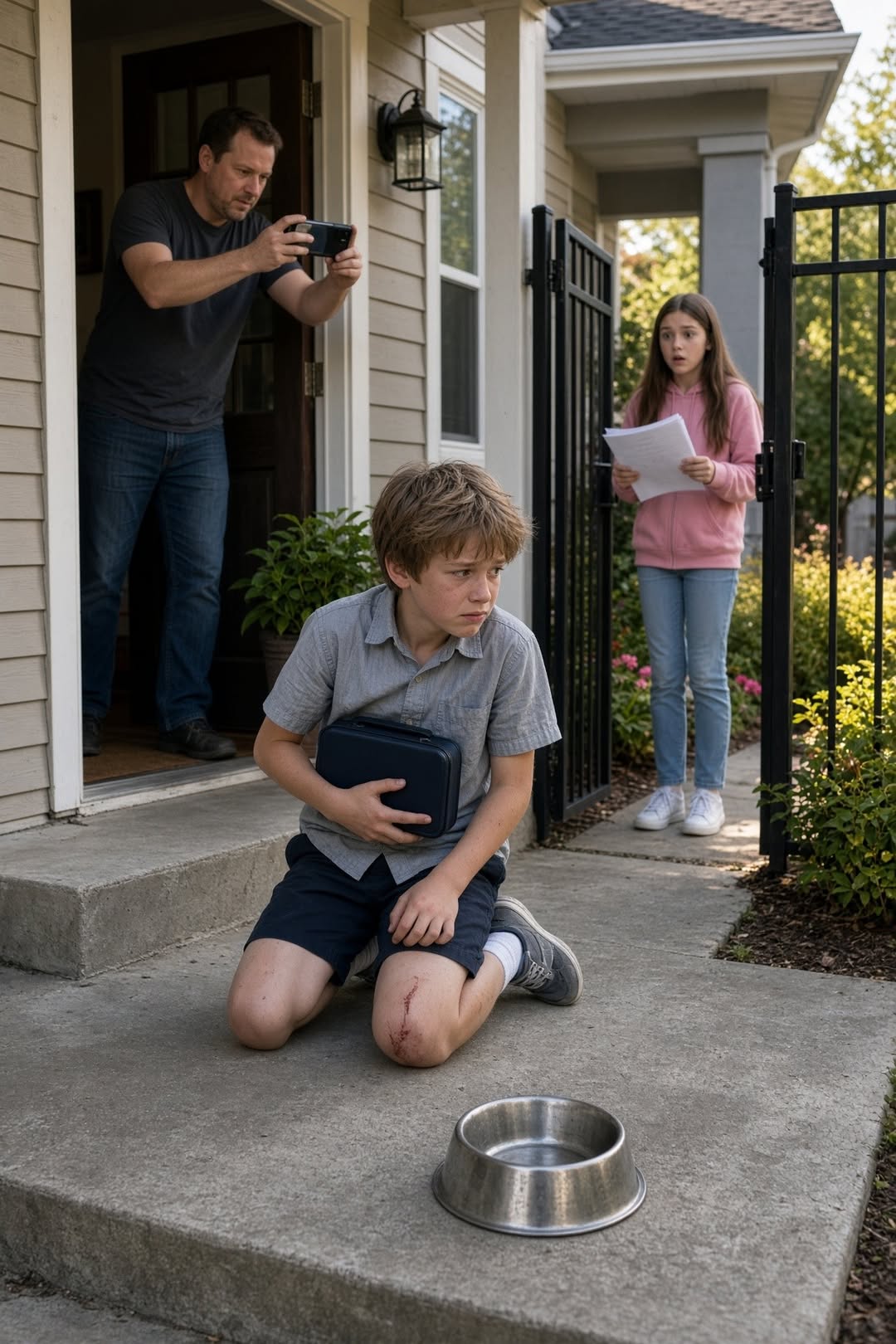
I looked at the locked kitchen door.
Then I looked at the lunchbox still tucked against my side.
“Yes.”
The neighbor’s mother turned the camera slightly toward the deadbolt again.
My mother noticed.
“You’re making this look worse than it is.”
“No,” the neighbor’s mother said. “I’m documenting what I can actually see.”
My mother stepped closer.
“You don’t know my family.”
“I know your daughter was kneeling beside an empty dog bowl with an unopened lunchbox while your boyfriend told her to bark for dinner.”
My mother opened her mouth.
Nothing came out.
Her boyfriend looked toward the street.
That was when my teacher asked about the fundraising page.
My mother immediately said it was legitimate.
The neighbor’s mother asked who had created it.
My mother said she had.
My teacher asked why the school had not been informed.
My mother said she had been too busy dealing with everything at home.
Then my teacher asked a question that neither of them expected.
“How much money has been raised?”
My mother hesitated.
Only for a second.
But everyone heard it.
“I don’t know,” she said.
The neighbor’s mother looked at me.
I didn’t know either.
I had never been told about a fundraiser.
I had never seen the page.
I had never asked anyone for money.
My mother had been posting videos of me while telling strangers online that I was difficult, ungrateful, and constantly demanding things she could barely afford.
Apparently, those same strangers had been sending money.
The neighbor’s mother asked my teacher whether the school had received any communication from my mother about my supposed lack of food or school supplies.
“No,” my teacher said.
That answer landed harder than an accusation.
My mother tried to regain control.
“She didn’t tell me to contact the school.”
My teacher replied, “I’m asking why the school was never contacted if she was struggling for basic necessities.”
My mother looked at her boyfriend.
He looked back at her.
For the first time, they seemed less like a team and more like two people trying to decide who would be blamed first.
Then my phone buzzed.
It had been in my pocket the whole time.
I pulled it out.
There was a notification from an unfamiliar account.
The message said someone had recognized me from one of my mother’s videos and wanted to know whether I really needed the things being listed on the fundraiser.
I showed the neighbor’s mother.
She read it twice.
Then she asked my mother, “Where is the money going?”
My mother snapped.
“That’s none of your business.”
“It became my business when I saw a child locked away from food.”
My mother stepped forward.
Her boyfriend moved too.
The neighbor’s mother did not retreat.
Instead, she told my teacher exactly what she had witnessed.
My teacher listened.
Then she said she was going to contact the school counselor and the principal.
My mother immediately objected.
“You are not taking my daughter away from me.”
My teacher’s voice remained calm.
“I haven’t said that.”
“You’re making it sound like I abuse her.”
No one answered.
My mother heard the silence and became louder.
“She has food. She has clothes. She has a home. She has everything she needs.”
I looked down at my lunchbox.
It was still sealed.
The neighbor’s daughter noticed too.
She whispered something to her mother.
Her mother nodded.
Then she asked my mother whether I could eat the lunch that was sitting in my hands.
My mother said dinner would be later.
Her boyfriend corrected her.
“She knows the rules.”
The neighbor’s mother looked at him.
“What rules?”
He said nothing.
My mother answered quickly.
“House rules.”
My teacher interrupted.
“I heard him say she gets dinner when she does what she’s told.”
The boyfriend’s jaw tightened.
My mother turned toward him.
It was the first time she had looked at him with something other than agreement.
He noticed.
“So now this is my fault?” he asked.
“I didn’t say that,” my mother replied.
“You’re looking at me like I did something.”
The neighbor’s mother raised her phone slightly.
“You both need to stop talking as though this is a video you can delete.”
That silenced them.
The next morning, the school counselor came to the house with the principal.
I was sitting at the kitchen table by then.
The door was no longer locked.
My mother had opened it before they arrived, but she kept insisting that the previous night had been misunderstood.
She said the dog bowl had been part of a harmless joke.
She said I had refused to eat.
She said her boyfriend had been teasing me.
She said the fundraising page had been created because she was trying to help me.
The counselor asked to see the page.
My mother hesitated.
Then she handed over her phone.
The page showed my name.
It used several photographs of me.
Some were from school.
Some were screenshots from videos my mother had posted.
The description said our family was struggling to provide me with food, school supplies, and basic necessities.
There was a donation total.
It was far more money than I expected.
The principal looked at my mother.
“Did you use these funds for school supplies?”
“Yes.”
“Can you show us the receipts?”
My mother said she would have to find them.
The counselor asked about food purchases.
My mother said those receipts were at home somewhere.
Then the principal asked whether the school had ever received any of the supplies supposedly purchased for me.
My mother said that was irrelevant.
It wasn’t.
My teacher had kept records.
I had repeatedly arrived without lunch.
I had missed assignments because I didn’t have access to the kitchen table or my school materials.
The neighbor’s daughter had been bringing my homework to the gate because I couldn’t go to her house.
None of those details alone explained everything.
Together, they told a story my mother could no longer control.
The counselor asked me whether I felt safe going home that night.
I looked at my mother.
She was watching me closely.
I thought about the phone pointed at my face.
The empty bowl.
The locked door.
The command to bark.
The sealed lunchbox.
Then I looked at my teacher.
“No,” I said.
My mother stood up.
“You don’t mean that.”
I did.
The school arranged for me to stay somewhere safe while the situation was assessed.
My mother protested all the way to the door.
She said everyone was turning against her.
She said I was being manipulated.
She said the neighbors had always disliked her.
Then she said something I will never forget.
She looked at my teacher and asked why strangers online had believed me more than she did.
My teacher answered quietly.
“They believed what you showed them.”
That was the end of the argument.
Not because my mother agreed.
Because there was nothing left for her to edit.
Over the following days, the school and the appropriate authorities reviewed the fundraiser, the videos, and the circumstances at home. The money connected to the page was traced as part of that process. My mother had to explain where donations had gone, why my name and photographs were used, and why the public story about my needs did not match what the adults around me had actually observed.
The videos changed everything too.
People who had once laughed at the clips began asking questions.
Some deleted their comments.
Some demanded refunds or explanations.
Others contacted the school after seeing the footage and realizing that what they had treated as entertainment involved a real child.
My mother stopped posting.
Her boyfriend stopped coming around the school.
I didn’t hear from either of them for a while.
The strangest part was how ordinary life began to feel after the chaos.
At school, my teacher stopped asking whether I had finished my homework before asking whether I had eaten.
The counselor made sure I had access to breakfast and lunch.
The neighbor’s daughter kept bringing me assignments, but now she didn’t have to stand at a gate to pass them through.
One afternoon, she sat beside me during study period and pushed a worksheet across the desk.
“You missed question seven,” she said.
I looked at it.
“I hate question seven.”
She smiled.
“Everyone hates question seven.”
I laughed.
It was a small laugh.
Nobody filmed it.
Nobody posted it.
Nobody turned it into proof that I was grateful or ungrateful.
It was just a laugh.
Weeks later, I was finally allowed to bring my own lunchbox to school without wondering whether I would be allowed to open it.
The first morning I opened it at my desk, I stopped for a moment.
I realized I was waiting for someone to tell me I hadn’t earned it.
No one did.
I ate.
That was all.
But it felt like something much bigger.
My mother had spent months trying to convince strangers that I was an ungrateful child who needed to learn a lesson.
In the end, the evidence that changed everything wasn’t a dramatic confession.
It was a sealed lunchbox.
An empty bowl.
A locked door.
A teacher’s note.
A neighbor who decided to document what she actually saw instead of arguing about what she was told.
And a girl my age who simply brought my homework to the gate because she noticed I was missing.
The fundraiser had promised people they were helping a child who needed food and school supplies.
But when the people around me finally looked at what was happening instead of what my mother told them to believe, they saw something very different.
They saw a child who had been taught to stay quiet.
And for the first time, someone asked me a question that wasn’t designed for an audience.
“What do you want?”
I didn’t have a big answer.
I wanted to finish school.
I wanted to eat when I was hungry.
I wanted my homework to stay mine.
And I wanted nobody to point a camera at me when I was hurting.
For once, those things were enough.