Chapter 1: The Anatomy of a Betrayal
A decade ago, seated around the scarred mahogany of our own kitchen table, my father auctioned off my fiancé to my younger sister as if he were negotiating a prime supplier contract.
He didn’t blink. He simply locked his cold, calculating eyes on mine and delivered the verdict. “Serena is polished, Elora. She’s ambitious. She is the kind of woman a man builds a legacy with. You are the engine we keep hidden in the back room. You are not a partner.”
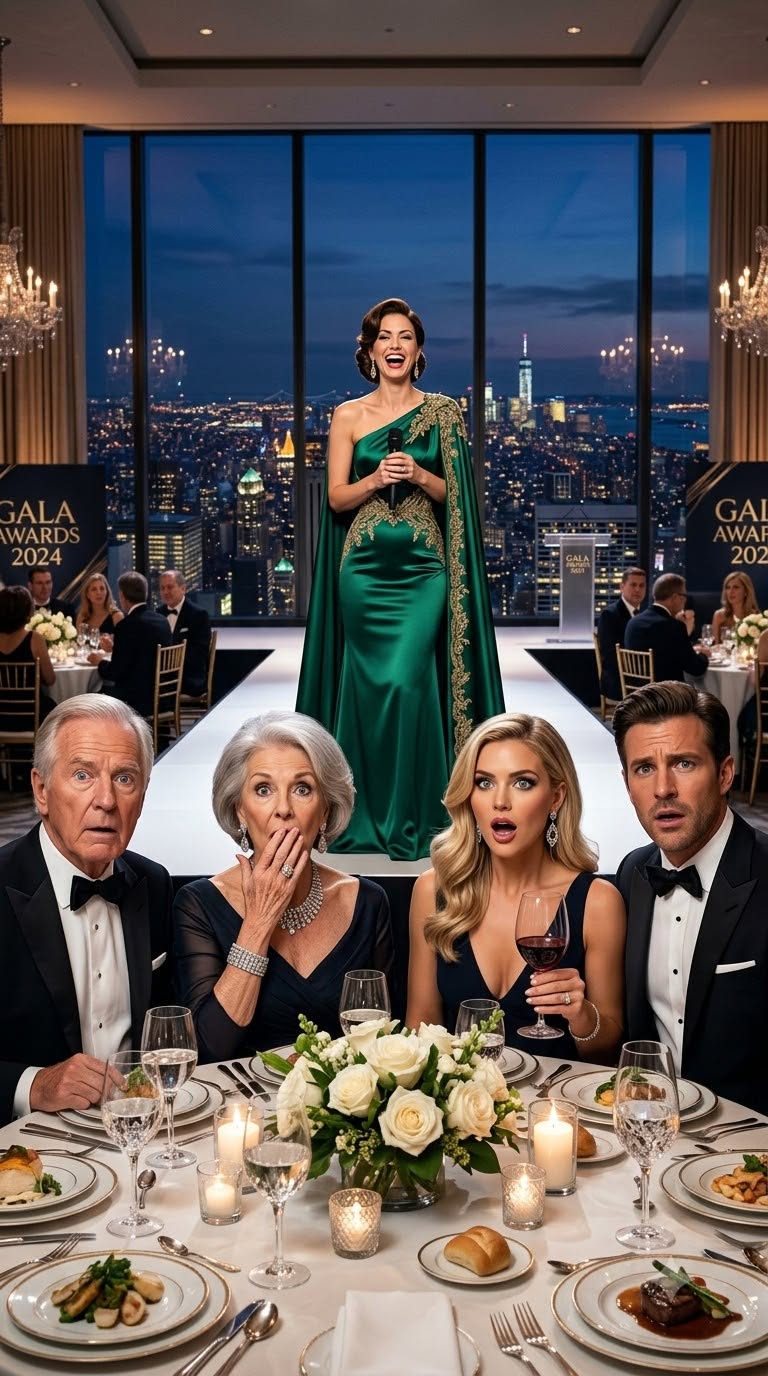
Beside him, my mother offered a slow, validating nod, her face a mask of pragmatic business logic. Across from her, my sister, Serena, allowed a small, sympathetic smile to touch her lips—the smile of a victor graciously accepting a trophy she always believed was hers. Not a single voice was raised. There was no screaming, no shattered glass. They had merely convened to officially classify me as a pair of calloused hands, deciding with terrifying calm that my late-night recipe development, my bruised knuckles, and the man I intended to marry were better suited for the daughter who looked the part.
I didn’t cry. The betrayal was so absolute it bypassed grief and crystallized directly into ice. I slipped the diamond engagement ring off my finger. I set it on the mahogany wood; it made a pathetic, hollow clink that no one acknowledged. I stood up, walked to the kitchen, and retrieved the one frayed, oil-stained ledger they had never bothered to open. By Tuesday of that same week, I had driven my beat-up sedan past the Ohio state line.
They truly believed that was my finale. They assumed my quiet compliance was a symptom of weakness. They had absolutely no comprehension of the empire a silent woman can construct once she permanently stops asking for a seat at their table.
My name is Elora Carter. I am thirty-four years old. If you have ever been treated like an indentured servant by the people whose blood you share, you will recognize the geography of this story.
To fully grasp the magnitude of that mahogany table, you must first understand the suffocating heat of the kitchen that birthed it. My parents were the proprietors of The Carter Hearth, a catering business in Chillicothe, Ohio. It had been operating for over two decades, existing in the town’s consciousness like an old, reliable oak tree. It was steady. It was respected.
What the town didn’t realize was that the celebrated, mouth-watering iteration of The Carter Hearth they adored didn’t exist until I was old enough to reach the stovetop.
I was barely twelve the first time my mother pointed a manicured finger toward the dishwashing station and told me to remain out of sight. A prominent local wedding was in full swing, and she needed the silver platters rotating seamlessly. I recall the stifling humidity, the cacophony of clattering porcelain, the way the elegantly dressed adults spoke right through me. I remember naively thinking, If I just execute this perfectly, they will trust me with more.
I executed it perfectly. I continued to execute it perfectly for the next fifteen years. And somewhere in that blur of scorched butter and blistered fingers, my flawless execution became the only currency I was allowed to spend.
In the ecosystem of our family, Serena was the glossy, embossed menu. I was the grease trap.
Serena is two years my junior. From the moment she could walk, the casting was finalized. She was the photogenic one, the charismatic conversationalist, the one they dressed in cashmere and positioned at the tasting tables to charm the affluent clients. By the time she turned twenty-two, she held a fabricated title in “Client Relations” for a neighboring firm. My parents breathed the word successful around her name with the reverence of a prayer.
I, conversely, was the phantom who could take a dry, archaic family recipe and quietly re-engineer it into a dish that people would drive forty miles to consume. My culinary alchemy never earned me a title. It only earned me heavier platters to carry. Every glowing review the business ever received filtered directly through my kitchen doors, yet not a single syllable of that praise was ever allowed to rest on my shoulders.
Chapter 2: The Architect in the Shadows
I could recount a thousand identical afternoons, but a single crisis encapsulates my entire existence in that house. I was nineteen. We were contracted to cater a lavish outdoor reception for two hundred and fifty guests. Ninety minutes before the first course was scheduled to drop, the compressor on the primary walk-in refrigerator died. Half of our premium proteins came up to room temperature, dangerously unsafe to serve.
My father was pacing the alleyway, screaming at an emergency repair dispatcher who promised a technician by tomorrow morning. My mother was hyperventilating near the loading dock, weeping tears of impending social ruin.
I didn’t panic. I surveyed the surviving inventory—a fraction of what we needed. In the span of four minutes, I mentally dismantled the entire five-course menu and rebuilt it from the ground up. I stretched the safe ingredients, merged three appetizers into two complex tapas, and radically altered the plating architecture to create an illusion of abundance. I cooked with a feral, mechanical precision.
When the reception concluded, no one in that tent had a clue we had been minutes away from a catastrophic failure. The bride’s weeping mother cornered my parents by the champagne fountain, clasping their hands, declaring it the most exquisite culinary experience of her life.
My father puffed out his chest, accepting the adoration as his birthright. My mother dabbed her eyes and purred, “We pour our souls into our craft.”
I was ten feet away, concealed behind a canvas partition, aggressively scrubbing a scorched copper pan, close enough to hear every stolen syllable. That was the exact moment the invisible contract of my life was illuminated. I was designated to manufacture the miracles. They were designated to collect the applause.
But I kept a ledger. This detail is the fulcrum upon which my entire life turned.
The Carter Hearth maintained a vintage wooden box filled with yellowing recipe cards. These were the foundational formulas my parents had utilized since their inception. They were adequate. They were profoundly mediocre.
What I curated was entirely different. Inside a heavy, black obsidian-bound notebook, I documented every microscopic adjustment I made. Every acid ratio I balanced, every braising technique I modernized, every subtle infusion that elevated their adequate food into something hauntingly memorable. The entire reputation of their business was trapped in the ink of my handwriting. My parents capitalized on the contents of that book every single day, yet they never once bothered to read it.
To them, the genius belonged to the family name; therefore, the credit belonged to them. When I was seventeen, I tentatively asked if my name could be printed in small font at the bottom of the seasonal tasting menu I had entirely designed. My mother didn’t even pause her typing.
“These are family traditions, Elora,” she scoffed, her tone dripping with condescension. “Nothing under this roof is exclusively yours.”
So, I bit my tongue, and I kept writing. But I made one crucial adjustment. I stopped leaving the Obsidian Ledger on the kitchen prep station overnight.
Chapter 3: A Strategy of Silence
Hovering above the primary chopping block was a framed certificate. It was a minor, regional industry accolade the business had won years prior, back when we still harbored illusions of grandeur. The certificate bore the signature of the lead adjudicator: Elias Thorne. I had no idea who he was. To me, it was just a scrawled signature on fading parchment—a ghost of a reminder that the food I labored over had, momentarily, been acknowledged by someone of consequence. I wiped the grease off that frame for years, utterly blind to its prophecy.
The afternoon the Valiant family arrived to discuss supply chain logistics, my mother intercepted me in the hallway. “Keep your apron on and stay near the dish pit,” she commanded in a hushed, urgent hiss. “Let Serena handle the introductions. They are looking to expand.”
I was instructed to vanish. I rationalized it as a simple division of labor. I was devastatingly naive.
Julian Valiant was the heir to Valiant Provisions, the monolithic distributor that supplied seventy percent of the region’s restaurants. He arrived unannounced one rainy Tuesday with a specialty delivery that wasn’t even on our manifest. Instead of leaving it with the dock manager, he bypassed the front office, navigated the labyrinth of hallways, and pushed through the swinging doors of my kitchen.
He found me elbow-deep in a massive batch of mirepoix.
“Someone hiding back here is the actual reason this joint has a three-month waiting list,” Julian said, dropping a crate of truffles onto the stainless steel. “I’ve spent two years trying to deduce who it was.”
I froze, the chef’s knife hovering in my hand. People did not venture into the back to find me. People sought out Serena’s radiant smile, and I slid plates through a window. But Julian kept returning. And every time he arrived, he bypassed the showroom and came straight to the grease and the heat. For the very first time in my existence, a human being was searching for me instead of looking through me.
We dated in secret, then in public, for two years. I handled his affection with terrified reverence, the way one holds a fragile, stolen artifact. He was confident, grounded, and his certainty anchored my anxiety. One evening, after I tearfully apologized for falling asleep during a movie after a grueling fourteen-hour double shift, he cupped my face.
“You do not have to perform to earn your keep with me, Elora,” he whispered. “That isn’t how love operates.”
He proposed in the biting chill of February. I was twenty-five. We began drafting plans for a modest autumn ceremony. For a fleeting, euphoric month, I genuinely believed my life was finally transforming into my own property.
My parents, however, were looking at a different blueprint. They saw Valiant Provisions.
My father began speaking of Julian not as a future son-in-law, but as a hostile corporate takeover he had successfully mitigated. He would swirl his scotch after Sunday dinners and pontificate: “A tier-one supplier bound to the family by marriage? Preferred wholesale pricing. First pick of seasonal yields. That isn’t serendipity; that is predatory strategy.”
Simultaneously, Serena began to infiltrate. It was microscopic at first. She would happen to drop by the kitchen when Julian was leaning against my counter. She would miraculously find a seat next to him during Sunday roasts. My mother began orchestrating the seating charts, deliberately praising Serena’s newfound “domestic interests” across the gravy boat, ensuring the volume was loud enough for Julian to absorb, and just loud enough to twist the knife in my ribs.
One specific dinner remains branded into my prefrontal cortex. Julian’s parents were visiting to discuss the wedding logistics. I had spent twelve hours fabricating a flawless, multi-course French-countryside menu. As the final plates were cleared, Julian’s father leaned back, deeply impressed, declaring it a Michelin-worthy feast.
My mother instantly reached out, placing a manicured hand over Serena’s wrist. “Serena has been dedicating herself to the culinary arts,” my mother purred. “She possesses an innate, almost magical intuition for flavors.”
Serena had not touched a skillet since the Bush administration. Yet, she lowered her eyelashes, smiled modestly, and absorbed the lie. Julian looked at my sister—really looked at her—with the expression a man wears when he discovers a hidden compartment in a luxury car.
I stood up silently and began clearing the soiled napkins, because that was my designated function at my own engagement dinner. A cold dread coiled in my gut, but I suffocated it. I was a master at explaining away the toxins that were actively poisoning me. It’s just wedding stress. My mother is just trying to make Serena feel included.
I was dangerously wrong, and I realized it three weeks too late.
The dinner that severed my timeline occurred in late May. My father requested a “strategic family alignment,” a phrase that should have triggered every alarm bell in my nervous system. When I pushed open the dining room doors, Julian was already seated. Serena was positioned closely beside him. Two glasses of expensive Bordeaux were poured at their quadrant of the table. My placemat was empty.
No one made eye contact. In a household that had spent two decades looking past me, the sudden, agonizing physical effort they exerted to avoid looking at me entirely was a siren wailing in the dark.
“We need to reevaluate what yields the highest return for this family’s future,” my father commenced, his voice devoid of paternal warmth.
The “highest return,” it was rapidly revealed, had been fully engineered in my absence. He laid it out with the clinical detachment of a corporate restructuring. Serena and Julian had realized a profound connection. It was statistically and socially more viable. Serena was equipped to host the galas a man of Julian’s stature required. She was the face of a dynasty.
And then, my father delivered the kill shot. “Serena is polished. She’s ambitious. She is the kind of woman a man builds a legacy with. You are the engine we keep hidden in the back room. You are not a partner.”
I implore you to focus on the terrifying vacuum of reaction that followed. My mother did not gasp in maternal horror. Serena did not weep in sisterly guilt. Julian did not violently push his chair back to defend my honor.
My mother nodded, validating the transaction. Serena offered her small, expectant smile.
The words didn’t shatter me; the unified, rehearsed silence of the three people co-signing my execution did. I whipped my head toward Julian. He was supposed to be my sanctuary. “Say something,” I demanded, my voice trembling for the first and last time.
Julian stared at his reflection in the mahogany. “Your family’s ecosystem just operates more efficiently with Serena at the front,” he muttered. “I am sorry.”
That was the entirety of his defense. Not a confession of overwhelming passion for her, nor a cessation of love for me. Just a cold calculation that my family “operated more efficiently” with the pretty sister. He believed he was marrying into an unstoppable local monopoly, securing a plush runway for his life. He was entirely oblivious to the fact that he was anchoring himself to a hollow shell that was rapidly hemorrhaging the single ingredient that kept it alive.
He didn’t know that yet. Neither did they.
I slid the ring off. The metal kissed the wood without a sound. I rotated on my heel and walked into my kitchen.
My mother shadowed me to the doorway, hovering like a warden. “Do not orchestrate a hysterical scene, Elora,” she warned. “Just leave the recipe box on the counter.”
She was referring to the vintage wooden box of adequate formulas. The intellectual property she deemed valuable. She had never once peeked inside my Obsidian Ledger, so it didn’t even cross her mind to confiscate it.
I reached to the highest shelf. I pulled down the heavy black notebook. Beside it lay a small, slightly rusted paring knife. The handle was chipped wood, with the letter ‘E’ deeply gouged into it by my own hands years ago. My mother had berated me to discard it for a decade. I slid the knife and the ledger into my duffel bag. I left their vintage wooden box exactly where it belonged.
She retained her precious index cards. She simply forfeited the mind that made them sing.
I packed my existence in thirty-six hours. I offered no arguments, penned no dramatic letters, and denied them the narcissistic supply of a tearful goodbye. I ignited the engine of my sedan with a notebook, a chipped knife, and fourteen hundred dollars to my name. I aimed the headlights toward a geographic location that felt appropriately vast.
I didn’t choose New York or Chicago. I chose away. Six hours of hypnotic highway lines, driving in absolute, suffocating silence because any music felt like a mocking intrusion on my grief.
Chapter 4: The Diner and the Stone
Somewhere near the border, the ghost of Ohio stopped haunting my rearview mirror and the brutal reality of survival commenced. I leased a microscopic room above a laundromat by the week. I possessed no blueprint, no network, and zero financial parachute.
The initial months were a masterclass in grueling, unromantic labor. My first foothold wasn’t a culinary temple; it was a fluorescent-lit diner that required a pulse for the graveyard shift. I accepted it because it covered the rent and the manager didn’t ask probing questions. I flipped rubbery eggs for exhausted long-haul truckers at 3:00 AM. I kept my mouth shut. Advertising my capabilities had only ever resulted in my exploitation, so I cloaked myself in radical mediocrity.
I consumed my meals standing over a trash can. The silence radiating from my phone was deafening. There is a very specific, haunting frequency to the silence that follows escaping an abusive family. It is a suffocating cocktail of profound relief and agonizing grief, and in the dead of night, it is impossible to distinguish which emotion is choking you.
But the diner’s head line-cook vanished on a bender, and their menu was a graveyard of sodium. One Tuesday at dawn, operating on pure muscle memory, I reconstructed a spoiled batch of hollandaise into a vibrant, citrus-infused béarnaise for a special I wasn’t authorized to run. The gruff owner sampled it, his eyes widening as he looked at me like I had been concealing a weapon.
I had been.
That was the initial fracture in the dam. Every subsequent door I encountered, I kicked open using the exact same methodology: I made myself aggressively undeniable at a microscopic task until the gatekeepers were forced to grant me access to a larger one. I monopolized the shifts everyone loathed. The brutal closes, the 4:00 AM prep. I executed the labor that leaves your nerve endings fried and your spine aching. I was terrifyingly competent—so fluid that the chaos of a rush hour kitchen seemed to bend to my will.
I refused assistance. I declined days off. When a sous-chef inquired when I last slept a full eight hours, I offered a response I only fully comprehended years later. “Rest is for people who have a destination to return to.”
I told him that the absolute first action I took in my rented, mildew-scented room every night was to sharpen my blade. I would sit on a mattress that wasn’t mine, in a city I selected solely for its distance from my trauma, and I would grind that chipped paring knife against a wet stone until the edge was lethal. My mother had ordered me to throw it away a thousand times. It was the singular, undeniable object I possessed that was purely mine. Not the family’s. Not the business’s. Not a recipe they could plagiarize.
It molded to my grip. It sliced clean. In those dark hours, it represented the entirety of my un-stealable worth. And for a long time, that razor edge was enough to keep the demons at bay.
I was sprinting, pretending my relentless momentum was merely a fierce work ethic. The psychological reality was significantly darker. I had been indoctrinated for a quarter of a century to believe my sole justification for breathing was my utility. Now, unmonitored and alone, I couldn’t switch the machinery off. I was terrified of what would remain of Elora if she stopped being useful.
Then, I encountered Silas Vance.
Silas was the executive chef at the second, much higher-tier establishment I infiltrated. He was a silver-haired stoic who communicated in grunts and micro-expressions. One evening, after a bruising service, he sat on a milk crate and consumed a staff meal I had frantically assembled from the walk-in scraps. He chewed, swallowed, and gently placed the ceramic bowl on the prep table.
“Who engineered your palate?” he rasped, his eyes locking onto mine.
“Isolation,” I replied flatly.
He analyzed me for an uncomfortable duration. The following Thursday, my name was scrawled on the whiteboard to command the expo line for a Friday dinner service alone. It was the first time in my thirty years on earth that another human being handed me the reigns instead of the scrub brush.
I solidified my standing with Silas the only way I knew how: by neutralizing a catastrophe before it detonated. We were two hours away from a VIP buyout—fifty covers, a rigid, highly publicized tasting menu. Our premier seafood purveyor ghosted us, leaving us with putrid halibut. Silas was reaching for the phone to cancel the buyout, ready to absorb the massive financial and reputational hit.
I slammed my hand over the receiver. “Give me twenty-five minutes.”
I utilized every favor I had banked in the underground network of line cooks. I bartered prep hours for premium cuts from two neighboring rival kitchens, radically pivoted the entire protein structure of the menu, recalculated the food costs in my head, and had the revised, exquisite tasting menus printed on heavy cardstock before the first VIP checked their coat. The service was a symphony of precision.
Silas observed me from the shadows of the pass for the duration of the night. As the final dessert cleared, he leaned against the steel frame, arms crossed.
“You do not move like a woman desperate for a paycheck,” he stated, his voice a low rumble. “You move like a woman meticulously drafting the blueprints for her own empire. You need to stop waiting for someone to grant you permission to build it.”
I didn’t possess the vocabulary to respond to that yet. But I inscribed his words in the back of my Obsidian Ledger. I was beginning to document absolute truths, just as I had once documented recipes, because I was slowly realizing I couldn’t rely on the world to remember my worth. I had to record it myself.
Silas was the catalyst who pushed me into the arena. He demanded I enter a highly prestigious, regional culinary gauntlet. I adamantly refused, citing my profound exhaustion with being evaluated and discarded by subjective judges.
He didn’t coddle me. He slammed the application onto my cutting board. “It is entirely blind, Elora,” he barked. “No names. No genders. No pedigree. The adjudicators consume the plate and grade the chemistry. It is the single uncorrupted battlefield in this entire venomous industry. Enter the damn ring.”
Blind. No face. No history. For the first time in my conscious memory, I would not be the phantom sister hidden in the scullery.