The name David Vance did more than give me a stranger to investigate. Once I traced him, the last year of my marriage began rearranging itself in my head, and ordinary moments I had never questioned suddenly looked like pieces of the same plan.
I searched public records first because I was afraid of leaving a trail anywhere Julian might see. David Vance’s name appeared beside a small medical-supply company that had closed two years earlier. The second name on the old state filing was Julian’s.
My husband had never told me David existed.
I stared at the screen until the letters blurred. Julian had always described that period of his life as a failed consulting project that cost him some savings. He had never mentioned a partner, much less a partner whose pharmacy receipt was now sitting beneath the container Eleanor used while preparing my tea.
I sent the filing to Sienna.
At first, she thought the receipt could have been accidental. She reminded me that scraps of paper moved around houses all the time, especially when several adults shared a kitchen. For a few minutes, I wanted desperately for her to be right.
Then I sent her David’s full name and the business record.
She called me immediately.
“Don’t go home alone tonight,” she said.
I didn’t.
I picked Chloe up from school myself and told her we were having a sleepover at Sienna’s apartment. Chloe accepted that explanation with the easy excitement of an eight-year-old who thought sleeping in a friend’s guest room sounded like an adventure.
Before we left our house, I moved a bowl of lemons from one side of the kitchen counter to the other. I don’t know why. My hands simply needed something harmless to do while my mind tried to understand that the people I loved might have been planning around my illness.
Julian called while Chloe and I were driving away.
“Where are you?”
I told him Sienna wanted me near the hospital because another doctor wanted to review my latest test results.
There was a pause.
Then he asked, “Did Mom make your tea this morning?”
Every muscle in my shoulders tightened.
It was such a normal question that I might once have missed it. But he had not asked whether I had eaten, whether I was dizzy, whether the doctor was worried, or whether I needed him.
He asked about the tea.
“I don’t remember,” I said.
Another pause.
“Is Chloe with Mom?”
“She’s with me.”
This time, the silence lasted longer.
When he finally spoke, his voice was warm again. “Okay. Keep me posted. I love you.”
I said goodbye without answering the last part.
That night, Chloe slept beside me in Sienna’s guest room while I watched the kitchen recordings on my phone. I had expected the footage to make me feel stronger because it gave me proof. Instead, seeing Eleanor move through our kitchen with practiced calm made me sick in a completely different way.
She rinsed my mug. She opened the tea box. She measured the powder. She stirred.
Then I noticed what I had missed the first time.
On one recording, Eleanor stood with the container closed for nearly thirty seconds. She kept looking toward the doorway instead of preparing the drink. Julian entered wearing his work clothes, set his coffee beside my mug, tapped two fingers against the counter, and walked out without speaking.
Only after he disappeared did Eleanor open the porcelain container.
I replayed it five times.
The gesture alone proved nothing. It could have meant anything.
But it was the first time I allowed myself to think the thought I had been resisting since finding David Vance’s name.
Maybe Julian wasn’t simply living beside what Eleanor was doing.
Maybe he knew.
The next morning, Sienna helped me contact the proper authorities and turn over copies of my medical results, the sample I had taken, the receipt, and the video files. I kept the originals backed up in two separate places. I was told not to confront anyone and not to return to the house with Chloe unless I had a safe reason to do so.
That advice was easy to accept until Julian started calling every hour.
His concern sounded convincing. He offered to bring clothes. He offered to drive me to appointments. He told me Eleanor was worried sick.
Then he said something that made my stomach turn.
“You shouldn’t be making decisions when you’re exhausted like this, Nora. Let me handle things for a few days.”
He had been saying versions of that sentence for months.
When the fatigue had become severe, Julian had started organizing my medications. He answered questions during appointments when I struggled to concentrate. He took over household bills after telling me stress was making my symptoms worse.
At the time, I had been grateful.
Now I remembered one appointment when he had asked my doctor whether prolonged illness could affect someone’s judgment. The doctor had answered generally and moved on. I had even squeezed Julian’s hand afterward because I thought he was frightened for me.
I hadn’t realized he might have been asking for himself.
Investigators began looking into David Vance while I stayed away from home. What came back was worse than the old company filing.
David had not merely worked with Julian. He had loaned money to Julian’s business shortly before it collapsed. Public court records showed a dispute over a large unpaid balance, followed months later by a private settlement.
The settlement happened during the same period when Julian began insisting that we should refinance my house.
The house was mine because my mother had left it to me before she died.
That detail had never mattered between us when our marriage felt safe. Julian and I raised Chloe there. Eleanor cooked there. Birthdays, Christmas mornings, fevers, school projects and late-night arguments had all happened beneath that roof.
But the title had always remained in my name.
Julian had brought up refinancing three times. Each time, I said no because I didn’t want my mother’s house tied to one of his business problems.
The last time I refused was about a month before my health began getting noticeably worse.
For the first time, I had something that looked like a motive.
It still wasn’t enough to tell me exactly what they planned to do.
For several days, nothing moved forward. Another recording showed Eleanor preparing my tea again, following the same routine with the same container. She looked at her phone, waited, measured the powder and stirred.
No one entered the kitchen. No message was visible. No second person appeared.
It confirmed the pattern but gave us nothing new.
Those days were almost harder than the first discovery because I had time to doubt myself. Julian continued playing the worried husband. Eleanor sent Chloe voice messages saying she missed her. Chloe asked why Grandma couldn’t come to our sleepover.
I told her only that the adults were dealing with something serious and that she had done the right thing by telling me what she saw.
“Is Grandma in trouble?” she asked.
I couldn’t lie to her.
“Some grown-ups made choices that need to be investigated.”
Chloe looked down at her hands. “She told me not to touch the white jar.”
I crouched beside her.
“When?”
“A lot. She said it was medicine for old people.”
I asked if Eleanor had ever put it in anyone else’s drink.
Chloe shook her head.
Only mine.
The next major break came from paperwork, not the camera.
A loan packet had been prepared using my house as collateral. The application had never been completed, but my name appeared on documents I had never seen, alongside a copy of an authorization that supposedly allowed Julian to act for me if I became unable to manage my own affairs.
The signature on one page looked like mine.
It wasn’t.
David Vance was connected to the financing company listed in the packet.
Suddenly the shape of the plan became visible.
My illness wasn’t random cruelty. My weakness had practical value to them.
The sicker I became, the more responsibilities Julian took over. The more responsibilities he controlled, the easier it became to portray me as someone who could no longer manage complicated decisions involving money or property.
I remembered documents he had brought to the hospital months earlier when I was dehydrated and barely awake. He had told me they were routine insurance forms. I had signed two places without reading everything.
Whether those papers were connected was still being determined, but I finally understood why Julian had been so interested in my appointments, my fatigue and my ability to concentrate.
He hadn’t just watched me become sick.
He had built a life around my sickness.
Sienna apologized for originally dismissing the receipt as something that might have been misplaced.
“I wanted there to be a harmless explanation,” she admitted.
“So did I.”
Neither of us said Eleanor’s name after that.
Then the situation seemed to collapse almost overnight.
Eleanor was questioned before anyone had enough evidence to take action against Julian. She admitted putting the powder into my tea but insisted Julian knew nothing about it.
According to what I was later told, she claimed she believed she was giving me something that would calm an inflammatory condition. She said David had provided it. She said she hid it because she knew I would object to taking something that wasn’t prescribed to me.
She took responsibility for the kitchen and separated Julian from every decision she described.
David, meanwhile, denied telling Eleanor to dose me with anything. He acknowledged knowing Julian and confirmed their financial dispute, but he claimed medication had disappeared from his belongings during a period when Julian had visited him frequently.
Three people. Three versions. And only one person admitting she had touched my tea.
For the first time since Chloe whispered to me, I felt genuinely afraid we would never prove the part that mattered most.
Eleanor might face consequences for what she had done, but Julian was still my husband. He was still Chloe’s father. He still had access to our finances and years of documents bearing both our names.
The evidence connecting him to the loan scheme could establish financial wrongdoing, but it did not automatically prove he knew what was being put into my body.
I sat in Sienna’s guest room after Chloe fell asleep and stared at Julian’s latest message.
“Mom made a terrible mistake. Please don’t destroy our family over this.”
Not once did he ask what the substance had done to me.
Not once did he ask how long recovery might take.
He asked me not to destroy the family.
I nearly called him.
I wanted to hear his voice and demand the truth. I wanted to ask how many mornings he had watched me lift that mug. I wanted to know whether he remembered rubbing my back when I was sick in the bathroom, or sitting beside my hospital bed while doctors tried to understand my bloodwork.
But I didn’t call.
That choice gave investigators time to examine the camera’s full memory rather than only the clips I had saved manually.
The final piece had been there the entire time.
My camera recorded motion at night as well as during the morning. Because I had been focused on Eleanor making tea, I had barely looked at the overnight clips.
One recording began after 1 a.m., two nights after I installed the camera.
Julian entered the kitchen alone.
He checked the hallway first.
Then he took the white porcelain container from behind the tea boxes.
From his pocket, he removed a prescription bottle.
Even before the image was enhanced enough to compare details, I recognized the shape and the pale tablets inside. Julian crushed several of them using the bottom of a small glass, poured the powder into Eleanor’s container and wiped the counter.
Then Eleanor entered.
She looked at the container and asked quietly, “How much tomorrow?”
Julian answered, “Less. Her appointment is Thursday.”
I stopped breathing.
Eleanor asked whether it was enough.
Julian said, “We just need her too sick to fight everything at once.”
There was no metaphor to hide behind. No innocent explanation. No gesture that could be interpreted two ways.
My husband had filled the container himself.
He knew there was an appointment.
He knew I was getting sick.
And whatever his exact expectation had been, he understood that my illness made it harder for me to protect myself.
The recording also changed David’s role. Additional evidence later supported that Julian had obtained medication connected to David, though investigators still had to determine what David knew about its eventual use. I stopped trying to solve every person’s legal responsibility myself.
I finally had enough to understand the betrayal that had happened inside my own home.
The consequences came quickly after that.
Julian could no longer present himself as the worried husband who had simply trusted his mother. Eleanor could no longer claim she had acted without his knowledge. The financial documents, the medical evidence, the kitchen recordings and the prescription connection were now parts of the same investigation.
I was advised that the final charges and court outcomes would take time, and I learned not to confuse an investigation with a finished verdict. What mattered immediately was that Chloe and I were protected, Julian no longer controlled my finances, and neither he nor Eleanor could simply walk back into the house and resume our old life.
David cooperated through an attorney. I never met him face-to-face. By then, I didn’t need another dramatic confrontation.
The confrontation I cared about came in a recorded message from Eleanor.
She was crying.
For ten years, that sound would have broken me.
She said she loved me. She said things had gone further than she intended. Then she said the sentence that finally ended whatever relationship remained between us.
“He’s my son, Nora. I was trying to save him.”
I listened once.
Then I stopped the recording.
She had spent ten years telling me I was like a daughter to her. But when protecting her son required sacrificing someone, she had decided exactly how much that daughterhood was worth.
Julian tried a different approach.
He said David had been pressuring him over money. He said the business failure had terrified him. He said he only wanted enough time to restructure the debt before I found out how bad things were.
Then he said, “I never wanted you dead.”
As if that sentence restored something.
As if there were a safe amount of secretly making your wife ill.
I didn’t answer him either.
My health did not return overnight. Once the exposure stopped and my doctors knew what they were looking for, the mystery surrounding my symptoms began to lift, but recovery was gradual. My bloodwork improved in stages. My skin cleared. Some mornings my joints still ached badly enough to remind me how long I had ignored my own body because people I trusted kept telling me everything was under control.
Chloe struggled too, although differently.
For weeks, she watched adults’ hands whenever someone prepared food. She once asked Sienna if she was putting anything secret into pasta sauce.
Sienna answered without laughing or making Chloe feel foolish. She showed her every ingredient on the counter.
That was when I understood how deeply Eleanor and Julian’s choices had reached into our home. They had not only damaged my health. They had taught my daughter that love might require surveillance.
I refused to let that lesson become permanent.
So we rebuilt ordinary things slowly.
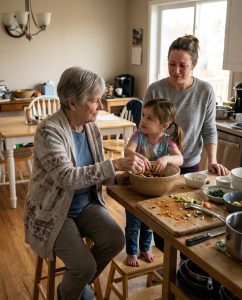
We cooked together. Chloe measured flour. I tasted sauces before serving them, not because I was afraid, but because that was what people did while cooking. We talked openly when either of us felt nervous.
Months later, after I was cleared to return home, the kitchen looked almost exactly as it had before.
The tea boxes were still in the cabinet. The same window faced the backyard. The same marks from Chloe’s crayons remained on one corner of the breakfast table.
The white porcelain container was gone with the evidence.
I was glad.
One Saturday morning, Chloe climbed onto a stool while I boiled water. She chose chamomile from a new box and dropped a tea bag into my mug.
Then she reached for the honey and stopped.
“Can I put it in?”
I handed her the spoon.
“Yes. While I’m watching.”
She smiled and stirred once, twice, three times.
For years, Eleanor had placed tea in front of me and told me it would help my stomach. I had believed the cup represented care because I trusted the person holding it.
Now I knew better.
Care wasn’t something hidden inside a gesture. It was the freedom to know what was being given to you, to ask questions, to say no, and to remain fully yourself around the people who claimed to love you.
Chloe pushed the mug toward me.
I picked it up with both hands.
This time, I knew exactly what was inside.