
Marcus Reed kept his hand on the mouse while the recovered GPS route flickered across his monitor. The line from the traffic stop ended at the riverside storage lot, then disappeared. For a few seconds, the dispatch center was silent except for rain against the windows and the low hum of equipment.
Sarah Bennett broke the silence.
“Marcus, can you send me the coordinates?”
“I already did.”
“Then I’m going there.”
“Wait.” Marcus looked again at the access history. “Don’t go alone.”
Sarah stopped beside the ambulance bay, one hand on the radio clipped to her vest. Harper had already been taken inside for treatment. The child was alive, but the image of her barefoot on that cold floor had stayed with both of them.
“I’m not waiting for someone who may be connected to this,” Sarah said.
Marcus understood what she meant. The deleted records had not vanished by accident. Someone with supervisor-level access had removed them. That same credential had been used to access Harper’s address before sunrise.
“I’m not asking you to wait,” he said. “I’m asking you to document everything before you touch anything.”
Sarah looked toward the hospital doors.
“Fine. But if that lot contains evidence, we don’t know how long it’ll still be there.”
Marcus pulled the surviving map onto a second screen.
“I know.”
He enlarged the final section of the GPS trail.
The cruiser had left the main road, passed the precinct, crossed an industrial intersection, and entered a fenced municipal storage facility beside the river. The location was used for seized vehicles, surplus equipment, and temporary storage. It was not a police station. It was not a holding facility.
And there was no documented reason for Elias Thorne to have been taken there.
Sarah drove with another officer from outside their precinct. Marcus stayed at dispatch, keeping the recovered records open while he tried to determine what had happened before the deletions.
Then he noticed a timestamp.
The supervisor credential had accessed the Elmbridge Avenue address at 3:04 a.m.
Harper’s call had come at 2:17.
Sarah had arrived before 2:30.
The credential had been used only minutes after the first officer entered Harper’s house.
Marcus stared at the screen.
Someone had been watching the response almost from the beginning.
He called Sarah.
“You need to know something.”
“What?”
“The supervisor credential accessed Harper’s address before you left the house.”
There was a pause.
“So someone was monitoring the dispatch response?”
“Looks like it.”
Sarah exhaled slowly.
“Keep digging.”
Marcus did.
The first thing he found was a maintenance record attached to the storage lot. A camera near the eastern gate had stopped recording at 3:18 a.m., shortly after the cruiser entered the property. The outage had been marked as routine equipment failure.
But the repair ticket had been created nearly twelve hours before the supposed failure.
Marcus opened the employee access list.
The ticket had been created under a municipal systems account.
Not a patrol account.
Not a supervisor account.
A contractor account.
That discovery gave him another path.
He searched the contractor’s recent work orders and found three locations connected to police evidence systems. One was the riverside lot. Another was the precinct archive room. The third was a small records facility across town.
The same contractor had performed camera and evidence-system maintenance at all three sites during the previous month.
Marcus copied the information before moving on.
At 3:41 a.m., Sarah called again.
“We’re inside the lot.”
“What do you see?”
“Mostly old vehicles. Seized cars. Municipal equipment.”
“Any sign of Elias?”
“Not yet.”
A second voice came over the radio.
“Sarah.”
She turned away from the phone.
Marcus heard footsteps through the open channel.
“What?”
“We found tire tracks near the river access.”
“Fresh?”
“Fresh enough.”
Sarah crouched beside the tracks. They led away from the storage buildings toward a narrow service road running along the water.
There was no vehicle at the end of it.
But there was something else.
A torn piece of paper had caught against a fence post.
Sarah picked it up carefully.
It was part of the pharmacy receipt.
The name was partially visible.
THORNE.
The time was visible too.
11:43 p.m.
The same purchase Marcus had already found in Elias’s financial record.
Sarah looked toward the river.
“Marcus, we found something that belonged to him.”
“Photograph it before moving anything else.”
She did.
Then she noticed a second object half-buried in the wet gravel.
Advertisement
A child-sized medicine bottle.
The label was damaged, but the prescription name matched Harper’s medication.
Elias had taken the medicine from the pharmacy.
He had intended to bring it home.
Somewhere between that store and Elmbridge Avenue, someone had stopped him.
Sarah stood and scanned the property.
“Marcus, there’s no sign of a struggle here.”
“That doesn’t mean he wasn’t here.”
“I know.”
“What does the lot log say?”
Sarah gave the plate number of Elias’s sedan.
Marcus searched the municipal vehicle database.
The sedan had been entered into the storage system at 4:02 a.m.
His stomach tightened.
“That’s impossible.”
“What?”
“The vehicle was logged here at 4:02.”
Sarah looked toward the far side of the lot.
“We found it.”
The sedan was parked behind a row of municipal vans.
The driver’s door was unlocked.
The passenger seat was empty.
The paper pharmacy bag was gone.
Sarah photographed the interior before anyone touched it. The car was otherwise remarkably clean. There was no broken glass. No blood. No obvious sign of a collision.
Then she opened the trunk.
Nothing.
She checked the floor around the driver’s seat.
A single object lay beneath the pedal.
A small plastic toy.
Harper’s name had been written across it in faded marker.
Sarah recognized it from the house.
Harper had told her that morning that it was one of the things her father kept in the car because she liked to hold it whenever they went somewhere together.
Sarah’s expression hardened.
“He had this with him.”
Marcus understood immediately.
“If it was in the car, Elias knew he was coming home.”
Sarah looked through the windshield toward the road.
“He wasn’t planning to disappear.”
“No.”
Marcus pulled the traffic footage back up.
He slowed the moment Elias stepped from the sedan.
There was something he had missed before.
Elias had not simply pointed toward the pharmacy bag.
He had pointed toward his wrist.
Marcus zoomed in.
A watch was visible beneath his sleeve.
Then he remembered the recovered video had shown Elias raising both hands before being pushed against the cruiser.
Marcus checked the next surviving frame.
The watch was gone.
He called Sarah.
“Check Elias’s car again.”
“For what?”
“His watch isn’t on him in the later frame.”
Sarah returned to the sedan.
She searched the front seats, the center console, the door pockets, and the floor.
Nothing.
Then the other officer called from behind the vehicle.
“Sarah, come here.”
He was holding a small rectangular object in a gloved hand.
A digital voice recorder.
It had been wedged behind the rear seat panel.
Sarah looked at Marcus through the phone.
“Do you want me to play it?”
“Don’t alter anything. Photograph it first.”
She documented the device, its position, and its condition. Then she connected it using the approved evidence equipment.
The recorder contained only one surviving file.
Duration: four minutes and seventeen seconds.
The first seconds were mostly road noise.
Then Elias spoke.
His voice was low and hurried.
“I don’t know who else to tell.”
Sarah and Marcus listened without speaking.
Elias continued.
“If something happens to me, Harper has to know I didn’t leave her.”
The recording crackled.
“I found something in the old case files. Someone has been changing reports after they close. Not just one case.”
Marcus looked at Sarah.
The recording continued.
“I took pictures. I copied names. I don’t know how far up it goes.”
Then came a sound outside the vehicle.
Elias stopped speaking.
A car door closed.
He whispered something too softly to understand.
Then the recording ended.
Sarah stared at the device.
“That explains why they took him.”
Marcus shook his head.
“It explains a reason. It doesn’t tell us what happened next.”
And that distinction mattered.
They could not turn suspicion into proof.
They needed the missing evidence.
Marcus searched the case-management system for Elias Thorne.
This time, he did not search his name alone.
He searched the case numbers referenced by the surviving audio metadata.
Three appeared.
All three had been closed within forty-eight hours of their original reports.
All three contained later edits.
And all three had been accessed by the same supervisor credential.
Sarah listened again.
“Can you identify the supervisor?”
Marcus opened the access directory.
The account belonged to Lieutenant Daniel Mercer.
Sarah knew the name.
“So do I,” she said.
Marcus had worked under Mercer for years.
He was not going to make an accusation based on a credential alone. Credentials could be shared, stolen, or used improperly. But the pattern was no longer something he could ignore.
He searched the internal communications archive.
Mercer had sent one message to patrol units the night Elias disappeared.
It was short.
“Keep Elmbridge clear.”
No reason was attached.
No incident number.
No emergency classification.
Just the instruction.
Sarah read it over the phone.
“That’s why the neighbors were scared.”
Marcus nodded.
“But there’s more.”
He searched the message timestamp.
It had been sent eleven minutes after Elias was pulled over.
The same eleven minutes that appeared between the traffic stop and the cruiser leaving the pharmacy camera’s view.
Marcus felt the pieces begin to connect.
Elias was stopped.
A second unit arrived.
The pharmacy bag disappeared.
Elias was taken into a cruiser.
His sedan was driven to the municipal lot.
Neighbors were warned.
Then records were deleted.
But one question remained.
Where was Elias?
Sarah returned to the river access.
The service road ended near an old maintenance gate. Beyond it stood a small municipal pump building, mostly unused since the river project had been completed years earlier.
Its door was locked.
Sarah checked the exterior.
No obvious sign of entry.
Then the second officer noticed something on the concrete step.
A shoe print.
Not enough to identify a person.
But fresh enough to matter.
Sarah requested the building’s access log.
Marcus pulled it from the municipal system.
One entry appeared after midnight.
03:27 a.m.
Access granted.
Credential: CITY-OPS-17.
Marcus searched the credential.
It belonged to the same contractor account that had been used for the camera maintenance ticket.
Sarah looked at the locked door.
“Can we get inside?”
“Not until you have authorization.”
She understood.
For the first time that night, they were not chasing a rumor. They were preserving a case.
Sarah contacted an outside supervisor and requested an independent evidence response.
While they waited, Marcus went back to the recording.
He listened to Elias’s final seconds repeatedly.
Road noise.
A car door.
A pause.
Then one faint sound.
Marcus isolated it.
A voice in the background.
He could barely make out the words.
“Where’s the copy?”
Marcus froze.
Elias had not been stopped because of Harper.
He had been stopped because someone believed he possessed evidence.
And Elias had made a copy.
Marcus searched the recovered case files for an attachment created by Elias in the week before he disappeared.
Nothing.
Then he searched the system’s deleted-file index.
One file appeared.
Created at 10:58 p.m., less than an hour before Elias left the pharmacy.
File name: ELMBRIDGE_4.
Status: Deleted.
Marcus tried to restore it.
The system refused.
A second warning appeared.
“Protected administrative deletion.”
He stared at the words.
Then a notification appeared on his screen.
Someone else had just attempted to access the same deleted file.
From inside the precinct.
Marcus checked the terminal identifier.
It was not Sarah’s.
It was not his.
It belonged to Lieutenant Daniel Mercer’s office.
Marcus immediately disconnected the archive terminal from the internal network.
He called Sarah.
“Someone knows we’re recovering the files.”
Sarah’s voice sharpened.
“Can they delete what we already copied?”
“Not if we keep the copies offline.”
“Then do that.”
Marcus began copying everything he could legally preserve for the investigation.
The access logs.
The GPS record.
The camera fragments.
The storage-lot entry.
The maintenance ticket.
The internal message.
The recorder metadata.
And the deleted-file reference.
Then Harper’s medical team called.
Sarah answered.
“What is it?”
The nurse’s voice was calm.
“Harper is awake.”
Sarah closed her eyes for a moment.
“Is she able to talk?”
“Yes. But she’s asking for her father.”
Sarah looked toward the river.
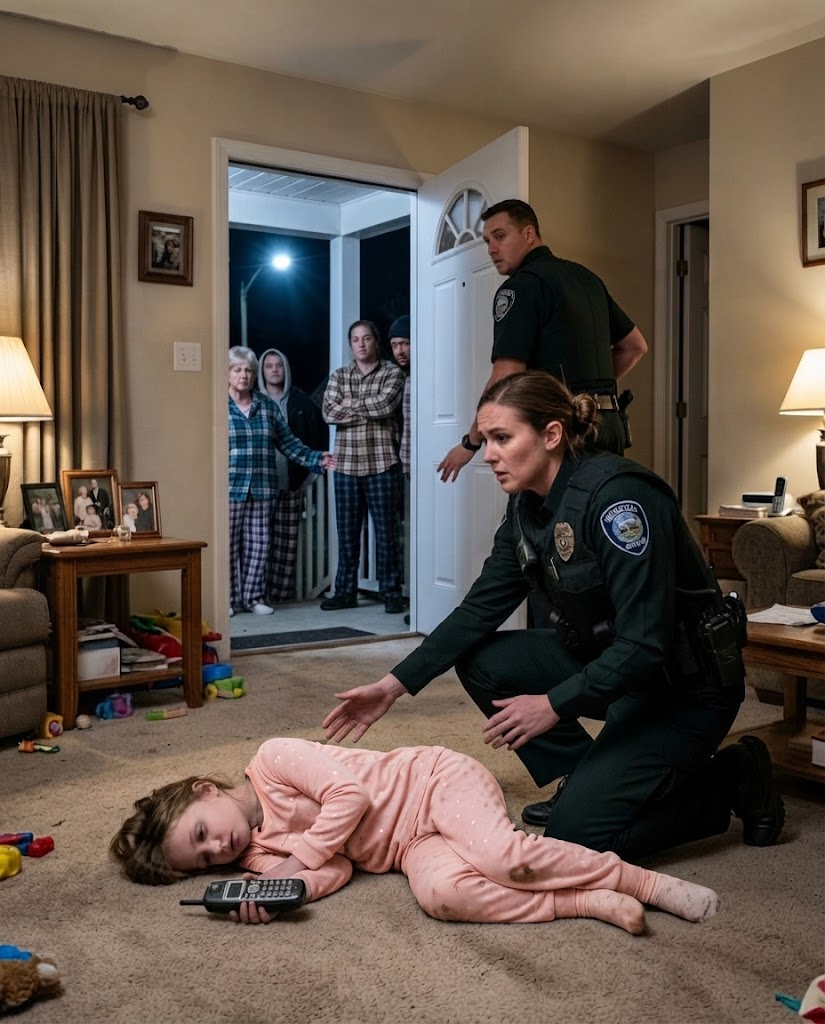
“We’re going to find him.”
She didn’t promise when.
She didn’t promise what they would discover.
She only said what she could defend.
“We’re not stopping.”
When Sarah returned to the hospital, Harper was sitting beneath a warm blanket with a cup of water in both hands. Her face was still pale, but her eyes were clearer.
Sarah pulled a chair beside the bed.
“Hi, Harper.”
The little girl looked at her.
“Did you find Daddy?”
“Not yet.”
Harper lowered her eyes.
Then she whispered something Sarah almost missed.
“Daddy knew they were coming.”
Sarah went still.
“Who?”
Harper looked toward the hallway.
“The men in the cars.”
“What did your dad tell you?”
Harper swallowed.
“He told me that if he didn’t come back, I should never open the blue box.”
Sarah’s pulse quickened.
“What blue box?”
Harper pointed weakly toward the nurse’s station.
“My daddy’s.”
Sarah followed her gaze.
A nurse had brought a small property bag from Harper’s house after the initial response. Inside were several ordinary household items.
And at the bottom was a small blue metal box.
Sarah had not noticed it before.
She stood slowly.
Marcus was still on the phone.
“Sarah?”
She looked down at the box.
“I think Elias left something behind.”
“Don’t open it yet.”
“I wasn’t planning to.”
They documented the box and secured it as evidence.
The outside showed no label.
No name.
No lock.
Just a strip of worn blue paint and a tiny scratch across the lid.
Harper watched Sarah carry it away.
“Daddy said it would prove he didn’t leave me.”
Sarah looked at the box.
For four days, Harper had believed her father had simply failed to return.
Now the evidence suggested something very different.
Elias had bought medicine.
He had prepared food.
He had made a recording.
He had copied case information.
And before leaving home, he had apparently made sure his daughter would eventually find the one thing he could not safely carry with him.
At the precinct, Marcus received one final alert.
The deleted ELMBRIDGE_4 file had been accessed again.
This time, the request came from a terminal that was not supposed to be connected to the evidence network at all.
Marcus opened the access details.
Then his face went cold.
The terminal was located inside the municipal storage lot.
Sarah was still there.
Marcus called her immediately.
“Get everyone away from the old pump building.”
“Why?”
“Because someone is accessing the deleted file from your location.”
Sarah looked toward the dark building beside the river.
A light had just appeared behind its small window.
Someone was inside.
The independent evidence team had not arrived yet.
Sarah raised her radio.
Nobody moved toward the building.
Nobody rushed the door.
They waited, documented the location, and called for the appropriate response.
Then the light went out.
A side door opened.
A man stepped into the rain.
Sarah recognized him immediately.
Lieutenant Daniel Mercer.
He stopped when he saw the patrol vehicles.
For a moment, neither side moved.
Then Mercer slowly raised both hands.
Sarah’s radio crackled.
Marcus heard her voice.
“Marcus.”
“What?”
“We found him.”
Marcus sat upright.
“Elias?”
Sarah stared at the open doorway behind Mercer.
“No.”
She looked toward the building.
“We found where they were keeping the evidence.”
And somewhere inside that locked riverside building was the answer to what had happened to Elias Thorne—and why an entire neighborhood had been ordered to stay silent.