THE SNAKE UNDER THE SOFA — THE ENDING
“Ma’am, we need to know something. Who else has keys to this house?”
The young officer — Daniels, his name tag read — asked the question gently, the way people speak to someone who has just been in a car accident. Like I might shatter if he raised his voice.
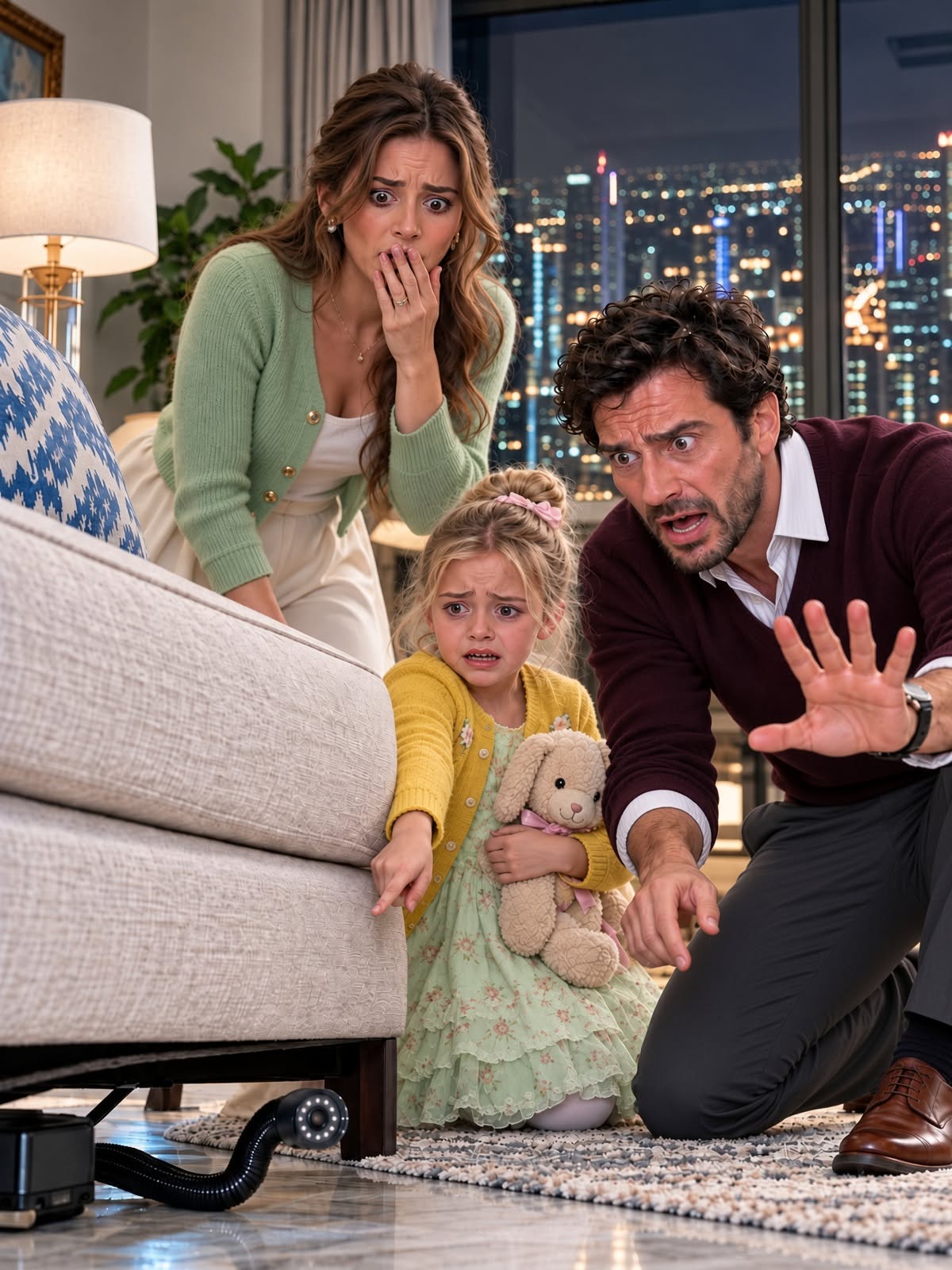
Behind him, the living room looked like a crime scene, which I suppose it was. The sectional sofa sat crooked in the middle of the floor, dragged away from the wall, its leather back exposed like something wounded. Blue and red light pulsed through the front windows, painting the walls in slow, silent color. Lily was in the kitchen with Mr. Henderson, who had made her hot chocolate with the automatic, trembling competence of a man trying very hard not to fall apart in front of a child.
I stared at Officer Daniels. “Keys?”
“To the house,” he said. “Anyone besides you and your husband. A cleaner. A relative. A neighbor.”
“Mr. Henderson has a spare,” I said slowly. “For emergencies. We’ve been neighbors for eleven years. He waters the plants when we travel.”
Daniels wrote that down without looking up. “Anyone else?”
“Marta,” I said. “Our cleaning service. She has the lockbox code for the side door. She comes every other Thursday.”
“When was she here last?”
“Thursday. Two days ago.” My voice sounded strange to me, flat and far away, like it was coming from the bottom of a well.
Daniels nodded and kept writing. Then, from the hallway, a woman’s voice cut through the low murmur of radios.
“Officer Daniels, hold that thought.”
She walked into the living room like she owned the quiet — mid-forties, dark hair pulled back, a blazer over a vest with DETECTIVE across it in white letters. She took in the sofa, the exposed baseboard, the hole in the wall no bigger than a dime with the black cable running through it, and then she looked at me.
“Emily?” she said. “I’m Detective Renee Marsh. I need you to sit down.”
“I don’t want to sit down.”
“I know.” She glanced toward the kitchen, where Lily’s small voice was asking Mr. Henderson whether marshmallows counted as a breakfast food. “But you’re going to want to be sitting for what I’m about to tell you, and I need Lily to stay where she is for a few more minutes. Can Mr. Henderson keep her in the kitchen?”
Something in her tone — not unkind, just immovable — made my knees unlock. I sat on the arm of the displaced sofa. The leather was cold.
“Your husband called 911 at three forty-one,” Marsh said. “From Chicago. He said there might be an intruder situation at this address and that his wife and daughter were inside. Then he called you.”
The phone call. David’s voice, calm in a way that had terrified me more than shouting would have. Why did you move the couch? How do you know?
“He knew,” I whispered. “Before I told him anything, he knew the couch had been moved. How is that possible, Detective? Is he—” I couldn’t finish the sentence. The question I’d been choking on since the phone call rose up anyway. “Is my husband involved in this?”
Marsh studied me for a long moment. Then she did something I didn’t expect. She sat down on the coffee table, facing me, so we were eye to eye.
“No,” she said. “Emily, listen to me very carefully. Your husband is not involved in this. Your husband is the reason we might catch the person who is.”
I stared at her. “I don’t understand.”
“Two weeks ago, David found the first camera,” Marsh said. “Not this one. One behind the bookshelf in your home office. He called us that same day.”
The room tilted slightly. I gripped the arm of the sofa.
“He found a camera in our house two weeks ago,” I repeated, “and he didn’t tell me.”
“He wanted to.” Marsh’s voice stayed level. “He begged me to let him tell you. I told him no.”
“Why would you—”
“Because we didn’t know who was watching, or how many devices there were, or whether they had audio. If you had known, Emily — if you had changed your routine, or confronted someone, or even just looked scared in the wrong room — the person watching would have known we were onto them. And we had reason to believe that person was planning to come inside this house.”
My hands had gone numb. I pressed them between my knees.
“David’s colleague — Nathan Cole, from his company’s IT security team — flagged something first,” Marsh continued. “Unusual outbound traffic on your home network. A device that didn’t belong to any of your phones or laptops, uploading video to an outside server in the middle of the night. David went looking. He found the camera behind the bookshelf. He called Nathan, Nathan called a friend of mine in cybercrime, and within forty-eight hours we had a quiet investigation running. We asked David to change nothing. To act normal. To keep you and Lily on your normal schedule.”
“He called me every night from that hotel,” Marsh said, and for the first time her professional calm slipped into something rawer. “Every single night at eleven, Chicago time. The first week he was holding it together. The second week he started falling apart. He said Lily had a nightmare and climbed into your bed, and he wasn’t there, and all he could think about was whether the person watching had seen her cry. He asked me — begged me — three separate times to let him tell you. The third time, he said he didn’t care about the investigation anymore, he just couldn’t stand lying to you for one more day.”
She looked down at her hands. “I told him that if the watcher had audio on any of those devices — and we had to assume he did — then the moment you knew, everything would change. The way you moved through the house. The way you looked at the walls. You’d have tried to be brave for Lily, and he would have seen the fear anyway. And a man who realizes he’s been discovered doesn’t usually just pack up and leave, Emily. He escalates. I told David that telling you might be the thing that got you hurt. So he stayed quiet. It nearly killed him.”
I thought about David in Chicago — the business conference, the keynote he’d been preparing for months. I pictured him in a hotel room at eleven o’clock at night, the city glittering outside his window, calling a detective to ask permission to tell his wife the truth.
“Did he sleep?” I asked quietly. “In those two weeks. Did he sleep at all?”
Marsh shook her head. “He said he kept seeing the timestamp on that first video. Two fourteen AM. He said he’d never forgive himself if anything happened while he was following my instructions instead of his instincts.”
“And the couch,” I said. My voice cracked. “The rule about never moving the couch.”
Marsh nodded slowly. “By then we’d found the network signature of at least three more devices, but we couldn’t locate them physically without tearing the house apart — which would have tipped off whoever was watching. David knew one of the signals was strongest in this room. He was terrified you’d move the furniture and find something before we were ready. So he invented the rule about the floors. It was the only thing he could think of that you’d accept without asking questions.”
Six months of that rule. Six months of me carefully vacuuming around the sectional, of Lily being told not to push her toy cars under it, of David casually redirecting every conversation about rearranging the living room. All of it — a lie. A protective lie, maybe, but a lie told to my face every single day.
“How did he know tonight?” I asked. “How did he know the couch moved?”
“Because we were monitoring the devices remotely,” Marsh said. “When that camera was physically disturbed and went offline, our system flagged it instantly, and David had insisted — against my advice — on getting the alerts on his own phone too. He called you within ninety seconds of the alert. And then he called 911, because the moment that camera went dark, the person watching knew they’d been discovered. Do you understand what that means, Emily?”
I didn’t, quite. My brain felt like it was moving through water.
“It means,” Marsh said quietly, “that whoever has been watching your family for six months now knows that you know. And we have reason to believe they were planning to act very soon. That’s why David told you to take Lily and leave the house. Not because he’s guilty. Because he’s terrified.”
From the kitchen came the clink of a mug being set down, and Lily’s laugh — small and brave and heartbreakingly normal. I looked toward the sound, and something in my chest caved in.
“Detective,” I said, “what did they find on those memory cards?”
Marsh hesitated. It was the first time I’d seen her hesitate.
“Come with me,” she said. “There’s something you need to see. But Lily stays in the kitchen.”
I stood on legs I couldn’t feel and followed her down the hallway, past Lily’s bedroom door — which stood open, her nightlight still glowing, her bed still rumpled from where she’d fled it at three in the morning — to our bedroom at the end of the hall. The door was open too. Inside, a police technician in gloves was photographing the inside of our closet, where a panel of drywall had been cut away to reveal a hollow space I had never known existed.
In that hollow space: a small metal lockbox, open. Inside it, a recording hub with blinking lights, and beside it, rows of memory cards in a plastic case, each one labeled in neat black marker.
Marsh picked up the case with a gloved hand and turned it so I could read the labels.
LIVING ROOM — MAR. KITCHEN — MAR. LILY BEDROOM — MAR. MASTER — APR. LILY BEDROOM — APR. HALLWAY — MAY.
On and on. Six months of labels. Six months of my daughter’s life, filed and dated like tax documents.
“There’s more,” Marsh said, and led me back to the living room, where a second technician had a laptop open on the coffee table. On the screen was a frozen video frame, timestamped in the corner: 02:14 AM, three nights ago.
It showed Lily’s bedroom. Her nightlight glowing. Her small shape under the blanket.
And in the doorway — a man’s silhouette, standing perfectly still, watching her sleep.
The sound that came out of me didn’t sound human.
“He was inside,” I gasped. “He was inside our house. While we were sleeping.”
“Three nights ago, yes,” Marsh said. “The camera in the hallway caught him coming in through the side door at two oh six and leaving at two twenty-one. Fifteen minutes. He stood in Lily’s doorway for nine of them.”
“Who is he? Do you know who he is?”
“Not yet. He wore a mask and gloves. But Emily—” Marsh turned the laptop toward me and clicked to another file. “I need you to look at this and tell me if you recognize anything.”
The new frame showed our living room, six months earlier judging by the Christmas tree in the corner. A man stood near the wall where the sofa now sat — where the sofa had been delivered just days before, I realized with a lurch. He was holding a drill. He was smiling.
I knew that smile. I’d seen it in my own house, eating my own food.
“That’s Ray,” I whispered. “Ray Calloway. The home theater installer.”
Six months ago, David had hired ClearView Home Theater to mount the new television and run speaker wire through the walls. Ray Calloway had been in our house for two days. I’d been at work. David had been traveling. Ray had been alone here, room to room, with his tools and his drill and his smile, and I had thanked him with a plate of cookies on his last day.
“He drilled that hole,” I said. “Behind where the sofa was going. He knew exactly where it would sit because David told him the delivery date. Oh God. Oh God, he was here for two days.”
Marsh was already on her radio, her voice sharp with new urgency. “I need everything we have on Raymond Calloway, ClearView Home Theater. Last known address, vehicle, phone. Move.”
She turned back to me. “Emily, the spare key. You told Officer Daniels about Mr. Henderson’s spare and the cleaner’s lockbox. Was there ever another key? One you might have forgotten about?”
I opened my mouth. Closed it. A memory surfaced — the kitchen junk drawer, the tangle of batteries and takeout menus and rubber bands, and among them, for years, a spare house key on a blue plastic fob.
“When did you last see it?” Marsh asked, watching my face.
“I don’t know,” I whispered. “Months ago. I haven’t thought about it in— I assumed it was still there. I never checked.”
Marsh dispatched an officer to the kitchen. Ninety seconds later he returned, shaking his head. The junk drawer held batteries, takeout menus, rubber bands — and no key.
“He took it,” I said. “Six months ago, he took it, and I never even noticed it was gone.”
Marsh nodded to the technician, who had been quietly working at the exposed baseboard with a fiber-optic scope. “Talk me through it, Alvarez.”
The technician — a wiry man with tired eyes — fed the scope into the dime-sized hole and watched the monitor. “Cable runs through the wall cavity, drops down into the crawlspace. There’s a signal repeater spliced in down there — professional job, weather-sealed, zip-tied to a joist. From the repeater it goes to a cellular uplink hidden behind the insulation. That’s how he did it. The cameras record locally to the cards, but they also stream. He could watch from anywhere. His phone, his laptop, that storage unit. Anywhere.”
“So when we moved the couch,” I said slowly, “and the camera went dark—”
“He lost his eyes instantly,” Alvarez said. “No warning, no fade. One second he’s watching, the next — nothing. That’s what panicked him.”
I stared at the little hole in my wall. Six months. For six months, a stranger’s eyes had passed through that hole every day, traveling up through my living room wall and out into the world, carrying images of my daughter eating cereal, doing homework, dancing in her socks on the hardwood floor. I thought about all the ordinary, sacred, boring moments of our lives — Lily losing a tooth at the kitchen table, David and I slow-dancing to a song on the radio while dinner burned — and felt something close to grief for them, as if those moments had been stolen and could never be clean again.
“Can you get it out?” I asked. “All of it. I don’t want a single piece of his equipment left in my house.”
“We’ll sweep every inch,” Marsh promised. “Alvarez’s team will pull the repeater, the uplink, every device. When we’re done, this house will be yours again. I give you my word.”
On the screen now: a cloud storage login page, and beside it, a line of text the cybercrime tech had traced. Marsh read it, and her expression changed — the immovable calm cracking into something urgent.
“He’s watching right now,” she said. “Or he was, until the camera died. The feed was live fifteen minutes ago.”
My stomach dropped through the floor. “He saw us? He saw us move the couch? He saw Lily?”
“He saw the camera go dark,” Marsh corrected. “That’s all. But Emily, listen — we traced the account. It’s registered to a storage unit across town. Unit fourteen, rented under the name R. Calloway. He didn’t even use a fake name.”
“Arrogant,” the technician muttered.
“Or sure he’d never be caught,” Marsh said. She was already moving, already on the radio requesting a tactical team and a warrant. Then she stopped and looked back at me. “There’s one more thing you need to know. About how he knew David was in Chicago.”
I braced myself. I was getting good at bracing myself. It was becoming my primary skill.
“Three days ago, you posted a photo on Facebook,” Marsh said, not unkindly. “You and Lily making pancakes. The caption said, ‘Girls’ weekend! Daddy’s off to conquer Chicago — see you Sunday, handsome!’ It was a public post, Emily. And David posted about the logistics summit on LinkedIn, with the dates.”
The pancakes. I’d posted the pancakes. Three hundred likes. Comments from my mother, my college roommate, seventeen people I hadn’t spoken to in years — and one man I had never truly known at all.
“I told him,” I whispered. “I told him David was gone. I announced it to the entire internet.”
“You couldn’t have known,” Marsh said firmly. “None of this is your fault. But I need you to understand the timeline now, because it matters. The note said phase two begins when David leaves Chicago. David left three days ago. The intruder was inside your house three nights ago — that was reconnaissance. We believe tonight was supposed to be the night.”
The room went very quiet, except for the radios and Lily’s voice in the kitchen, asking Mr. Henderson if the police lights could stay because they were pretty.
“Tonight,” I repeated.
“That’s why David said to leave the house,” Marsh said. “And that’s why I’m saying it now. You and Lily are not staying here tonight. I’m putting a unit on this house until Calloway is in custody, and I’m asking you to go somewhere he doesn’t know about. Is there anywhere — family, a friend —”
“My sister,” I said automatically. “Karen. She lives forty minutes away. He doesn’t know her. He’s never—” I stopped. “Has he? How would I know what he knows? He’s been watching us for six months. He probably knows what I had for breakfast.”
Marsh put a hand on my shoulder. It was the first human touch I’d felt in what felt like days, and I nearly broke apart under it.
“Pack a bag,” she said. “Just essentials. An officer will drive you. And Emily — leave your phone on, but don’t post anything. Not a word. Not until he’s caught.”
I nodded and walked toward the hallway on legs that belonged to someone else. Behind me, I heard Marsh say into her radio, “I want eyes on that storage unit in twenty minutes. If he so much as breathes near it, I want to know.”
In Lily’s bedroom, I pulled her little pink suitcase from the closet and started folding clothes with hands that shook so badly I had to redo every fold. Her rabbit — the stuffed one she’d clutched all night — sat on the pillow, one ear flopped over. I tucked it into the suitcase first, like a talisman.
That’s when I heard it. The sound that had started everything.
Not a scream this time. A whir. Soft, mechanical, deliberate — coming from under Lily’s bed.
I froze, my hand halfway into the suitcase.
Slowly, I knelt and lifted the dust ruffle.
There, mounted on a flexible black stalk beneath the bed frame, was a camera the size of a marble. And as I watched, its lens turned toward me. Toward my face. It moved with a smooth, hungry precision, and I understood, all at once, with a clarity that made me want to vomit, what Lily had seen under the sofa.
It hadn’t been a snake. It had been this — a pan-tilt camera on a flexible cable, moving on its own. Motion tracking. When Lily got up for water at three in the morning and walked past the sofa, the camera had followed her. Its rounded tip lifting. Looking around the room. Looking at her.
It had been watching my six-year-old daughter in the dark, and she had seen its eye turn toward her, and she had run screaming for her mother.
I stumbled backward, scrambled to my feet, and ran for the living room.
“Detective! There’s another one! Under Lily’s bed — it moved, it looked right at me—”
Marsh was already signaling her team. Two officers moved past me down the hall with the grim efficiency of people who had stopped being surprised an hour ago.
I stood in the hallway, shaking, and through Lily’s open bedroom door I could see her bed — the bed where my baby slept every night, under the unblinking eye of a stranger — and I thought about the silhouette in the doorway at 2:14 AM, standing there for nine minutes, just watching her breathe.
Mr. Henderson appeared at my elbow. He must have seen my face from the kitchen.
“Emily,” he said quietly. “Come sit with Lily. There’s nothing more you can do in this hallway.”
I let him lead me to the kitchen. Lily looked up from her hot chocolate, marshmallows bobbing, and smiled at me with complete trust.
“Mommy, Mr. Henderson says the police are going to catch the snake.”
I sat down and pulled her into my lap, though she was getting almost too big for it, and held her so tightly she squirmed.
“That’s right, baby,” I said into her hair. “They’re going to catch the snake.”
Over her head, Mr. Henderson met my eyes. His were wet. He’d lived across the street for eleven years. He’d watched Lily learn to ride a bike. And tonight, at three in the morning, he hadn’t hesitated — he’d grabbed a flashlight and walked into our nightmare with us.
“Thank you,” I mouthed.
He just shook his head, like thanks was an absurd currency for this.
My phone buzzed. David. I stepped into the laundry room to take it, Lily protesting as I set her down.
“Emily.” His voice was raw now — the calm from the first call burned away. “Are you okay? Is Lily okay?”
“We’re okay. We’re going to Karen’s. Detective Marsh—”
“I know. She called me.” A pause, and I heard airport noise behind him — announcements, rolling suitcases. “I’m at O’Hare. First flight out boards in forty minutes. I’ll be home by nine.”
“David.” I leaned against the washing machine. “Why didn’t you tell me? Two weeks, David. Two weeks you knew someone was watching our daughter sleep and you didn’t tell me.”
The silence on the line was so complete I thought the call had dropped.
“I wanted to,” he said finally, his voice breaking. “God, Emily, you have no idea how much I wanted to. Every night I lay awake in that hotel room thinking about it. But Marsh said— she said if the watcher had audio, if he heard us change anything, he might move up his timeline. She said the safest thing was for you to not know, so you’d act normal. So Lily would act normal. I thought— I thought I was protecting you.”
“You decided for me,” I said, and the tears came now, hot and furious. “You took away my right to know what was happening in my own home. To my own child. Do you understand that? I tucked her in every night, David. I kissed her forehead two feet away from a camera, and you let me.”
“I know.” He was crying now too; I could hear it. “I know, and I will spend the rest of my life being sorry for it. But Emily, please — please believe me about one thing. The couch rule. The floors. That was never about the floors. I was so scared you’d move it and find that hole before the police had him. I was scared every single day for two weeks.”
I closed my eyes. In the kitchen, Lily laughed at something Mr. Henderson said.
“Just get home,” I whispered. “Just get on that plane and get home.”
“I’m already in line to board.”
We packed in a daze. An officer named Reyes drove us to Karen’s, taking a route with three unnecessary turns that I understood without being told. Karen met us at the door in her bathrobe, took one look at my face, and folded Lily and me into her arms without asking a single question. That is the thing about sisters. They don’t need the story first.
Lily fell asleep on Karen’s couch within minutes — the resilience of the very young, or sheer exhaustion. Karen and I sat at her kitchen table, and I told her everything, and she held my hand so hard it hurt, and neither of us slept.
At 6:17 AM, my phone rang. Detective Marsh.
“We have him,” she said.
I stood up so fast the chair tipped over. Karen caught it.
“Raymond Calloway,” Marsh said. “He went to the storage unit at five forty this morning — we think when the feed died, he panicked and went to wipe the drives. Our team was already in position. Two officers, plainclothes, parked across the lot since four AM. He pulled up in the gray van — the one your neighbor reported seeing on your street — and he had a hammer in his hand. He was going to smash the drives.”
“What happened?” I whispered.
“He saw the officers and ran,” Marsh said. “Made it about thirty feet before they took him down in the parking lot. He fought — one of my officers has a split lip. But he’s in custody, Emily. He’s in a cell right now, and he is not getting out.”
I sank back into the chair, my legs gone watery with a relief so intense it felt like grief. Karen gripped my shoulder.
“Emily, you need to hear what we found in that unit.”
I braced myself. Bracing had become my primary skill, and I was excellent at it now.
“A monitoring station,” Marsh said. “Three screens. And a wall — an entire wall — of printed photographs. You. Lily. Hundreds of them. Some going back six months. Some from this week.”
My knees buckled. Karen grabbed my arm.
“And a duffel bag,” Marsh continued. “Packed. Zip ties. Duct tape. A ski mask. A burner phone. A printed map of your street with your house circled. David’s flight itinerary, printed from LinkedIn. And a notebook. On the last page, in his handwriting: ‘Phase two — tonight.'”
Tonight. The word landed like a stone in still water.
“He was coming tonight,” I whispered.
“Yes,” Marsh said. “While you and Lily slept. The camera going dark at three AM ruined it — he couldn’t confirm David was still gone, couldn’t confirm you were asleep. He spent the rest of the night trying to decide whether to run or go ahead. He decided to run to the unit. That’s where we took him.”
I thought about Lily’s scream at three in the morning. About a thirsty six-year-old padding down a dark hallway. About a camera’s eye turning to follow her.
“If she hadn’t woken up,” I said slowly, “if she hadn’t gotten thirsty—”
“Don’t,” Marsh said firmly. “Don’t do that to yourself. She did wake up. You’re both safe. He’s in custody. That’s the only timeline that matters now.”
After she hung up, I sat at Karen’s table and stared at nothing for a long time. Karen made coffee neither of us drank. At some point Lily woke up, crawled into my lap, and asked when we were going home.
“Soon, baby,” I said. “Daddy’s coming home first.”
David arrived at Karen’s at ten thirty that morning, unshaven, his shirt wrinkled, his eyes red. Lily launched herself at him with a shriek of joy, and he caught her and held her like she was the only solid thing in the universe, and over her shoulder, his eyes found mine.
We didn’t speak. Not then. There would be time for the hard conversation — there had to be, because something between us had cracked in those two weeks of his silence, and I didn’t yet know if it could be repaired. But in that moment, watching him hold our daughter, I believed what Detective Marsh had told me in the first terrible minutes: my husband was not the villain of this story. He was a man who had made an impossible choice badly, out of love and fear, and nearly lost us anyway.
The days that followed passed in a blur of police interviews, victim advocates, and paperwork. Ray Calloway — forty-one, divorced, no criminal record, a man who had installed home theaters in two hundred houses across the county — pleaded guilty to burglary, aggravated stalking, unlawful surveillance, and attempted kidnapping of a child. At his sentencing, the prosecutor read from his notebook. I didn’t attend. Karen went in my place and told me afterward that he never looked up from the defense table. He got twenty-two years.
Karen told me about the sentencing in pieces, over weeks, the way you tell someone about a surgery that went well — only the parts they can handle. The prosecutor, a woman named Diane Osei, read from Calloway’s notebook in open court. Phase one: observe. Phase two: enter. There were dates. There were notes about our routines — what time David left for work, what time Lily’s school bus came, which nights I worked late. He had documented our lives with the care of a biographer and the soul of a thief.
“He cried,” Karen said quietly, one evening on her porch, when I finally asked. “When they read the part about Lily’s doorway. He put his head in his hands and cried. I wanted to feel something — satisfaction, pity, anything. But I just felt tired.”
I understood. I felt tired too, in a way sleep couldn’t fix. Tired in my bones, in the place where trust used to live unexamined.
What I didn’t expect was the guilt — not for anything I’d done, but for everything I hadn’t seen. I replayed those two days six months ago a hundred times: Ray Calloway in my house, drinking my coffee, complimenting Lily’s drawings on the refrigerator. I remembered him asking where the new sofa would go — “so I can run the speaker wire cleanly behind it,” he’d said, and I’d thought he was being thorough. Professional. I’d tipped him fifty dollars and left a five-star review online. The review was still up for weeks after his arrest, my cheerful words sitting there like an obscenity, until the platform finally took it down.
Dr. Patel — Lily’s therapist, who became something like mine too — told me that guilt was the mind’s misguided attempt to reclaim control. “If it was your fault for not noticing,” she said, “then the world is still a place where noticing is enough to keep you safe. It’s easier to blame yourself than to accept that sometimes you can do everything right and still be victimized by someone else’s evil.”
I think about that every time I catch myself replaying the pancake photo, the junk drawer, the cookies I gave him on his last day.
The memory cards were held as evidence, then destroyed by court order — every last frame of my daughter’s childhood that a stranger had stolen, fed into an industrial shredder while a deputy watched. I asked Detective Marsh to confirm it was done, and she sent me a photo of the shredded plastic. I keep that photo in a drawer. It helps, on the bad nights.
We changed every lock in the house. We installed a real security system — cameras we chose, that we control, with the feed going to our phones and nowhere else. The side door got a deadbolt and a reinforced frame. The junk drawer got a lock, which Karen said was excessive and I said was non-negotiable.
And the sectional sofa — the enormous leather monument to six months of secrets — we sold it. I picked the new one myself. It’s smaller, a soft gray fabric, and the first thing I did after the delivery men left was drag it six inches to the left, just because I could. David watched me do it, and laughed, and then cried a little, and then helped me push it back.
Lily started seeing a therapist — a kind woman named Dr. Patel who specializes in children and who told us that Lily’s nightmares were normal, that her brain was processing, that the “snake check” ritual we’d invented was actually excellent. Every night before bed, Lily and I take a flashlight and check under every piece of furniture in the house together. Under the new sofa. Under her bed. In the closets. “No snakes,” Lily announces solemnly each time, clicking off the flashlight like a detective closing a case. It gives her back the control that was taken from her. It gives me back a little of mine, too.
The first night we slept in the house again — three weeks after the arrest, after the sweep, after the new locks and the new system — Lily stood in her bedroom doorway and wouldn’t go in. She just stood there, rabbit dangling from one hand, staring at the bed like it might bite her.
“Do you want to do the snake check together?” I asked.
She nodded, very seriously, and we got the flashlight — a big yellow one David had bought her, “for official investigations” — and we checked everything. Under the bed: no snakes. In the closet: no snakes. Behind the curtains, under the dresser, inside the toy box. Each time, Lily clicked the flashlight off with a decisive little nod, like a detective closing a case.
Then she crawled into bed, and I tucked the blanket around her the way I always had, and she looked up at me with those enormous eyes and said, “Mommy, is the camera gone too?”
Dr. Patel had prepared me for this question. Answer honestly. Don’t over-explain. Let her lead.
“Yes, baby. The police took every single camera out. I watched them do it. There’s nothing in your room now except your things.”
“And the man can’t see us anymore?”
“No. He can’t see us. He can’t come here. He’s locked up, and there are police watching to make sure.”
She was quiet for a moment, processing this with the grave concentration of a six-year-old. Then: “Good. Because I’m going to be a police officer when I grow up, and I’m going to catch all the snakes.”
I laughed through the tears that came out of nowhere. “You’re going to be the best snake-catcher there’s ever been.”
“Damn right,” she said solemnly, and I decided not to correct her language, just that once. David, listening from the hallway, had to cover his mouth to keep from laughing out loud.
She fell asleep within minutes — the deep, limp sleep of a child who finally feels safe. I sat beside her bed for a long time after, watching her breathe, the yellow flashlight on the nightstand like a small sun. David came in and sat on the floor beside me, and we didn’t speak, because there was nothing to say that the quiet didn’t say better.
Mr. Henderson comes for dinner every Sunday now. Lily calls him Grandpa Henderson, and he pretends to be embarrassed about it and is transparently delighted. He told us, months later, that he’d seen a gray van parked down the street twice that week — the week everything happened — and had mentioned it to no one, and had been unable to sleep the night Lily screamed, which was why he was under the streetlight at three in the morning, smoking the cigarette he’d supposedly quit in 2019. “Some guardian angel,” he said gruffly, waving off our thanks for the hundredth time. “I just happened to be awake.”
David and I started counseling in November. It was David’s idea, which mattered to me more than I expected. In our third session, I finally said the thing I’d been carrying since that night in the laundry room.
“You decided for me,” I told him, while our therapist nodded encouragingly and David’s hands twisted in his lap. “You took away my right to be afraid with full knowledge. I understand why the police asked you to. I even understand why you agreed. But I need you to understand that it broke something, and I need you to help me fix it.”
He looked at me for a long moment. Then he said, “I was trying to be the wall between you and the danger. But I became another thing you had to be afraid of — me, keeping secrets. I’m sorry. I’ll spend as long as it takes proving that there are no more walls.”
It wasn’t a perfect apology. There are no perfect apologies for something like that. But it was an honest one, and we’ve been building on it ever since — slowly, deliberately, the way you rebuild anything that matters. With inspections. With no hidden compartments.
In our sixth session, our therapist asked David to describe the moment he found the first camera. He’d never told me the details — only that Nathan had flagged the network traffic and he’d gone looking. Now, in that quiet office with the ticking clock, he told us both.
“It was behind the bookshelf in the office,” he said, staring at his hands. “I moved the shelf to dust — Emily, you always said I never dusted, and that day I decided to prove you wrong — and there it was. This little black eye, staring at me. I stood there for a full minute, and my first thought wasn’t fear. It was embarrassment. Like I’d walked in on someone. Then I realized it had probably watched me walk in on it a hundred times.”
He looked up at me. “I sat on the floor of that office and I thought about every private moment we’d had in that house. You singing while you folded laundry. Lily’s dance recitals in the living room. And I thought — he’s seen my daughter in her pajamas. He’s seen my wife. And I wanted to rip every wall down with my bare hands. Nathan had to talk me out of it. He said, ‘David, if you touch anything, you’ll never find out who it is, and he’ll know you’re looking.’ So I put the bookshelf back. I put it back exactly where it was, and I went downstairs and made dinner, and I asked Lily about her day, and I died inside with every word.”
I reached across the space between our chairs and took his hand. It was the first time I’d touched him voluntarily since that night. His fingers closed around mine like a drowning man finding a rope.
“I hated you for those two weeks,” I said quietly. “Not the way you think. I didn’t hate you the way I hated him. I hated that you were suffering alone and wouldn’t let me suffer with you. That’s what marriage is, David. It’s not protection. It’s shared suffering. You don’t get to decide which parts I can handle.”
“I know that now,” he whispered.
Our therapist smiled — the small, satisfied smile of a woman watching a wall come down in real time. “Say it again,” she told David. “The last part. In your own words.”
David turned to me, his eyes wet. “No more walls,” he said. “No more deciding for you. From now on, we get scared together.”
Last month, a storm knocked out the power at two in the morning, and Lily appeared in our bedroom doorway, rabbit in hand, whispering that she’d had the dream again — the snake dream. David and I made room for her between us, the way we always do now, and she curled up small and warm, and after a while her breathing evened out.
In the dark, David’s hand found mine across the blanket.
“Is the snake gone, Mommy?” Lily murmured, half-asleep — the question she still asks sometimes, like a prayer.
I looked at my husband in the dark. I thought about a black cable moving under a sofa. About a stranger’s eye following my daughter down a hallway. About a husband who lied to protect us and nearly lost us to the lie. About a neighbor under a streetlight at three AM, and a detective who sat on my coffee table and told me the truth, and a little girl whose thirst in the night saved her own life.
“Yes, baby,” I whispered. “The snake is gone.”
“Really really?”
“Really really. Daddy checked. I checked. The police checked. There are no more snakes in this house.”
She sighed, satisfied, and slept.
I lay awake a while longer, listening to the two of them breathe — the two people I would burn the world down to protect — and I thought about what that night had taught me, the thing I carry with me now like a stone in my pocket, smooth from handling.
I had questioned everything about my husband. The answers turned out to be worse than my fears and better than my hopes, both at once. A stranger had watched us for six months — had stood in my daughter’s doorway in the dark. And the man I married, flawed and frightened and human, had stood between us and that stranger the only way he knew how, and gotten it wrong, and then spent every day since trying to get it right.
Home, I understand now, was never the safest place in the world because of its walls or its locks. It was never safe because David promised not to move the couch. It is safe — insofar as anywhere is safe — because of what we do when the walls fail: we grab a flashlight, we call for help, we tell each other the truth, even when the truth is terrible. Especially then.
There are no more snakes in this house.
And this time, I mean it.