I didn’t show him the note.
I folded it back along its original creases and slid it into the small beaded clutch hanging from my wrist, the one that still had my lipstick and a spare bobby pin in it, objects from a version of the night that existed about forty minutes ago when I still believed I understood my own wedding.
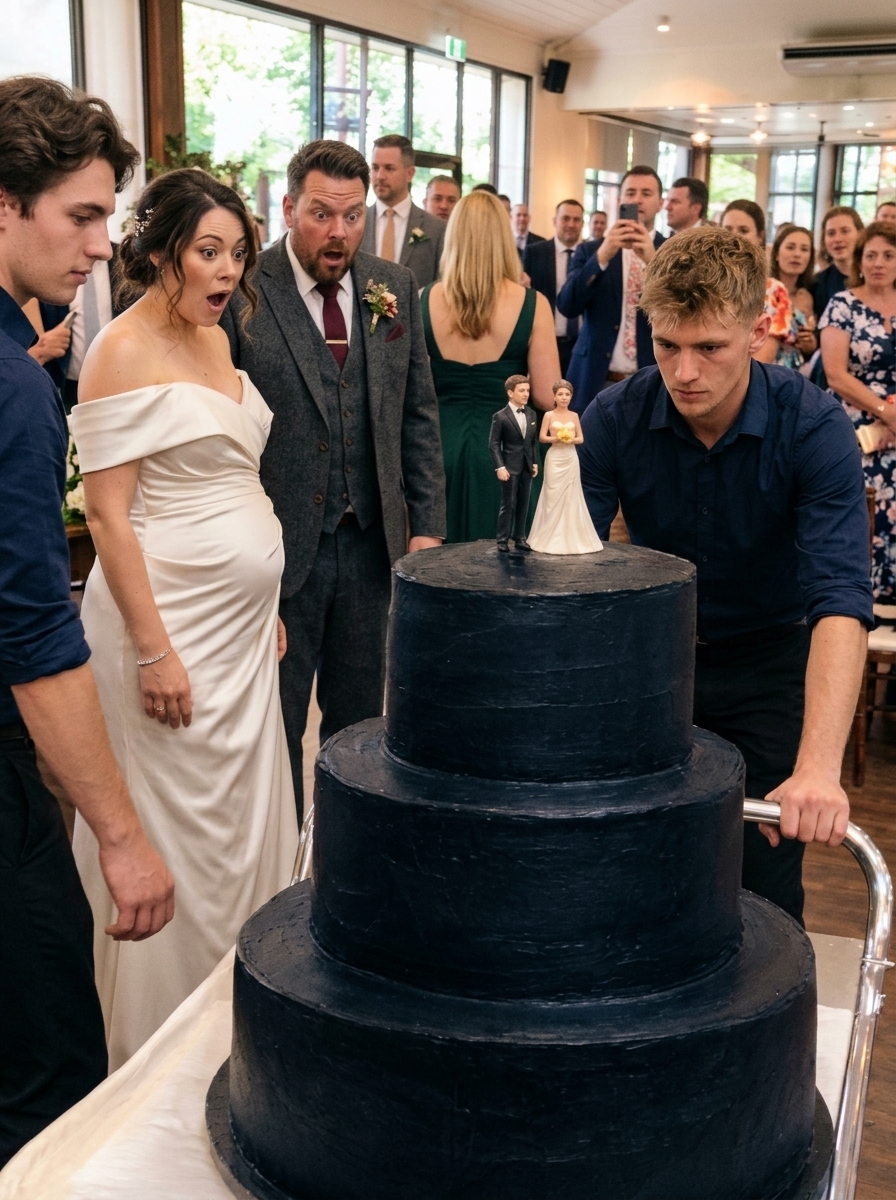
Denise was handling the cake situation the way professionals handle disasters — calmly, efficiently, with a voice that promised everything would be fine while her eyes said otherwise. She had the servers wheel the cake into the kitchen, out of sight, and produced a backup dessert table of cupcakes that had clearly been meant as a thank-you favor, not a centerpiece. The DJ smoothed things over with an upbeat song. Guests drifted back to their tables, murmuring, already composing the story they’d tell at brunch tomorrow.
I found Bradley near the bar, a glass of something amber in his hand that he wasn’t drinking.
“We need to talk. Now.”
“Claire, can we please just get through tonight—”
“Who is M?”
He set the glass down.
“I don’t know.”
“You looked like you were going to throw up when you saw that signature.”
“It was a shock. Someone played a sick joke on our wedding. Of course I reacted.”
“That’s not what that was.”
“What do you want me to say?”
“The truth. For once.”
His jaw worked, like he was chewing on several different sentences and couldn’t decide which one was safe to say out loud.
“Melissa didn’t have a sister,” he said finally. “If that’s what you’re thinking. She was an only child. There’s no M in her family. I don’t know who sent that cake.”
“I didn’t say Melissa’s sister. You did.”
He went quiet.
I watched him realize what he’d just handed me.
“Why would you even think of that?” I pressed. “Unless you’ve been wondering the same thing.”
“Because the cake had her—” He stopped himself.
“Had her what, Bradley?”
“Nothing. I misspoke.”
“You don’t misspeak. You’ve never once misspoken in three years. You’re the most careful man I’ve ever met.”
He looked at me then with something that almost resembled relief, like being accused of being careful was easier to hear than the alternative.
“I’m tired, Claire. It’s been a long day. Can we table this until tomorrow?”
“No.”
I walked away before he could argue, weaving through tables of relatives who smiled at me with the particular sympathy reserved for brides whose weddings have gone wrong, and found Denise near the kitchen doors, clipboard pressed to her chest like a shield.
“Tell me about the woman who dropped off the cake.”
Denise glanced toward the kitchen, then back at me, and lowered her voice.
“She came through the service entrance around five. Told the staff she was with the bakery, said there’d been a last-minute design change approved by the client. She had a signed form. I didn’t check it against anything because — why would I? People don’t usually lie about wedding cakes.”
“What did she look like?”
“Thirties, maybe forties. Hard to say. She had a scarf wrapped around her neck, sunglasses, even indoors. I thought it was odd but brides change things last minute all the time. I didn’t think—”
“Did she say anything else? Anything at all?”
Denise hesitated, the particular hesitation of someone deciding whether a detail is worth repeating.
“She asked if the little girl was here yet. Paige, I mean. She used her name.”
The hallway seemed to tilt again.
“She knew Paige’s name.”
“I assumed she’d read it off the seating chart. The easel was right by the entrance.”
I thanked her and walked straight to the restroom, locked myself in a stall, and called the bakery directly, the number still saved in my phone from three months of back-and-forth about fondant and flavors.
The owner, Linda, picked up sounding half-asleep and twice as confused to be getting a call from the bride at ten-thirty on her wedding night.
“Linda, it’s Claire Bennett. I need to ask you something important.”
“Of course, is everything—”
“The order. The design change. Who approved it?”
“The client did. A woman came in two days ago, said she was family — the groom’s sister-in-law, I think she said — had the order confirmation number, the whole file. Said the bride wanted to surprise everyone with a dramatic color change. I didn’t think twice, she had all the right information.”
“Bradley doesn’t have a sister-in-law.”
Silence on the line.
“She had the order number, Claire. The confirmation email. The guest count. Things only someone connected to the wedding would have.”
I sat on the edge of the bathtub-shaped reality of my own wedding and tried to breathe normally.
“What was her name?”
“She gave the name Ward. M. Ward.”
I hung up without saying goodbye, which I’d apologize for later, and sat there with my dress bunched around my knees, running through every person Bradley had ever mentioned. His late wife, Melissa. Her parents, both gone before the fire. No siblings. No cousins close enough to call family. I had met everyone in his life worth meeting over three years, and not one of them was named Ward.
When I came out of the bathroom, Paige was sitting alone on a bench in the hallway, swinging her legs, a cupcake untouched in her lap.
I sat beside her.
“Hey, sweetheart. Can I ask you something?”
She nodded, still swinging her legs.
“That lady you mentioned. The one who visits you at school. What does she look like?”
Paige considered this with the serious concentration kids give to questions they think are tests.
“She has a scarf. Always. Even when it’s hot.”
My skin prickled.
“Does she ever tell you her name?”
“She said I could call her Mare.”
“Mare,” I repeated.
“Like a horse, but not a horse,” Paige clarified helpfully. “She brings me cookies. She said not to tell Daddy because it would make him sad.”
“Why would it make him sad?”
Paige shrugged, the universal gesture of a child who has stopped finding the question interesting.
“She said she used to be my mommy before. But now she’s just my friend.”
I didn’t trust my voice to ask anything else.
I walked Paige back to her grandmother and found a quiet corner near the coat check, needing five minutes alone before I did something I couldn’t undo. My phone buzzed in my clutch — a text from the bakery number, which struck me as strange since I’d just hung up with Linda.
It wasn’t from Linda.
Unknown number: You deserve to know what you married into. Ask him about the fire inspector’s report. Ask him why the smoke detectors were disconnected.
I stared at the screen until the words blurred.
Bradley appeared at the end of the hallway, phone pressed to his ear again, and this time I didn’t look away fast enough. He saw me seeing him. Whatever he was saying, he cut it off mid-sentence, and when he lowered the phone, I caught a glimpse of the lock screen before it went dark.
A photo. The black cake, exactly as it looked tonight, scorched bride and bloodied groom, timestamped three weeks ago.
Three weeks before anyone had ordered a cake switch tonight.
He had known. He had seen this coming, and he had let me walk down an aisle anyway.
I didn’t confront him in the hallway.
Some instinct, sharper than fury, told me that whatever this was, I needed more before I used it. So I smiled when he asked if I was okay, told him I needed air, and spent the next hour doing something I’d never done in three years with Bradley.
I lied to his face and watched how easily it came to me now.
The reception limped toward its natural end. Guests left in twos and threes, hugging me, telling me the cake disaster would make a great story someday, not understanding that the cake was the least broken thing in the room. By midnight, it was just family — his mother, Judith, nursing her third glass of champagne at a corner table; my parents, exhausted and worried, waiting by the door; and Bradley, pretending none of it had happened.
I sat down next to Judith.
“Can I ask you something? About Melissa.”
Judith’s whole body changed. Posture straightening, glass lowering an inch.
“What about her?”
“Did she have any family? Anyone named Ward?”
“No. Why would you ask that?”
“The cake. The signature on the delivery slip.”
Judith’s eyes flicked toward her son, thirty feet away, deep in conversation with the venue manager about the final bill like a man trying very hard to look busy.
“Melissa’s maiden name was Corbett,” Judith said carefully. “No Wards in that family. Her parents passed years before the fire. She had no one.”
“Then who would know her well enough to use her initial? To know Paige’s name? To know things about—”
I stopped myself before I said the fire.
Judith’s hand tightened around her glass.
“What exactly are you asking me, Claire?”
“I’m asking if you ever had doubts. About the fire. About how Melissa died.”
The silence that followed told me more than words could have.
“The investigators ruled it accidental,” Judith said, too quickly, the way people recite things they’ve repeated to themselves for years to make them true. “Faulty wiring. The smoke detectors had old batteries.”
“Disconnected,” I said. “Not old batteries. Disconnected.”
Judith’s face went the color of the tablecloth.
“Where did you hear that?”
“Is it true?”
“I don’t—” She stopped, glanced again at Bradley, lowered her voice to something barely above breath. “There were questions. After. Melissa’s body was never positively identified, not fully, the fire was too severe. They used dental records, a partial match, that’s all anyone needed to close the case because nobody wanted to look harder. I wanted to look harder. Bradley told me I was grieving badly. That I needed to let her rest.”
“A partial match.”
“Claire, it was eight years ago. I was half out of my mind with grief too, I didn’t—”
“Did anyone ever investigate whether she was even inside that house?”
Judith’s hand came up to her mouth, and for one unguarded second, I watched a mother confront a thought she’d clearly buried alive a long time ago rather than let it breathe.
“I have to go check on Paige,” she said, standing too fast, chair scraping, and walked away before I could ask anything else.
I sat alone at the table for a long moment, the black cake’s ruined figurines still sitting in a box near the kitchen door where someone had set them aside instead of throwing them out, and I understood that everyone in this family had spent eight years agreeing not to ask the one question that mattered.
My phone buzzed again. The same unknown number.
Check the fire department’s public incident log. Badge number on the responding officer’s report: 4471. Ask him about the life insurance payout. Ask him how fast he remarried.
I typed back with shaking hands.
Who are you?
Three dots appeared, disappeared, appeared again.
Someone who should have been dead for eight years. Ask Paige about her dreams. She remembers more than he thinks she does.
I looked across the room at Paige, asleep now against a stack of coats on a chair, exhausted from a wedding that had broken apart around her without her fully understanding why. Seven years old and already carrying something none of us had let her say out loud.
I found Bradley by the valet stand, finally alone, staring at his phone with an expression I’d never once seen on him in three years — not grief, not confusion, but calculation. Fast, cold, the look of a man running numbers.
“I called the bakery,” I said. “Linda told me everything. A woman with a scarf and sunglasses, who knew the order number, the guest count, Paige’s name. The same woman Paige has been meeting at school. The same woman who signed a delivery slip as M. Ward.”
Bradley’s jaw tightened.
“Claire, you’re exhausted, it’s been a terrible night, let’s just go home and—”
“Your mother told me Melissa’s body was never fully identified. Dental records. A partial match.”
Something in him cracked, just slightly, at the edges.
“Don’t,” he said quietly. “Don’t do this here.”
“Do what? Ask why the smoke detectors were disconnected?”
His head snapped toward me.
“Who told you that?”
“Does it matter? Is it true?”
“It was ruled an accident.”
“That’s not an answer.”
“Claire, I lost my wife in that fire. I nearly lost my daughter. Do you understand what you’re implying right now?”
“I’m not implying anything. I’m asking why someone who knows everything about that night sent me a cake with a scorched bride and bloodied hands and signed it with Melissa’s maiden initial.”
He went very still.
“What did you just say?”
“The initial. M. Not Ward. What if it was never a last name at all?”
I watched the realization land on him like a physical blow, watched him understand, in real time, that I had just said something he had clearly spent eight years making sure no one ever said out loud.
“It’s not possible,” he said, but his voice had lost all its certainty.
“What’s not possible, Bradley?”
He didn’t answer. He turned and walked toward the valet stand, pulling out his phone, dialing with hands that weren’t quite steady, and I heard him say one name into the receiver before he walked too far for me to hear anything else.
“Vanessa. We have a problem.”
I had never heard that name in three years together.
Behind me, through the propped-open ballroom door, I could see the discarded cake box still sitting by the kitchen, the groom figurine tipped on its side, tiny red-stained hands facing the ceiling like a man finally caught reaching for something he should never have touched.
Denise found me sitting on the curb outside the venue an hour later, my wedding dress pooled around me on the concrete, shoes abandoned somewhere I couldn’t remember, the night air finally cold enough to feel real.
She sat down next to me without asking permission, which I appreciated more than she probably knew.
“I should have told you something earlier,” she said. “I didn’t, because I was scared of what it would mean for the venue. For my job. I’m not proud of that.”
I looked at her.
“Told me what?”
Denise stared straight ahead at the parking lot, at the rows of cars belonging to people who had driven here believing they were attending a wedding and not whatever this had become.
“The woman who delivered the cake. I said I didn’t get a good look at her. That wasn’t entirely true.”
My whole body went quiet, waiting.
“She lifted her sunglasses once, just for a second, when she was signing the form. I think she wanted me to see her. I’ve been telling myself I imagined it, because the alternative didn’t make sense.”
“What did you see?”
“Scarring. Along her jaw, down onto her neck, under the scarf. Old scarring. Years old, not fresh. I’ve seen burn scars before, my uncle was a firefighter, I know what they look like after they’ve healed. That’s what this was.”
I pressed my hand against my mouth.
“Why didn’t you say something right away?”
“Because I’m a coordinator, Claire. My entire job is making sure a wedding looks perfect no matter what’s happening underneath it. I’ve spent twelve years getting very good at not seeing things that would ruin a reception. Tonight, I looked at a woman with burn scars delivering a cake with a scorched bride figurine to a groom whose first wife died in a fire, and I told myself it was a coincidence because believing anything else meant I’d have to actually do something about it.”
She finally looked at me, and there was something raw in her face I hadn’t seen all night, something that had nothing to do with professionalism.
“I’m done pretending I don’t see things,” she said. “I have a form with her signature. I have the timestamp from our security camera at the service entrance. I should have handed this to you an hour ago instead of trying to protect a bakery’s reputation and my own paycheck.”
She pulled her phone from her blazer pocket and handed it to me, a grainy black-and-white still from a security feed already pulled up on the screen. A woman in a long coat, scarf wound high around her throat, sunglasses despite the hour, carrying a white box through a service door. The time stamp read 4:52 PM.
I zoomed in as far as the resolution allowed. The woman’s hand, gripping the edge of the box, showed the faint, mottled texture of old scar tissue along three fingers.
“Can you send this to me?”
“I already did. Right before I came out here.”
I looked at her, this woman I’d known for exactly four months of frantic planning calls about seating charts and flower orders, who had just handed me evidence at the cost of her own career without being asked twice.
“Thank you,” I said. “I mean it.”
Denise nodded, eyes wet, and looked away toward the venue, where the last of the lights were being switched off by exhausted staff who just wanted to go home.
“For what it’s worth,” she said, “I don’t think that woman wanted to hurt you tonight. I think she wanted you to see something before it was too late to matter. There’s a difference between a threat and a warning. That cake felt like the second thing to me. I’ve planned enough weddings to know the difference between cruelty and desperation.”
I thought about the note folded inside the cake. SHE KNOWS. Not a threat aimed at me. A message meant to travel through me, to land somewhere else.
“Do you think she’s still here? At the venue, somewhere, watching?”
Denise considered this, glancing back toward the dark windows of the building behind us.
“I think,” she said slowly, “she’s been a lot closer than any of us realized, for a lot longer than tonight.”
We sat there another minute in silence, the kind that didn’t need filling, and for the first time since the cake had rolled through those doors, I felt something other than panic. Something steadier. Someone in this mess had chosen honesty over self-preservation, even late, even imperfectly, and it mattered more than I expected it to.
“What will you do now?” I asked. “About your job, I mean. If this gets out.”
Denise exhaled, a short, tired laugh with no humor in it.
“I’ve spent twelve years curating perfect days for other people. I think it’s time I stopped being so good at looking away. If I lose the job over telling the truth, it was never a job worth keeping.”
She stood, brushed off her slacks, and extended a hand to help me up off the curb, careful of the dress.
“Go home, Claire. Not his home. Somewhere safe. Figure out what you need to know before you figure out what you need to say to him. And take Paige’s words seriously. Kids don’t lie about things like that. They don’t have the imagination for details that specific.”
I took her hand and let her pull me up, the fabric of my wedding dress dragging across the pavement, ruined beyond saving, and for once I didn’t mourn it. There were bigger things to mourn tonight, and most of them hadn’t fully revealed themselves yet.
Denise walked me to my car, waited until I was inside with the doors locked, and tapped the window once before she left.
“Whatever you find,” she said through the glass, “you’re not alone in this. Not anymore.”
I watched her walk back toward the venue, shoulders straighter than I’d seen them all night, a woman who had just decided, at considerable cost to herself, to stop pretending not to see.
I sat in the driver’s seat for a long time after she disappeared inside, phone in my lap, the security still image glowing on the screen, scarred fingers gripping a white cardboard box.
Then I opened my messages and typed to the unknown number one more time.
I want to meet you. Tell me where.
The reply came faster than I expected.
Ashwood Sweets. Corner of Fifth and Mill, Barrow Creek. Come alone. Bring the locket if he ever showed you one. You’ll understand why when you see it.
I had no idea what locket she meant.
But I knew, with absolute certainty, that I was about to find out.
Barrow Creek was forty minutes from the venue, a town small enough that its main street went dark by nine and stayed that way. Ashwood Sweets sat on the corner exactly where the text said it would, a narrow storefront with a hand-painted sign and a single light glowing behind the counter.
I still had my wedding dress on, bunched up and pinned at the hem where I’d torn it climbing into the car, mascara long gone, hair falling loose from whatever had held it up nine hours ago. I must have looked like a ghost walking in off the street.
The woman behind the counter looked up when the bell over the door rang, and for a moment neither of us moved.
I recognized her.
Not from tonight. From three months ago, sitting across a small table at this exact bakery during a cake consultation I’d booked after seeing a referral online, a woman who’d introduced herself as Maren, who had talked me through fondant versus buttercream for forty minutes and ended up staying another hour just talking about nothing — my job, Bradley, Paige, the wedding, all of it. I remembered thinking she was easy to talk to. I remembered telling her things I hadn’t told my own mother yet.
I had spent an entire afternoon with this woman and never once suspected she was anything other than a kind stranger who happened to be good with sugar flowers.
“You,” I said.
She didn’t flinch. If anything, something in her shoulders loosened, like she’d been waiting a long time for this exact moment and was relieved it had finally arrived.
“Maren isn’t my real name,” she said. “I’m sorry for that. I needed to see you before you married him. I needed to know what kind of person you were.”
“And?”
“And I liked you. That made everything so much harder.”
She came around the counter slowly, favoring one side slightly, a limp I hadn’t noticed three months ago when she’d been sitting the whole time. Under the harsh overhead light, I could see what the scarf and sunglasses had been hiding at the venue — scarring along the left side of her jaw and down her neck, pale and old, the kind that comes from healing over years, not weeks.
“You’re Melissa,” I said. It wasn’t a question.
“I was. For a long time I wasn’t anyone. It takes a while to become a person again after you’ve been declared dead.”
My knees went weak enough that I reached for the edge of the counter.
“Paige thinks you’re dead. Bradley thinks you’re dead. Everyone thinks—”
“I know what everyone thinks. I let them think it, because it was the only way to survive what he did to me.”
“What he did—”
“He set the fire, Claire.”
She said it simply, without theater, the way you say something you’ve said to yourself ten thousand times until it stops sounding unbelievable even though it never stops being true.
“I woke up because Paige was crying. The smoke detectors never went off. I got her out through her window, handed her to a neighbor, went back in because I thought Bradley was still inside. He wasn’t. He was already in the driveway, on the phone, calm as anything, telling the operator his wife might still be in the house.”
“That doesn’t mean—”
“I went back inside looking for him and the staircase gave out under me. I fell through to the basement. There was an old storm door down there that led out to the yard, something Bradley didn’t know I knew about because I’d found it years earlier chasing the cat. I got out through there while the house came down behind me. By the time the fire department arrived, there was a body already unaccounted for and a very grieving husband telling everyone his wife never made it out.”
“A body—”
“A homeless woman who’d been sleeping in our shed for warmth that winter. I found that out two years later, piecing together old reports. Nobody ever identified her remains properly. The dental match they used was inconclusive at best. Bradley collected four hundred thousand dollars in life insurance eleven weeks after my funeral and married his mistress’s best friend’s replacement a year later.”
“Me,” I said. “I’m the replacement.”
“You’re the second one. There was someone before you. She left him after eight months, moved across the country, never said why. I found her. She told me things that made me understand he’d do it again, given the right incentive.”
“What incentive?”
Melissa — I made myself think of her by her real name now — reached under the counter and pulled out a small velvet pouch, setting it on the glass display case between us.
“The insurance policy on you is four times the size of mine,” she said. “He had it drawn up two months after you got engaged. I have a copy. A friend in records owed me a favor.”
I felt the room tilt, the way it had tilted at the reception when Paige touched the scorched figurine.
“And the baby,” she added quietly. “There’s a rider on the policy. For the baby too.”
I didn’t say anything. There wasn’t anything to say that would have been big enough.
She opened the velvet pouch and slid a locket across the glass toward me, worn silver, oval, a small dent along one edge.
“He showed me a photo once,” I said slowly, remembering. “An old photo from a trip to the coast. You were wearing something like this.”
“He gave it to me on our honeymoon. I was wearing it the night of the fire. It should have burned with everything else in that house.”
“How do you have it?”
“Because I was wearing it when I crawled out through that storm door. It’s the only thing that survived the night with me.”
I turned it over in my hands, the metal cool despite the heat radiating off everything else in the room, and opened the tiny clasp. Inside, a photo no bigger than a thumbnail — Melissa, younger, unscarred, holding an infant Paige, both of them laughing at something outside the frame.
“Why the cake?” I asked finally. “Why not just tell me all of this at the bakery three months ago?”
“Because three months ago you wouldn’t have believed me. A stranger telling you your fiancé is a murderer, over wedding cake samples? You’d have smiled, paid your deposit, and never come back. I needed you standing in the middle of the wreckage before you’d be ready to hear the truth. I needed you to already be asking the question before I gave you the answer.”
“So you switched the cake. Signed it with your own initial.”
“I wanted Bradley to see it and understand exactly who had been in that room. I wanted you to see it and start asking the questions no one else would ask for you.”
I set the locket down on the glass, gently, like it might still burn.
“Paige said you visit her. At school.”
For the first time, Melissa’s composure cracked, just slightly, around the eyes.
“I couldn’t stay away from her forever. I know it was selfish. I know I should have stayed hidden until I had everything proven and could do this properly, legally, safely. But she’s my daughter, Claire. Eight years is a long time to watch your child grow up through a chain-link fence at recess.”
Outside, somewhere down the street, a car door slammed, and both of us went still at the sound before realizing it had nothing to do with us.
“He called someone tonight,” I said. “A woman named Vanessa. Right after I mentioned your initial.”
Melissa’s face changed completely, the fear in it sudden and absolute.
“Vanessa Hale,” she said. “She’s not just his mistress, Claire. She’s a claims adjuster. She works for the insurance company that holds your policy.”
The shop seemed to shrink around me.
“She approved the rider personally,” Melissa continued. “She’s the one who’s going to process the payout, Claire, if anything happens to you.”
I don’t remember driving home that night. I remember the locket in my coat pocket, heavy out of all proportion to its size, and I remember standing in the hallway of the house I shared with Bradley at two in the morning, staring at the family photos lining the wall like I’d never actually looked at them before.
Wedding photos. A photo of Bradley holding newborn Paige. A small framed photo near the end of the hallway, half-hidden behind a larger one, that I had always assumed was a stock picture that came with the frame — a hospital, a nurse in scrubs, a crying infant, blurred and candid, the kind of image you’d never choose to display unless it meant something.
I had never once looked closely at it in three years of living in this house.
I took it down and turned it over. On the back, in handwriting I now recognized from the note folded into the black cake, someone had written a date and three words.
Barrow Creek General. Survivor.
The date was eight years and two months ago. Three weeks before the fire that supposedly killed Melissa.
I sat down on the floor of the hallway with the photo in my lap and did the math slowly, carefully, the way you check an equation you’re terrified of solving correctly.
Eight years ago, I had been twenty-two, finishing my nursing certification, doing my required hospital hours at Barrow Creek General before I transferred my credits and eventually left healthcare entirely for the marketing job that led me, years later, to the dinner party where I met Bradley.
I had worked a burn unit rotation that winter. I remembered it the way you remember the worst parts of any job — not in detail, but in weight. The smell. The silence of certain rooms. One patient in particular had stayed in my memory longer than the others, a woman admitted without identification after a house fire, badly burned, terrified, who had grabbed my hand on her second night and wouldn’t let go through an entire shift while she cried without making any sound at all, afraid that crying out loud would get her found by whoever she believed had done this to her.
I had never learned her name. She’d been transferred to a specialized burn facility three days later, and I’d gone back to finishing my degree, and the memory had settled into the general sediment of difficult things I’d witnessed in a job I eventually left because I didn’t have the stomach for that much pain on repeat.
I had told Melissa this story three months ago, at the bakery, during the hours of easy conversation I now understood had never been as casual as it felt. I remembered saying it exactly like this: There was one patient I never forgot. A woman, no name on her chart, burned so badly we didn’t think she’d make it through the first night. She held my hand until her knuckles went white and never said a single word the whole time.
I remembered Melissa going very quiet when I told that story. I had assumed, at the time, that it was simply a sad story landing the way sad stories do.
It hadn’t been a stranger’s sad story at all.
It had been hers.
I called the number I’d been texting all night, hands shaking too badly to type, and she picked up on the second ring.
“Was it you?” I asked, before she could say anything. “At Barrow Creek General. Eight years ago. A burn unit patient with no name on her chart. Was that you?”
The silence on the line stretched long enough that I thought she’d hung up.
“I wondered if you’d remember,” she said finally, her voice unsteady in a way I hadn’t heard from her even standing in the bakery with her whole life on the table between us. “When you told me that story three months ago, I almost couldn’t finish the conversation. I had to excuse myself to the back room. I told you I was checking on an order.”
“It was you.”
“I didn’t recognize your face at first. It had been so many years, and I was in so much pain that whole week, everything’s blurred at the edges. But I remembered a voice. The way you hummed something under your breath when it got quiet, some song you probably didn’t even realize you were singing. You did it again, three months ago, while you were deciding between fondant samples. I knew before you finished your sentence.”
I sat on the hallway floor with the photo in my lap, understanding now why someone had written survivor on the back of an image I’d never been meant to find, understanding that whoever had taken this photo — Bradley, almost certainly, keeping some private record of the woman he’d tried to erase — had no idea that the nurse’s aide holding that patient’s hand eight years ago would one day be standing at his altar.
“You knew,” I said slowly. “At the bakery. You knew who I was, and you let me become the woman marrying him anyway.”
“I thought about telling you everything that first day. I almost did. But I didn’t have proof yet. The insurance rider hadn’t been drawn up. Vanessa hadn’t been confirmed. All I had was fear and a theory, and fear and a theory don’t save anyone, they just scare them into running somewhere just as dangerous.”
“So you waited.”
“I watched. I got close enough to help without getting close enough to ruin what little chance I had of protecting Paige through legal means instead of disappearing with her, which is what every instinct told me to do and what would have destroyed any real case against him forever.”
I thought about the hand in mine eight years ago, the grip that hadn’t loosened for an entire overnight shift, the woman who hadn’t made a sound even while crying because she was afraid of being found.
I had held Melissa’s hand once already, in a different life, without either of us knowing what it would come to mean.
“I’m not an outsider in this,” I said quietly, mostly to myself. “I was never just the next wife stumbling into someone else’s tragedy. I was there, at the beginning, holding your hand, and none of us knew it.”
“I think,” Melissa said carefully, “some part of me chose that bakery because I wanted to see your face again. I didn’t let myself understand why until much later.”
Down the hallway, a door opened. I heard Bradley’s footsteps on the stairs, unhurried, the careful tread of a man who still believed he had hours left before anyone connected the final pieces.
“He’s home,” I whispered into the phone.
“Claire, listen to me. Don’t confront him alone. Get Paige somewhere safe first, then call the number I’m about to send you — it’s Detective Ruiz, he reopened the arson case last year on my information, he’s been building a file for months, he just needed a second witness willing to go on record.”
“Who’s willing?”
“You are. As of right now.”
Bradley’s silhouette filled the top of the staircase, and I slid the photo and my phone beneath the hallway runner in one motion, heart slamming hard enough that I was sure he could hear it from across the house.
“Claire?” he called down. “What are you still doing up?”
I looked at the wall of photographs I had walked past a thousand times without truly seeing, at the frame now sitting crooked where I’d rushed to hide what was behind it, and understood that from this moment forward, there was no version of tonight where I walked back into being someone who didn’t know.
“Just thinking about the wedding,” I said, and my voice came out steadier than I had any right to expect. “About everything that went wrong.”
“Come to bed. We’ll figure out the cake thing tomorrow.”
I stood up slowly, keeping my face arranged into something he’d recognize, something tired and sad and ordinary.
“I’ll be right up.”
He disappeared back into the bedroom, and I stood alone in the hallway with eight years of buried truth humming under the floor runner beneath my feet, finally understanding exactly what role I had always been meant to play in this story, long before I ever knew there was a story at all.
I didn’t go to bed.
I waited until I heard the particular rhythm of his breathing change, the slow drag into real sleep, and then I called Detective Ruiz from the bathroom with the fan running to cover my voice, Paige’s door cracked open down the hall where I’d already checked twice to make sure she was still sleeping, oblivious, wrapped around the stuffed rabbit she’d carried since she was three.
Ruiz didn’t sound surprised to hear from me. He sounded like a man who had been waiting a long time for the call to finally come through the right door.
“Melissa said you’d call tonight. Are you somewhere safe?”
“For now. What do you need from me?”
“A statement, eventually, on record. Tonight I need you to get the child out of that house before morning, and I need you to not confront him alone under any circumstances. We have enough on the insurance fraud and the fire investigation irregularities to bring him in for questioning, but I need this done clean. No tipped hands.”
“He already knows something’s wrong. He called someone tonight — Vanessa Hale.”
“We know about Vanessa. We’ve had her under surveillance for six weeks. She’s the one who’s going to flip first, once she understands the payout’s never coming and prison is.”
I packed a bag for Paige in the dark, moving on instinct more than thought, folding small shirts and a worn rabbit-eared blanket into a duffel while my hands shook with an adrenaline that had nowhere left to go. I woke her gently, told her we were going on a surprise early adventure, and she came without question the way children do when they trust the adult asking.
Bradley was still asleep when we left. I left my engagement ring on the kitchen counter, next to the note I’d never gotten the chance to write at the wedding, and drove to my parents’ house with Paige buckled into the back seat asking sleepy questions about whether this adventure involved pancakes.
Detective Ruiz and two officers arrived at the house an hour after sunrise. I wasn’t there to see it, but Judith called me twenty minutes later, her voice hollow in a way I’d never heard from her before.
“They took him,” she said. “They took my son out of his own house in handcuffs.”
“Judith—”
“I should have asked more questions eight years ago. I told myself I was protecting him from suspicion during his grief. I was protecting myself from having to know what kind of man I raised.”
I didn’t have comfort to offer her. I wasn’t sure comfort was the right thing to offer, not yet, not with everything still unfolding.
The next seventy-two hours moved in fragments. A formal statement at the police station, recorded on camera, my hands wrapped around a paper cup of coffee that went cold before I finished explaining the hospital, the hand I’d held eight years ago, the woman who had turned out to be sitting across from me three months ago discussing cake flavors. Vanessa Hale’s name surfacing in financial records tying the inflated policy directly to her signature. The fire department’s original incident report, reopened and compared against a second analysis that found what everyone had been too willing to miss the first time — accelerant residue in a pattern inconsistent with faulty wiring, smoke detectors removed rather than malfunctioning, their batteries found later in a drawer in the garage, never disposed of, kept the way guilty men sometimes keep the small evidence of what they’ve done because some part of them wants it close.
Melissa gave her statement the same day I gave mine, in a different room, her scars fully visible under the fluorescent station lights for the first time since the night she’d crawled out through a storm door and decided the world would believe her dead rather than risk what the truth might cost her daughter.
Paige asked me, the second night at my parents’ house, sitting cross-legged on the guest bed with her rabbit tucked under one arm, whether her other mommy was real or whether she’d made her up like Daddy always gently suggested when she brought it up.
“She’s real,” I told her. “She’s very real, and she loves you more than you know, and she’s going to be part of your life again. Properly this time. Not just at recess through a fence.”
Paige considered this with the same serious concentration she gave to everything, then asked the question I’d been dreading and hoping for in equal measure.
“Is Daddy a bad guy?”
I thought about every version of the truth I could give a seven-year-old, and settled on the only one that was both honest and survivable.
“Daddy did some very bad things. That doesn’t mean you did anything wrong, or that it’s your job to fix it. It just means some grown-ups made choices that hurt people, and now other grown-ups are making sure it stops.”
She nodded slowly, processing this the way kids process things — fully, without the adult instinct to soften or avoid, and then asked if her other mommy liked pancakes too, as if that detail might determine everything that came next.
Melissa and Paige were reunited two weeks later, in a supervised setting arranged through the family court while custody proceedings moved forward, a process that would take months and required more patience than any of us had reserves for. I wasn’t in the room when it happened. I waited outside with Judith, who had shown up unannounced and uninvited, standing in the hallway with her hands clasped so tightly her knuckles had gone white.
“I don’t deserve to be here,” Judith said quietly.
“Neither do any of us, probably. We’re here anyway.”
Through the frosted glass of the family room door, I could see shapes moving — a small figure running forward, a taller figure crouching down to meet her, the particular, unmistakable shape of two people who had been separated by eight years and a house fire and a lie built to survive, finally allowed to close the distance between them.
Paige’s laugh carried through the door, high and sudden and completely unguarded, and Judith’s hand found mine in the hallway, gripping it the way you grip something when the ground underneath you has just become, impossibly, a little more solid than it was five minutes earlier.
My own baby moved inside me for the first time that I consciously noticed, a small and insistent flutter, as if even she understood that something in this story had finally tipped toward survival instead of ruin.
I pressed my free hand against my stomach and stood in that hallway between a woman learning to forgive herself and a daughter who finally had both of her mothers in the same building, and understood, for the first time since a black cake rolled through a ballroom door, that I hadn’t lost a wedding that night.
I had been rescued from one.
Three months later, I stood in Melissa’s kitchen at Ashwood Sweets, early morning light coming soft through the front windows, flour dusted across the counter between us like the beginning of something instead of the end.
Paige sat on a stool pulled up to the counter, sleeves rolled, a streak of frosting already on her cheek, carefully piping tiny sugar flowers onto a small practice board the way Melissa had shown her twice already that morning.
“Petal first,” Melissa said, guiding her hand without taking over it. “Then you pull back slow. Don’t rush the pull.”
Paige pulled back slow, and a small, imperfect, entirely beautiful sugar flower bloomed under the tip of the piping bag.
“I did it.”
“You did it.”
I watched them from across the counter, a baby girl asleep in a carrier strapped to my chest, born six weeks ago with a full head of dark hair and a grip, when she first wrapped her tiny fist around my finger in the hospital, that I recognized instantly as the exact grip Melissa had used on my hand eight years and one lifetime ago.
Bradley was in a county facility awaiting trial, the arson charges stacking on top of the insurance fraud charges, Vanessa Hale having given a full statement in exchange for a reduced sentence of her own, the kind of collapse that happens fast once the first domino finally falls after being propped up for years. I hadn’t spoken to him since the morning Ruiz walked him out of the house in handcuffs, and I didn’t plan to. Some conversations don’t need to happen for a story to be finished.
Custody had been restored to Melissa fully, with supervised transition phased out faster than anyone expected once the court saw how Paige responded — not confused, not torn, just quietly, completely relieved, the way children are when an adult finally stops asking them to keep a secret too big for their hands.
I had my own small apartment now, two streets over from the bakery, close enough that Paige split her time easily between both places, close enough that some mornings looked exactly like this one — three generations of women who weren’t related by blood and were bound tighter than most families managed to be anyway, standing in a kitchen that smelled like vanilla and sugar instead of smoke.
“Can we make a cake?” Paige asked, setting down the piping bag. “A real one. Not practice.”
“What kind of cake?” Melissa asked.
Paige thought about it with her whole face, the way she thought about everything.
“White,” she said finally. “With flowers. Like the one that was supposed to happen before. The pretty one.”
Melissa glanced at me across the counter, a question in her eyes that I answered with a small nod before either of us said anything out loud.
We spent the next two hours building it together — three of us, flour on our hands, the baby waking once to be fed and settled again, Paige insisting on placing every single sugar flower herself even when they came out slightly crooked, because crooked, she declared, looked more like a real garden anyway.
When it was finished, white frosting smooth under the afternoon light, small sugar flowers climbing the sides in uneven, handmade rows, Melissa disappeared into the back room and returned holding something small in her closed hand.
She set it on top of the cake.
Two figurines. Not the ones from the black cake, scorched and bloodied and carved with a warning no one had been ready to hear. New ones, bought that week, repainted carefully by hand — a woman in white, unmarked, and beside her, not a groom at all, but a little girl, hand raised mid-laugh, exactly the pose Paige had struck a hundred times that morning pulling sugar petals too fast and laughing at her own mistakes.
Paige studied the figurines for a long moment, then reached up and turned the small bride figurine slightly, so it faced outward, toward the room, toward all of us, instead of toward some absent groom who had never belonged on top of this particular cake at all.
“There,” she said, satisfied. “Now she’s looking at her family.”
Nobody corrected her. Nobody needed to.
I shifted my daughter higher against my chest, feeling her settle back into sleep against the sound of my heartbeat, and watched Melissa’s hand come to rest, light and certain, on top of her own daughter’s head.
Outside, the morning kept moving the way mornings do, ordinary and unremarkable, sunlight falling across a bakery counter covered in flour and small sugar petals, a white cake sitting finished between three people who had built, out of the wreckage of one impossible wedding, something steadier than any single vow could have promised.
The little bride figurine stood facing the room, watching all of it happen.
THE END !