I always believed my family loved me because I was the one who showed up when they needed help—until I accidentally opened a group chat I was never meant to see and discovered what they really called me behind my back.
I always believed my family loved me because I was the one who showed up when they needed help—until I accidentally opened a group chat I was never meant to see and discovered what they really called me behind my back.
“Sarah is an idiot with a savior complex. As long as we smile at her, she’ll keep paying.”
I read the message twice before I understood that Sarah was me.
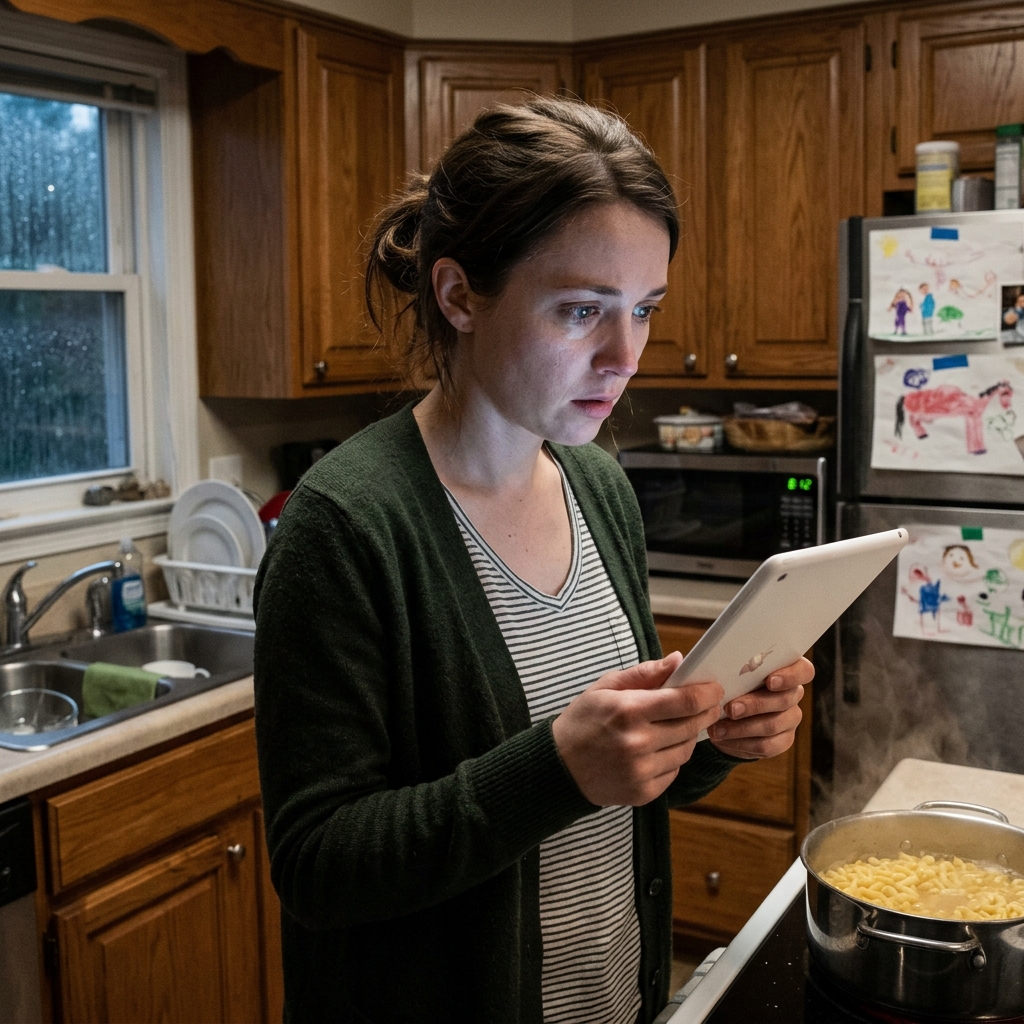
I was standing in my sister Claire’s kitchen, holding her tablet while macaroni boiled on the stove. It was 8:12 on a rainy Tuesday night. The tablet had been vibrating constantly, so I picked it up, thinking the boys’ school might be trying to reach her.
Instead, I saw a group chat called Real Family.
I was not included.
The newest message was from my mother, Barbara.
Don’t worry. Sarah always gives in. Just make her feel needed.
Below it was a voice message from my brother, Derek.
“She’s an ATM with abandonment issues.”
Claire had replied:
Don’t push her too hard this week. She already paid Mom’s electric bill and my car payment. If we ask for more, she might get suspicious.
My hand went cold.
I scrolled upward.
There were months of messages about me. They shared screenshots of my transfers and mocked my worried phone calls. My mother advised them to cry whenever I asked too many questions. Claire admitted that her sons’ dental emergency had cost less than half the amount she requested. Derek bragged that he had spent his insurance money on a weekend trip.
Another message from my mother read:
Pretending to be affectionate with her is exhausting, but she’s the only one with a steady income.
Farther up, I saw a sentence I did not understand.
If Sarah ever stops paying, at least we still have the Beacon Hill money.
I assumed it referred to one of my mother’s accounts.
Using my own phone, I recorded the tablet screen and photographed the most important messages.
Then the pot boiled over. Foam spilled onto the burner with a hiss.
Claire entered, drying her hands on a towel.
“Who keeps messaging?”
I placed the tablet facedown.
“Something from the school, I think.”
She studied me. “You look pale.”
“I’m tired.”
That evening, I ate with my nephews as though nothing had happened. I washed the dishes, kissed the boys goodnight, and drove home through the rain.
I did not cry.
I opened my laptop and reviewed every payment connected to my family.
I paid my mother’s electricity and phone bills. My bank account was attached to Claire’s car payment. My card covered Derek’s insurance. My mother also carried an additional credit card issued under my account, supposedly for emergencies.
For years, I had believed helping them was how I earned my place in the family.
That night, I realized I had been purchasing a seat at a table where everyone laughed after I left.
By morning, I had moved my savings to another bank, changed every password, and canceled the additional card. I removed my bank account from Claire’s car payment and my card from Derek’s insurance.
I did not warn them.
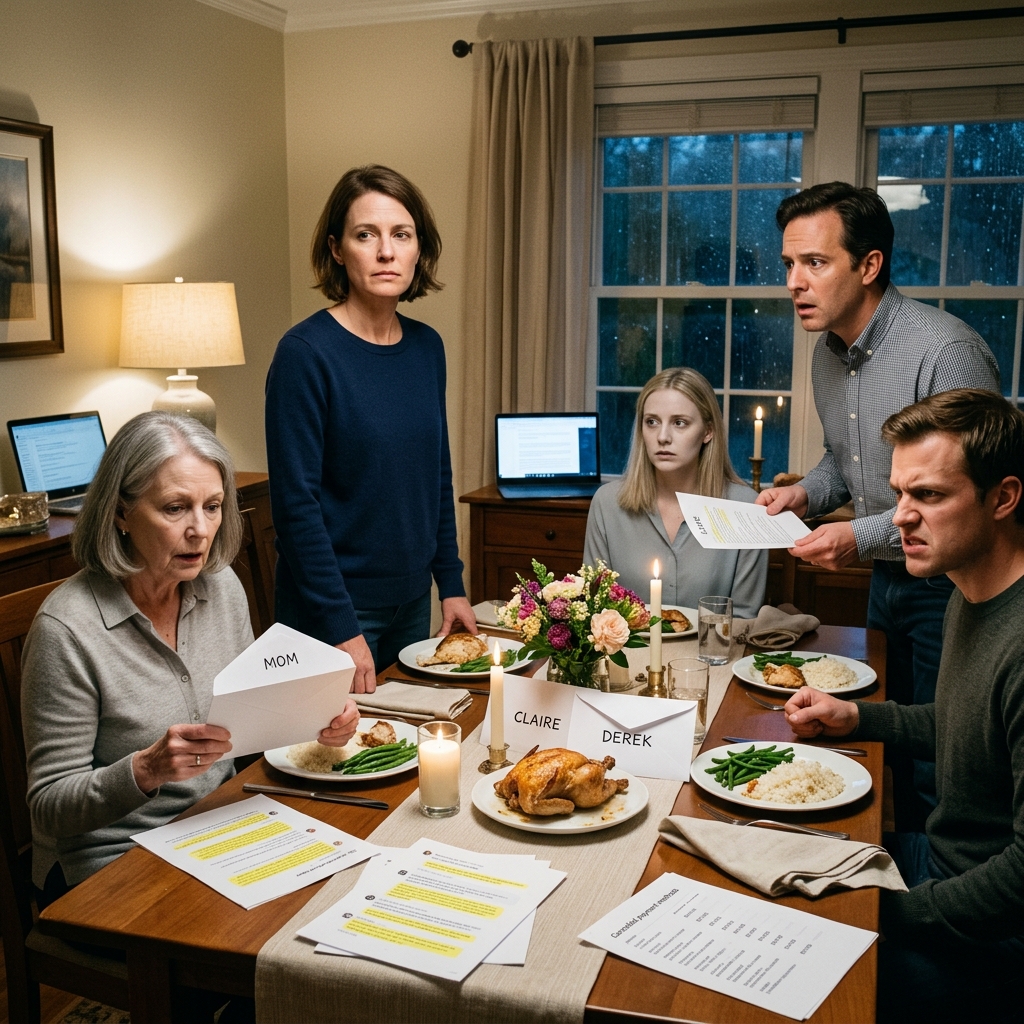
Instead, I printed the messages, highlighted every cruel sentence, and placed the pages inside three envelopes.
MOM. CLAIRE. DEREK.
The following Sunday was our monthly family dinner, which my mother always expected me to host.
I did not cancel it.
I roasted chicken, cooked rice and green beans, bought flowers, and set the table with candles and cloth napkins.
I wanted them comfortable.
At 6:30, Claire arrived with her husband, Mark, and their two sons. Derek came next, already complaining about traffic. My mother arrived last, carrying a cheap bouquet and wearing her usual expression of sacrifice.
“Everything looks lovely,” she said. “I hope you didn’t spend too much.”
“Don’t worry,” I replied. “Tonight, everything is paid for.”
They did not understand.
During dinner, they acted warm and affectionate.
Then my mother sighed.
“My electric bill is high again. I’m about $300 short.”
Derek leaned back.
“My insurance payment is due too. I’ll send you the amount.”
Claire smiled apologetically.
“And the boys’ school fees piled up. I was going to mention them after dessert.”
I set down my fork.
Then I placed the envelopes in front of them.
“Open them.”
I sent my nephews into the living room with cake and a movie.
My mother opened her envelope first. Her face drained of color.
Claire froze.
Derek clenched his jaw.
“I found your chat,” I said.
For once, no one had a prepared lie.
My mother recovered first.
“That conversation was private.”
I laughed once.
“You called me an ATM, and your concern is privacy?”
“We were joking,” Derek said. “Everyone complains about family.”
“Families don’t rehearse fake tears to get money.”
Claire pushed the papers away.
“We were stressed. You don’t understand what things have been like.”
“I understand perfectly,” I said. “I paid for it.”
Mark picked up one of the pages. His expression changed.
“What does this mean?” he asked Claire. “Sarah paid the car payment?”
Claire stared at him.
“Mark, not now.”
“You told me your mother was helping.” He read another message. “And Sarah paid the boys’ school fees? You said that came from your savings.”
Claire went pale.
I had not known she was lying to her husband too.
My mother struck the table lightly.
“This is between my children.”
“No,” I said. “You made me a family project. Now you can hear the results.”
I placed a list in the center of the table. It showed every payment method I had removed and every card I had closed.
My mother stared at it.
“You stopped paying my phone?”
“You have until the end of the billing cycle to transfer the number.”
Claire looked panicked.
“What about my car?”
“My account is no longer attached to the loan.”
Derek grabbed the list.
“You removed your card from my insurance?”
“Yes.”
“You’re going to cause me problems.”
“No. You caused your own problems by building your life around someone else’s money.”
My mother’s voice softened instantly.
“Sarah, I carried you for nine months. You cannot punish your mother over a few foolish messages.”
“I’m not punishing you. I’m no longer rewarding you for despising me.”
Claire began to cry.
“You’re destroying everything.”
Mark stood.
“I’m taking the boys to my mother’s house tonight,” he said. “Then I’m reviewing every account we have.”
Claire grabbed his sleeve.
“Please don’t do this here.”
“You should have thought about that before lying to me.”
Derek turned toward me.
“Look what you’ve done. You’re destroying the family.”
“No,” I said. “I’m dismantling the system you built on top of me.”
My mother stood.
“When this tantrum is over, call me.”
I picked up my phone, opened my contacts, and changed Mom to Barbara Bennett.
Her expression cracked.
“What are you doing?”
“Calling things by their real names.”
Derek moved toward the door.
“You’ll regret this when you’re alone.”
I opened it for him.
“I was always alone. It simply used to cost me more.”
My mother was the last to leave.
“You don’t know how to live without us.”
“No,” I said. “You don’t know how to live without my money.”
For the first time, the silence after they left did not feel empty.
At 11:47 that night, my phone vibrated.
The message came from Susan Miller, my mother’s next-door neighbor.
Sarah, I’m sorry to contact you so late. Your father gave me your number years ago and asked me to call if I ever believed you needed to know something.
A second message appeared.
Tonight I heard your mother arguing with Derek through the wall. She said that if you stopped paying, she would move him into your father’s Beacon Hill apartment and make sure you never took control of it.
My heart seemed to stop.
My father had died six years earlier. I believed his small apartment had been sold to cover debts.
I called Susan immediately.
She explained that my father had told her the apartment was meant for me. She had always assumed I knew. Only that night had she realized my mother had hidden it.
“She has been collecting rent from a retired teacher for years,” Susan said. “I’ve seen him bring her envelopes.”
I barely slept.
The next morning, I went to the county recorder’s office with every document I had from my father’s death.
Several hours later, an employee handed me a recorded transfer-on-death instrument.
My name appeared beneath the property description.
Beneficiary: Sarah Anne Bennett.
My father had legally arranged for the apartment to become mine when he died.
The correspondence address on the property file was my mother’s home. Tax notices, building letters, and insurance documents had all gone to her. She had intercepted them and told the building management that she handled the apartment for me.
She had been collecting rent from my property for six years.
I contacted an attorney named Jessica Hayes.
“Do not confront her yet,” Jessica said. “First, we document everything.”
Over the next two weeks, we gathered evidence.
The building management had records of my mother presenting herself as my representative, although she had no written authorization. Susan gave a statement. The tenant, a retired teacher named Arthur Pendelton, produced years of handwritten receipts signed by Barbara.
When I visited him, he looked confused.
“Your mother told me you lived in Texas and wanted nothing to do with this place.”
“I’ve never lived in Texas.”
He shook his head.
“Your father came here often before he became ill. He always said this apartment was for you.”
My throat tightened.
“He said he wanted you to have a home so you would never have to beg anyone for a roof.”
The group chat and other messages also revealed where some of the rent had gone. My mother had used it to cover Derek’s debts, pay her credit card balances, and fund family trips. She had not needed me to pay her basic bills.
She simply preferred spending my money.
Jessica located the attorney who had prepared my father’s property documents. His office still had a scanned copy of the original file.
Inside was a letter my father had written to me.
The records showed that the complete packet had been mailed to my father’s home shortly after his death.
My mother had received it. She had never given it to me.
I told Barbara to meet us at Jessica’s office on Thursday.
She arrived with Derek. Claire came alone, looking exhausted.
“I didn’t know about the apartment,” she said quietly.
“But you knew about the chat.”
She lowered her eyes. “Yes.”
At least she did not lie again.
Inside the conference room, Jessica placed everything on the table: the ownership document, rent receipts, management records, Susan’s statement, and the attorney’s file.
My mother folded her arms.
“I managed the property because Sarah was not ready. She has always been weak.”
The word no longer had power over me.
“I wasn’t weak,” I said. “I was loyal.”
My mother looked at me with contempt.
“Your father spoiled you. That is why you think everyone owes you something.”
Jessica handed me my father’s letter.
I unfolded it.
My dear Sarah, I am leaving the apartment to you because I know you carry more than you admit. Do not let anyone convince you that love requires you to end up with nothing. Helping someone should not destroy you. This home should always be yours. Your peace should belong to you too. Love, Dad.
My voice broke on the last line.
Claire cried silently. Derek stared at the floor.
My mother showed no remorse. She only looked angry that the truth had survived her.
“Dad knew me,” I said. “The rest of you only knew my bank balance.”
Jessica explained that the evidence supported a strong civil claim. My mother had collected years of rent, falsely presented herself as my representative, and intercepted property correspondence.
If she refused to cooperate, we were prepared to file immediately and submit the records for further investigation.
The agreement required her to acknowledge my ownership, surrender all keys and documents, stop representing herself as my agent, disclose the rent she had collected, and negotiate repayment.
My mother stared at me.
“You would take your own mother to court?”
“Because you are my mother, I’m giving you the chance to sign first.”
Derek slammed his palm against the table.
“You’re taking everything from her!”
“I’m taking back what was mine.”
Jessica moved the unsigned filing papers beside the agreement.
My mother understood that I was no longer bluffing. Her hand shook with anger as she signed.
Outside, Claire followed me.
“Mark took the boys to his mother’s house,” she said. “He doesn’t know whether he can trust me again.”
“I’m sorry for the boys.”
“I am too.” She wiped her face. “I lied because I wanted him to believe I could afford our life. Then asking you became easier than admitting the truth.”
I said nothing.
“I’m sorry,” she continued. “You deserved a sister, and I treated you like an account.”
“Then don’t ask me to forgive you quickly.”
“I won’t.”
Derek walked past us.
“Enjoy your apartment. Don’t ever ask me for anything.”
I almost smiled.
“I never relied on you, Derek. You relied on me.”
My mother came out last.
“You’re going to end up alone.”
For the first time, it did not frighten me.
“No, Barbara. I’m going to end up at peace.”
Over the following week, I formally took control of the apartment. Arthur signed a new lease, and I opened a separate account for the rent.
I closed the last financial connection my family had to me. I changed my beneficiaries and emergency contacts. I removed my mother from every important record.
The first evening no one asked me for money, I cooked only for myself.
Soup, bread, and coffee.
The silence in my apartment no longer felt like punishment. It felt like freedom.
Several days later, Claire sent me a message.
I started therapy. I’m not asking you for anything. I only wanted you to know.
I eventually replied:
Do it for yourself and your children.
Derek blocked me.
My mother sent voice messages that shifted between crying and insults. I deleted them unopened.
One Saturday, Arthur gave me an old box he had found on the top shelf of a closet. Inside were photographs, repair receipts, and one of my father’s notebooks.
On the final page, beneath a list of expenses, he had written:
Sarah helps everyone. I hope one day she learns to help herself.
I pressed the notebook against my chest and cried.
Not because I was broken. Because I was finally becoming mine again.
My family told people that money had changed me. They said I destroyed us over private jokes.
But money did not change me.
The truth did.
I learned that false love leaves receipts.
I learned that generosity without boundaries becomes permission.
And I learned that being excluded from a dishonest family is not the same as being alone.
Sometimes, saving yourself begins when you stop financing the lie everyone else calls love.