
My daughter-in-law announced that 30 extended family members would be staying in my four-bedroom house for Christmas. She expected me to foot the bill for an extravagant menu, cook every meal, clean up the mess afterward, and surrender the primary bedroom—the exact room where I had held my late wife’s hand during her final moments. When my son quietly told me it was “no big deal,” something inside me snapped. I didn’t argue or raise my voice. I just smiled and said, “Wonderful. I’ll be away on vacation, so you’ll be responsible for everything this year.” Her smug confidence evaporated, but she still had no idea what that quiet smile truly meant.
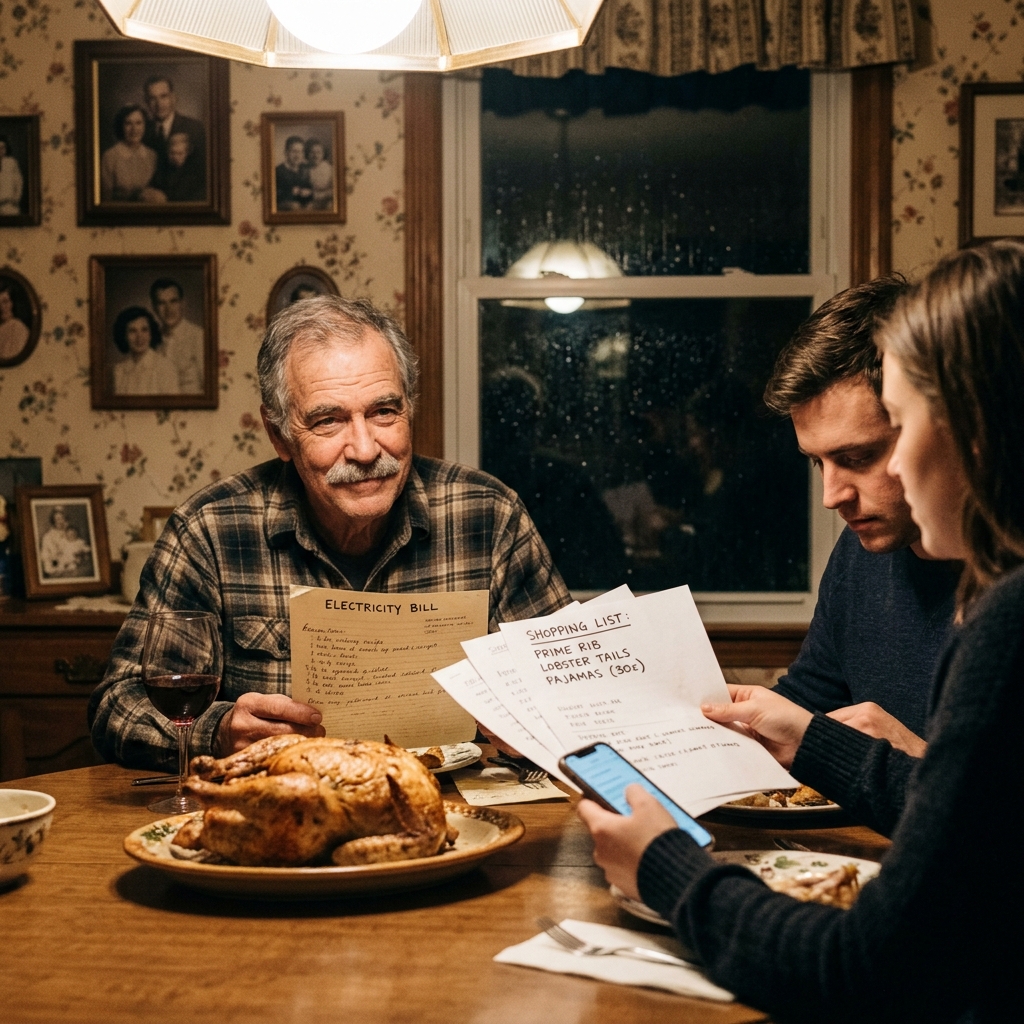
The announcement came over roasted chicken on a dreary Tuesday evening outside Philadelphia. I had prepared the meal using a recipe my wife, Sarah, had scribbled on the back of an electric bill nearly three decades ago.
Sarah had been gone for five years, but fragments of her spirit remained everywhere.
Chloe breezed into the dining room, phone in hand, and sat beside my son, Mark.
“I’m finalizing our Christmas plans,” she said casually.
“Finalizing what?”
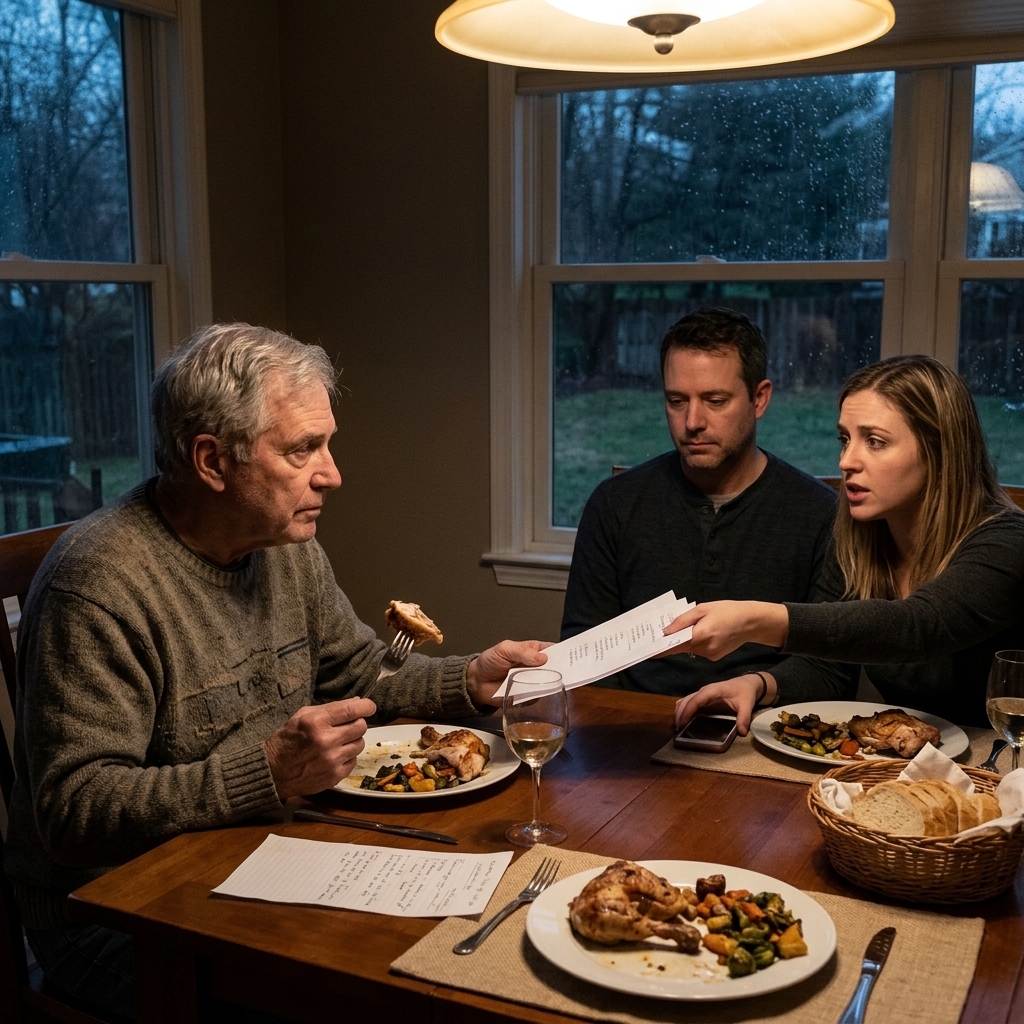
“My family is spending the holidays here. My parents, my sisters, their husbands, the kids, my uncle, and a few cousins. They’ll arrive on December 20th and head out on the 26th.”
“Thirty people for six nights?”
“It’ll be cozy. Everyone just loves this house.”
My house.
She only called it that when a plumbing bill or a propertytax notice arrived. The rest of the time, it was magically “our home.”
Mark and Chloe had moved in three years prior, claiming they needed six months of rent-free living to save up a solid down payment. They contributed next to nothing toward utilities or groceries. Every conversation I tried to have about them moving out ended with another fabricated excuse.
Then, Mark drained his savings to buy a luxurypickup truck instead of putting that money toward a mortgage. That was the moment I finally understood: they were never planning to leave.
Chloe pushed a few sheets of paper across the dining table. “I made the shopping list.”
It was absurd. She expected me to pay for:
-
Prime rib and lobster tails
-
Imported artisanal cheeses and premium wines
-
Matching holiday pajamas for all 30 guests
-
A professional photographer for family portraits
The total was easily going to exceed $6,500.
“You expect me to pay for this?”
“Well, I’m already organizing the decorations, the daily activities, and the sleeping arrangements. I can’t do everything, Arthur.”
“With four bedrooms, where exactly is everyone going to sleep?”
“My parents will take the primary bedroom. My sisters can take the other guest rooms. The kids and cousins will just use air mattresses down in the basement and in the living room.”
“You mean my bedroom?”
“It has the en-suite bathroom. My parents are older, so it just makes sense. You can sleep on the pullout couch in the basement until you leave for your vacation.”
The basement was unfinished and freezing. The old sofa bed had a broken spring that jabbed right through the thin mattress.
More importantly, the primary bedroom was where Sarah and I had slept for 38 years. Her reading chair still sat perfectly angled by the bay window. It was also the room where I sat by her side as she took her last breath.
I turned my gaze to Mark. He knew exactly what that room meant to me.
“It’s only for a few nights, Dad,” he mumbled, refusing to meet my eyes. “Don’t make it into a big issue.”
Something deep inside me went completely still.
For years, I had mistaken my own surrender for peace. But a peace built entirely on one person’s silent suffering is just permission for others to keep taking.
I smiled.
“That sounds highly practical. I’ll clear out the room.”
Chloe immediately picked up her phone and began texting her mother.
That same evening, I called Marcus Vance, the estate attorney who had handled Sarah’s affairs.
“I’m ready to make some major changes,” I told him.
Within three days, Mark’s access to my primary household bank account was legally revoked. I stopped covering his overdraft fees and immediately canceled the supplemental credit card Chloe carried.
I sent them a formal written notice stating that the credit card and all voluntary financial support would be terminated on December 15th.
I also added one final line:
“After Christmas, you need to begin looking for another place to live. This living arrangement is permanently ending.”
Mark replied to the email with a single word: “Fine.”
Chloe didn’t respond at all.
Next, I asked Marcus to contact the commercial developer who had been trying to buy my double-lot property for the past five years. I had always refused, feeling that selling the house meant erasing Sarah. But I realized Sarah wasn’t trapped inside drywall and floorboards. Her memory could survive anywhere it was respected.
The developer eagerly renewed their cash offer. I signed a purchase agreement, and a hefty earnest-money deposit was placed into escrow. The closing would occur only after the property was completely vacant.
Marcus prepared a formal 60-day eviction notice requiring Mark and Chloe to vacate the premises by the end of February.
While the paperwork was processing, I began to pack. I carefully boxed up Sarah’s jewelry, framed photographs, handwritten recipe cards, her favorite books, and her porcelain collection, moving them into a secure climate-controlled storage unit. I also removed all my important financial documents and personal valuables.
When Chloe noticed the tower of moving boxes, she asked what I was doing.
“Just clearing out some old clutter before your relatives arrive.”
Her suspicion instantly shifted into sheer approval. “Good. My mother is going to need the closet space.”
Without even realizing it, she was watching me systematically erase my entire life from the house.
On December 15th, Chloe’s credit card declined at the supermarket, exactly as my written notice had promised.
She called me from the checkout lane, furious. “The card was declined.”
“I know.”
“Then fix it right now! I have three carts full of groceries.”
“That account is no longer available to you.”
“You can’t just do this to us five days before Christmas!”
“I warned you in writing.”
“I thought you were just venting and would change your mind!”
“That was your mistake.”
Mark called me less than ten minutes later.
“Dad, this has gone way too far.”
“No, Mark. It went too far when you bought an $80,000 truck while living under my roof for free. It went too far when your wife assigned my sanctuary of a bedroom to her parents, and you looked me in the eye and told me it was no big deal.”
“Is this all because of the Christmas party?”
“No. Christmas was just the catalyst that made me stop pretending. After the holidays, you and Chloe need to find a new place to live.”
“You don’t mean that.”
“I absolutely do.”
“Mom would never have done this.”
Those words cut deeper than he could possibly realize. During Sarah’s final months, she had watched me run myself ragged trying to solve everyone else’s problems. One quiet evening, she squeezed my hand weakly and whispered, “Promise me you won’t let your kindness become the reason people stop respecting you.”
At the time, I brushed it off, telling her she was worrying over nothing. Now, I finally understood that she had seen a painful truth I had stubbornly refused to acknowledge.
“Do not use your mother against me,” I warned him. “She loved you unconditionally, but she knew the sharp difference between helping someone and allowing them to use you.”
The first wave of relatives descended on December 20th. Soon, my driveway was gridlocked with SUVs, while the house filled with rolling luggage, folding cots, loud decorations, and a mountain of gifts.
Chloe stood in the foyer, directing traffic like a stressed hotel concierge.
“My parents are taking the master upstairs. My sisters have the guest rooms. Kids on the air mattresses, cousins in the basement!”
Then, she stopped and stared at my rolling suitcase.
“You’re really leaving?”
“Yes.”
“But nearly 30 people are walking through that door.”
“I’m well aware.”
“Who is going to cook?”
“You are.”
The chaotic living room suddenly fell dead silent.
“I can’t cook for 30 people!”
“Then you probably should have considered that before you invited them.”
“You’re being incredibly selfish.”
After forty years of grinding at my career, raising a son, nursing my dying wife, and financially supporting Mark and Chloe for three years… the very first time I actually chose my own well-being, I was branded selfish.
I quietly slipped on my winter coat.
Behind me, Mark panicked. “What are we supposed to do?”
For the first time in my life, I didn’t hand him an answer.
I got in my car and drove straight to the airport, flying out to a small, oceanfront cottage I had rented in Cannon Beach, Oregon.
On my first morning there, I woke up to the sound of crashing Pacific waves instead of someone demanding my money or my labor. Sarah would have adored it. We had spent decades promising each other that “someday” we would buy a place by the ocean and drink our morning coffee without worrying about anyone else’s schedule. Life just kept postponing that “someday” until Sarah was gone.
I carried my mug out onto the chilly wooden deck.
“I made it,” I whispered to the wind. “I just wish you were here to see it.”
By noon, I had 11 missed calls. I finally answered the 12th.
“Dad, it’s an absolute disaster,” Mark said, sounding breathless.
“What happened?”
“There isn’t anywhere near enough food. The kids are physically fighting over the air mattresses. Chloe’s parents won’t stop complaining about the cheap towels, and two of her uncles already packed up and left for a Marriott.”
“Chloe planned the gathering.”
“She planned the Instagram photos and the matching outfits! She had no idea how much actual work keeping 30 people alive for a week would be.”
“Well, now she does.”
“Can you please just come home?”
“No.”
“Please, Dad.”
For 68 years, that word would have made me drop everything to rescue him. But bailing him out now would only prove that my boundaries were made of glass.
“You invited them,” I said firmly. “You will handle it.”
Mark was silent for a long moment before asking, “Were you actually serious about making us move out?”
“Yes.”
“What exactly are you doing, Dad?”
That was when I dropped the final piece of the puzzle.
“I signed a purchase agreement with a commercial developer. I sold the house.”
I could hear his breathing hitch over the receiver.
“You sold it?”
“The sale will officially close once the property is vacant. You’ll receive formal legal notice and have a standard 60 days to secure a new apartment.”
“You never even told us you were selling!”
“I told you this arrangement was permanently ending. You just decided I was bluffing.”
I returned to Pennsylvania on December 27th.
Most of Chloe’s family had fled, but the carnage of their stay was everywhere—overflowing contractor trash bags, stained carpets, flattened cardboard boxes, and deflated air mattresses littering the hardwood. Her parents had stayed one extra day just to help them scrub the kitchen.
Chloe met me in the hallway. Her hair was a tangled mess, and her overpriced Christmas sweater was stained with grease.
“You actually stayed away.”
“I did.”
“Mark worked himself to the bone.”
“Good. He desperately needed to understand what real responsibility feels like.”
“You just wanted us to struggle?”
“No, Chloe. I wanted you to stop expecting someone else to shield you from the consequences of your own decisions.”
The very next morning, a courier formally delivered the 60-day eviction notice.
Chloe screamed. Mark accused me of abandoning my own flesh and blood. For several weeks, the house was a war zone of icy silence; they only spoke to me when absolutely necessary.
But eventually, the anger burned out, giving way to cold, hard reality.
They were forced to sit down and actually examine their incomes and their debts. Mark traded his luxury truck in for a used Honda Civic with a fraction of the monthly payment. Chloe sold several designer handbags online just to cover the security deposit for a standard apartment complex.
I did not offer them a single dime.
Near the end of January, Mark appeared in the doorway of my study.
“I don’t really know how to say this right,” he began softly. “But I was wrong.”
I set my book down and waited.
“I treated your help like it cost you nothing, just because you had a better savings account than we did. I completely forgot that every dollar you have came from your time and your sweat.” He stared hard at the floorboards. “And Mom wasn’t just a bedroom. She was your wife. That room was where you took care of her, and I just sat there like a coward while Chloe treated it like a free hotel suite.”
“What hurt me the most wasn’t the money, Mark,” I said quietly. “It was watching my son say nothing at all.”
“I know. I am so sorry, Dad. I don’t expect you to trust me again right away.”
That was the very first sign his apology might actually hold weight.
By mid-February, Mark and Chloe had signed a lease on a modest two-bedroom apartment. It was cramped and a much longer commute to Mark’s office than they wanted, but it was theirs, and they could actually afford it.
Our relationship didn’t miraculously heal overnight. Mark still got defensive occasionally, and I kept my guard up. But slowly, the nature of his phone calls shifted. He started calling me just to catch up—without a hidden financial agenda. He asked about my day, complained about his boss, and once, he called just to share a terrible joke Sarah used to tell.
Trust was returning, one small piece at a time.
The house sale officially closed in March.
Before handing the keys over to the developer, I walked through the echoing, empty rooms one last time. The company planned to tear the structure down and replace it with accessible senior cottages centered around a community garden.
I saved the primary bedroom for last.
Sarah’s chair was already wrapped up in storage. The afternoon sunlight hit the bare hardwood right where our bed used to sit. I fully expected to feel the crushing weight of losing her all over again.
Instead, I felt a profound sense of peace.
Sarah had never lived inside the drywall or the paint. She lived in the recipes I still cooked, the beautiful memories I carried, and the quiet promise I had finally kept to her.
I pressed my palm against the bedroom doorframe.
“Goodbye,” I whispered.
Not to Sarah. Never to her.
I was saying goodbye to the long, heavy years where I genuinely believed that loving my family required me to disappear.
After the funds cleared, I bought a permanent little cedar cottage near the Oregon coast. It only has two bedrooms, no formal dining room, and absolutely zero space for 30 unexpected houseguests.
It is perfect.
Several weeks later, Mark flew out to visit me. We sat together on the back deck, watching the gray Pacific waves roll in.
“I’m sorry I didn’t step up and protect you,” he said over the wind.
“You still have plenty of time to become the man your mother believed you could be.”
He nodded slowly. “So do you, Dad.”
For the first time in years, my son had traveled all the way to see me without asking for a single thing in return. It wasn’t a magical, cinematic forgiveness, and it didn’t erase the ugly parts of the past. But it was a real beginning.
The old house was gone, but everything worth keeping had come with me. Mark was finally learning how to be a responsible adult, and I had finally learned that setting firm boundaries is not the opposite of love.
Sometimes, boundaries are the exact thing required to save it.
At 68 years old, I had convinced myself that the most important chapters of my life were already written. I was wrong. The life I had constantly postponed for everyone else’s convenience was just beginning.
And this time, I wasn’t waiting around for anyone’s permission.
The End